
Selecting the correct bulk container geometry and material specification directly dictates operational safety and supply chain profitability. Using an improper big bag design leads to static ignitions, seam bursts, line stoppages, or moisture contamination.
As a global manufacturer producing over 6 million bulk containers annually, EPP Vietnam engineers custom solutions for severe industrial environments. This technical guide outlines the primary structural types of FIBC bags, safety standards, and selection criteria of EPP Vietnam for industrial buyers.
Types of FIBC bags Classified by Electrostatic Protection
Bulk handling of fine powders and dry chemicals generates significant static electricity during high-speed filling and discharge operations. Electrostatic discharges in flammable or dust-laden atmospheres pose severe explosion hazards.

EPP Vietnam engineers custom Big bags for severe industrial environments
The International Electrotechnical Commission (IEC 61340-4-4) categorizes bulk packaging into four primary electrostatic safety types. Matching the appropriate electrostatic bag class to plant zones protects workers and facility infrastructure.
Type A FIBC Bags
Type A bulk bags consist of standard woven polypropylene fabric without any electrostatic protection. They possess no mechanism to drain or dissipate static electricity accumulation during material movement.
These bags are strictly limited to non-combustible products such as sand, gravel, agricultural grain, and limestone. Plant operators must never use Type A containers near flammable gases, solvent vapors, or combustible dust clouds.
For a foundational understanding of standard woven polypropylene specifications, readers can review our essential guide to PP jumbo bags HS code to navigate global customs and tariff declarations seamlessly.
Type B FIBC Bags
Type B containers use woven insulating fabrics engineered to maintain a low surface breakdown voltage of less than 6 kV. This specific threshold prevents high-energy propagating brush discharges from jumping across the fabric surface.
Type B bags safely transport dry, combustible powders (MIE > 3 mJ) in non-flammable plant environments. However, because they lack grounding paths, they cannot safely dissipate static in zones containing flammable solvent vapors or explosive gas mixtures.
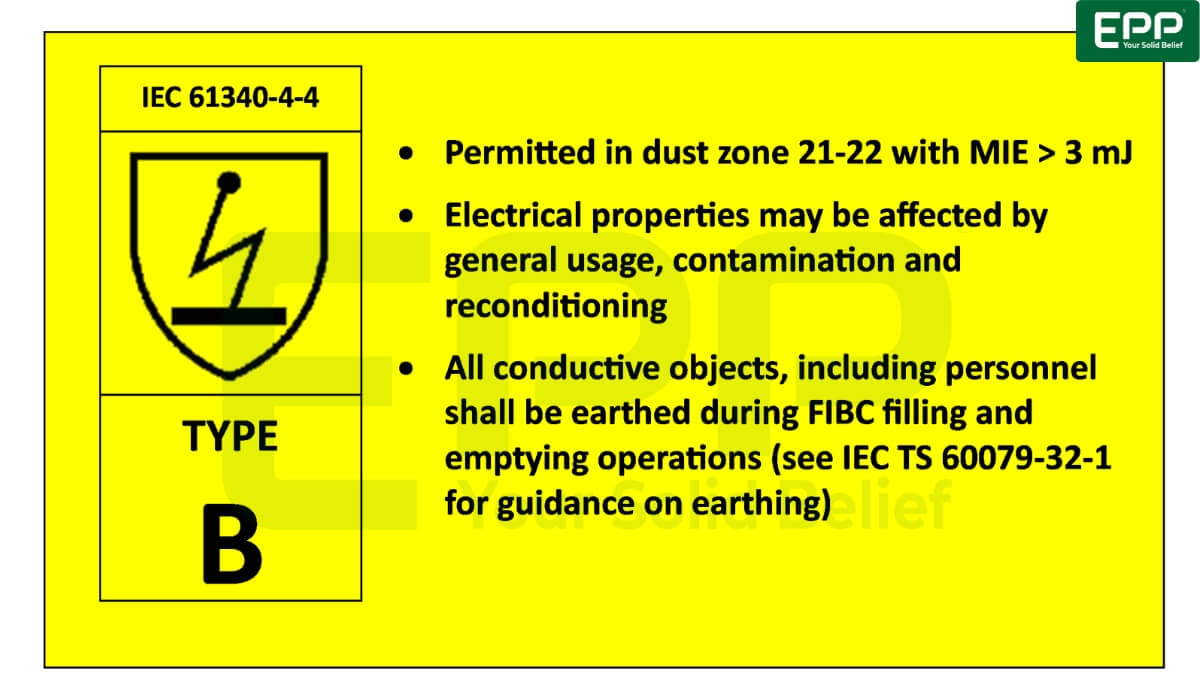
Close-up of a certified Type B antistatic safety label attached to an EPP Vietnam bulk bag
Type C FIBC Bags
Type C containers, commonly referred to as groundable conductive bulk bags, are woven from non-conductive polypropylene yarns interwoven with a continuous grid of conductive carbon or silver filaments.
All conductive threads interconnect at dedicated grounding carbon conductive tabs sewn on the bag body. During filling and emptying, operators must connect grounding clamps to drain static accumulation to earth. Electrical resistance to the grounding point must measure less than 10^7 Ω.
Type D FIBC Bags
Type D bulk containers feature patented static-dissipative threads woven throughout the polypropylene structure. These specialized threads safely dissipate electrostatic charges into the atmosphere through low-energy Corona discharge.
The primary operational advantage of Type D bags is that they require no manual grounding cables. This eliminates catastrophe risks caused by human error or missing ground connections in fast-paced chemical processing plants.
Operators seeking deeper technical definitions on antistatic fabric weaving can consult our detailed glossary of jumbo bag specialized terminology for comprehensive manufacturing terms.
Types of FIBC Bags by Structural Construction & Body Designs
The body construction of a super sack defines its load-bearing behavior, volume capacity, and physical stability on pallets. Selecting the right body style prevents leaning, bulging, and transit damage.

Top 5 types of jumbo bags classified by body construction for storage
U-Panel FIBC Bags
U-Panel bags utilize three primary fabric components: one long central fabric piece forming a continuous U-shape (bottom and two sides) sewn to two opposite side panels.
This design delivers exceptional lifting strength and structural reliability. U-Panel bags remain the industry standard across North America and Europe for heavy industrial products up to 2,000 kg (4,400 lbs).
Circular / Tubular FIBC Bags
Circular bulk bags are woven on specialized circular looms to create a seamless fabric tube. Stitching occurs only at the top inlet, bottom discharge spout, and corner lifting loops.
Because circular bags eliminate vertical side seams, they provide excellent protection against fine powder leakage. They are highly suited for fine chemicals, minerals, and hygroscopic agricultural grains.
4-Panel FIBC Bags
4-Panel bags are constructed by sewing together four distinct rectangular fabric pieces to form a square box shape.
While requiring more sewing labor, 4-Panel bags hold their cubic shape better under load than standard circular bags. They are widely used for dense materials where maintaining a neat stack profile is critical.
Baffle Bags (Q-Bags)
Standard bulk bags naturally bulge outward into rounded shapes when loaded, causing overhang on standard shipping pallets. Baffle bags (Q-Bags) solve this issue using internal fabric baffles welded or sewn across all four corners.
These internal baffles feature flow-through perforations that allow material to distribute evenly while preventing the outer walls from expanding outward. Baffle bags optimize ocean shipping container space by 20% to 30%, drastically reducing ocean freight costs per metric ton.
One Loop and Two Loop Big Bags
One loop and two loop big bags differ in the number of lifting loops, impacting how they are handled during transport. One-loop bags are simpler and generally less expensive, making them suitable for lighter loads. In contrast, two-loop bags offer more stability and ease of handling, making them ideal for heavier or bulkier materials.
Specialty & Industry-Certified Bulk Bags
Beyond standard type of big bags, sensitive applications demand specialized cleanroom manufacturing, safety testing, or custom barrier properties check out our Specific fibc bulk bags for sale below:
Food-Grade & Pharmaceutical FIBCs
Food and pharmaceutical products require zero contamination. EPP Vietnam manufactures food-grade bags inside enclosed, positive-pressure cleanrooms certified under BRCGS and ISO 22000 standards.
Our food-grade production protocol mandates ultrasonic fabric cutting to eliminate loose thread ends, 100% light-table seam inspections, online metal detection, and vacuum cleaning before final bundling.
UN Certified Bulk Bags for Dangerous Goods
Transporting hazardous materials—such as toxic chemicals, corrosive solids, or flammable materials (UN Classes 4, 5, 6, 8, and 9)—requires official UN packaging certification.
EPP Vietnam’s UN certified bags undergo rigorous prototype testing, including top-lift testing, tear propagation checks, drop testing from heights up to 1.2 meters, and multi-week stacking pressure tests under UN 13H1/13H2/13H3/13H4 specifications.
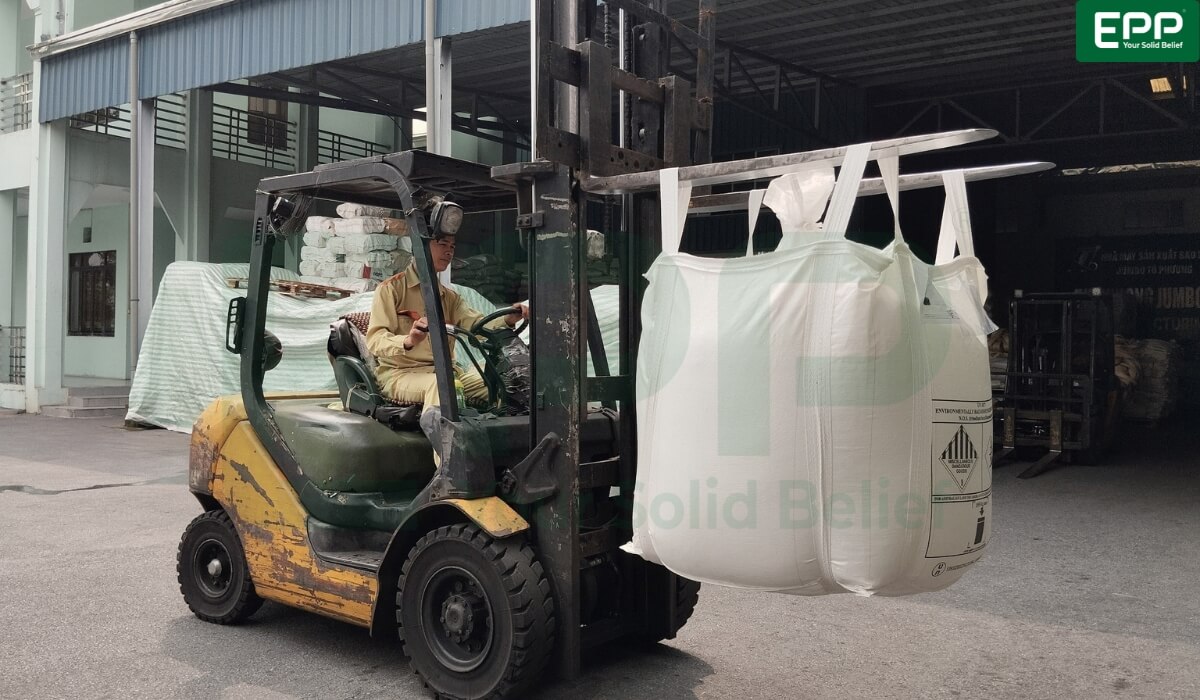
Filled UN rated bulk bag from EPP Vietnam’s factory
Ventilated & Breathable Super Sacks
Agricultural produce such as potatoes, onions, garlic, and firewood logs require air circulation to prevent mold, decay, and moisture buildup during storage.
Ventilated super sacks feature vertical air-strip vents woven directly into the polypropylene fabric. These slots encourage continuous airflow through the bag body, keeping agricultural produce fresh during long-distance transit.
Choosing the Right FIBC bags types by Industry
Selecting the optimal bag specification involves matching physical material traits with handling infrastructure and safety codes.
The table below outlines recommended FIBC specifications across key industrial sectors:
| Industry Sector | Primary Operational Risk | Recommended Super sack types | Key Technical Feature |
| Fine Chemicals & Resins | Static spark ignition | Type C or Type D FIBC | Conductive threads / Corona dissipation |
| Food & Dairy Powders | Microbial contamination | BRCGS Food-Grade Baffle FIBC | Cleanroom made, ultrasonic cut |
| Hazardous Chemicals | Toxic spillage & tearing | UN Certified big bag | Drop-tested, high safety factor |
| Agricultural Crops | Mold & decay | Ventilated Bulk Bag | Woven air-strip slots |
| Heavy Minerals & Sand | Bottom bursts & seam tears | U-Panel bag with 180–220 GSM | Heavy fabric weight, heavy loops |
Engineers interested in reviewing physical yarn specifications can consult our guide on polypropylene raw materials and fabric GSM to select the right tensile strength for heavy loads.
Selecting the right types of FIBC bags is far more than an administrative buying decision—it is a core engineering requirement that impacts workplace safety, product integrity, and shipping efficiency.
Whether your facility requires the static-dissipative security of Type C or Type D containers, the space-saving performance of Baffle Q-Bags, or the stringent purity of BRCGS cleanroom manufacturing, matching types of bulk bags to your bulk material’s physical and chemical traits is essential.
Partnering with a fully certified manufacturer like EPP Vietnam guarantees 100% virgin polypropylene resin, rigorous safety factor testing, and transparent pricing indexed directly to global market benchmarks.
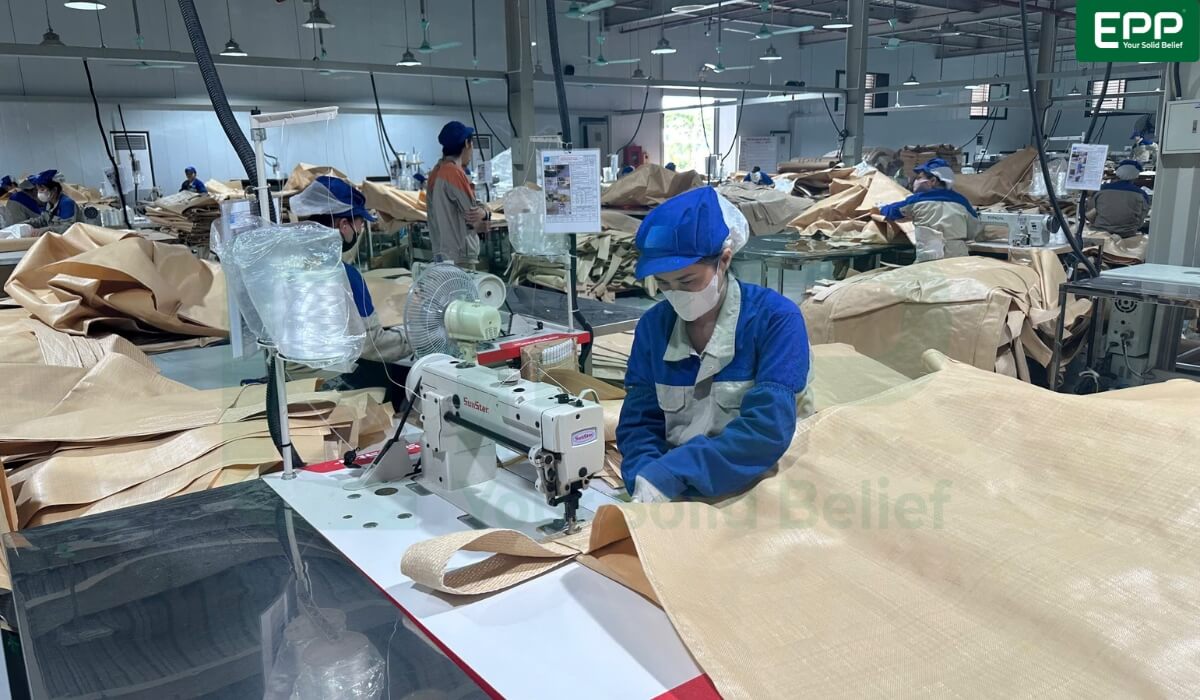
FIBC production line in EPP Vietnam
Contact our technical sales engineers today for a free fabric audit, complimentary sample bag, or a transparent quote aligned with weekly ICIS polymer benchmarks!
Website: epp.vn
Alibaba website: https://eppvietnam.trustpass.alibaba.com/
Email: [email protected] Hotline/ Whatsapps: +84 986 002 888


90-90-100cm uv heat protection bags
1000-2000kg weight capacity need pricing 1000-2000bags
Thanks Jimmy for your inquiry. Please kindly send your inquiry to our email [email protected] for the consultation and quotation. Looking forward to cooperating with you!