Tracing the history of FIBC bags reveals how continuous advancements in textile engineering, static electricity protection, and international safety standards transformed heavy, expensive containers into today’s agile, cost-effective packaging.
Understanding this technical evolution helps modern supply chain executives select certified, high-performance packaging that protects personnel, prevents cargo loss, and fulfills corporate ESG goals. As a leading FIBC supplier in Vietnam, EPP Vietnam builds upon decades of packaging innovation to deliver export-grade bulk packaging compliant with strict international standards, including ISO 21898, BRCGS, and UN Dangerous Goods regulations.
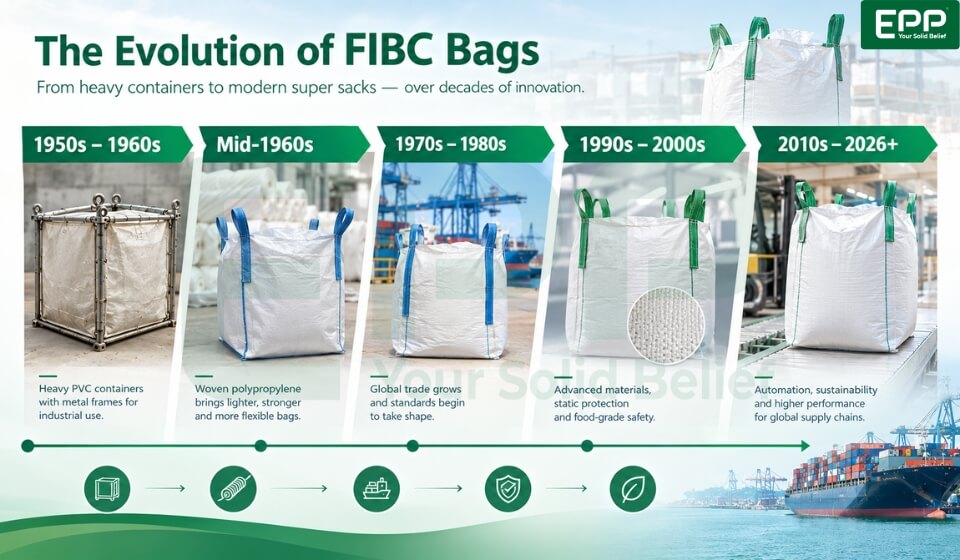
Understanding the history of FIBC bags reveals how material engineering transformed heavy industrial packaging into high-tensile bulk sacks.
The Dawn of Bulk Packaging: 1950s–1960s Early Innovations
The earliest precursors to modern bulk bags emerged in the late 1950s and early 1960s across Europe, Japan, and the United States. Industrial facilities sought an efficient alternative to heavy steel drums, rigid wooden crates, and labor-intensive 25 kg paper sacks.
The Genesis of Heavy-Duty Containers
Early bulk containers were manufactured by welding heavy sheets of PVC-coated nylon or polyester fabric together. These early bags were heavy, stiff, and required integrated metal collar frames or rigid lifting rings to maintain structural balance during filling and hoisting. While durable, their high unit cost restricted their use to closed-loop, high-value chemical applications.
The Breakthrough of Woven Polypropylene
The defining milestone in the history of FIBC bags arrived in the mid-1960s with the development of extruded Polypropylene (PP) tape yarn. Extruding polypropylene resin into thin, high-tensile strands created a lightweight fabric when woven together on industrial looms.
Woven PP offered exceptional tensile strength at a fraction of the raw material cost and weight of PVC. It allowed bulk sacks to be easily folded flat when empty, lowering return logistics costs and establishing the technical foundation for modern bulk bag manufacturing. To better understand how these foundational materials are categorized today, explore standard FIBC terminology and definitions.
Global Expansion and Standardization: 1970s–1980s
The 1970s marked the rapid transition of FIBCs from specialized containers into mainstream international trade.
The 1973 Oil Crisis and Middle East Construction Boom
The global energy crisis of 1973 triggered massive infrastructure development across oil-producing nations in the Middle East. European cement manufacturers needed to transport millions of metric tons of dry cement rapidly across long ocean routes.
Paper multi-wall sacks proved too fragile for rough maritime transit, while rigid containers were cost-prohibitive. Woven polypropylene FIBCs provided the perfect solution: high capacity, water resistance, and rapid crane handling. During this decade, shipment volumes skyrocketed from thousands to millions of units annually.
Regulatory Recognition and the Birth of FIBCA
As usage grew, the need for standardized safety rules became critical. In 1983, industry leaders established the Flexible Intermediate Bulk Container Association (FIBCA) in North America to formulate safety standards, standardized testing protocols, and proper handling guidelines.
During this period, regulatory bodies like the US Department of Transportation (DOT) approved FIBCs for shipping non-hazardous dry chemicals. Test parameters were established for Safe Working Loads (SWL) and Safety Factors (SF)—specifically 5:1 for single-trip bags and 6:1 for multi-trip bags—ensuring structural integrity during overhead lifting and sea transit.
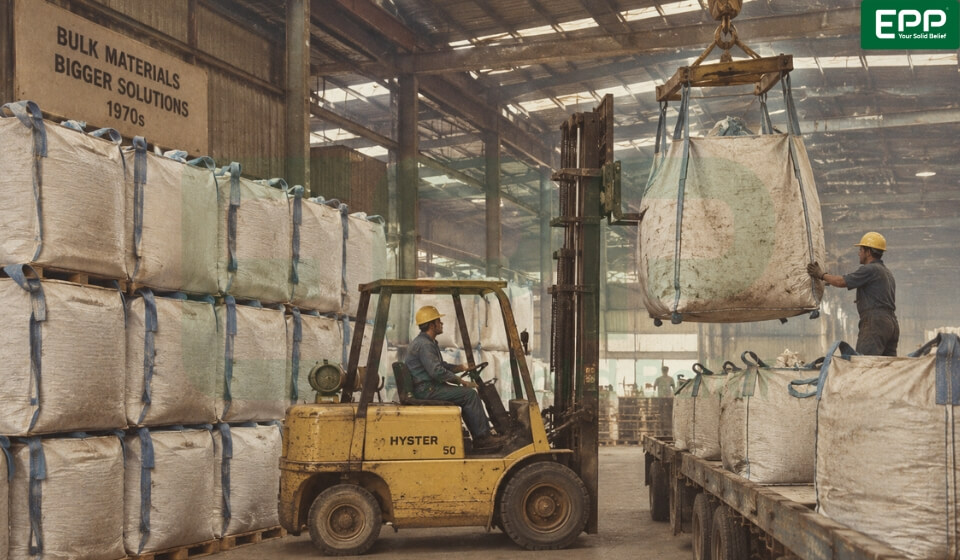
The 1973 energy crisis accelerated the history of FIBC bags, making woven PP super sacks the international standard for bulk transport.
Technical Milestones in Electrostatic and Food-Grade Packaging (1990s–2000s)
During the 1990s and 2000s, material engineering expanded the use of FIBCs into sensitive, highly regulated industries like pharmaceuticals, fine chemicals, and food processing.
The Evolution of Static Protection (Type A to Type D)
Handling dry powders at high fill rates generates static electricity through friction. In explosive dust environments, an electrostatic spark can trigger severe dust explosions. To solve this, the industry introduced four standardized electrostatic classifications under IEC 61340-4-4 guidelines:
- Type A: Standard non-antistatic PP bags for non-combustible products.
- Type B: Fabric with a breakdown voltage under 6 kV to prevent propagating brush discharges.
- Type C (Groundable): Interwoven with conductive carbon or silver grid threads that must be grounded (resistance to earth under 100 megohms) during operation.
- Type D (Antistatic): Manufactured with specialized quasi-conductive dissipative threads that safely discharge static electricity into the atmosphere without earth cables.
For detailed guidelines on compliance markings for these bags, review our guide on safety labeling protocols for static protective FIBCs.

Cleanroom Production and Food-Grade Certifications
As food safety regulations tightened globally, FIBC manufacturing shifted from standard factory floors to certified cleanrooms equipped with positive air pressure, ultrasonic cutting to eliminate loose threads, and automated light-table inspections. Achieving certifications like BRCGS Food Safety, ISO 22000, and HACCP allowed bulk bags to directly store food ingredients, milk powders, and active pharmaceutical ingredients (APIs).
To see how these cleanroom standards apply across different bag designs, explore the various types of FIBC bags manufactured by EPP Vietnam.
The Modern Era (2010s–2026+): Automation, Asia’s Leadership, and Net-Zero
In recent years, the history of FIBC bags entered a new phase driven by global supply chain shifts, advanced automation, and circular economy requirements.
Shift of Manufacturing Hubs to Southeast Asia & Vietnam
To satisfy growing global demand while maintaining strict quality control, FIBC production shifted to Southeast Asia. Vietnam has emerged as a premier manufacturing hub due to its advanced textile infrastructure, skilled workforce, and competitive trade agreements like EVFTA and CPTPP.
EPP Vietnam has played a central role in this transition. By operating modern automated extrusion lines, circular looms, and certified cleanroom facilities, EPP Vietnam delivers export-certified bulk packaging to tier-1 industrial clients across North America, Europe, Australia, and the Middle East. Learn more about raw material selection and fabric construction in our technical breakdown of high-tensile FIBC raw materials and fabric construction.
Sustainability, PCR Plastics, and Circular Economy
Modern packaging strategies focus on sustainability. Manufacturers are developing 100% recyclable mono-material bulk bags (combining PP body fabric, loop webbing, and PE liners) to simplify recycling.
Additionally, integrating Post-Consumer Recycled (PCR) polypropylene resin (up to 30% or more) allows industrial buyers to meet corporate ESG goals and Net-Zero commitments without compromising SWL load capacity. Commercial buyers can review factory-direct options on our dedicated catalog for export-grade FIBC jumbo bag solutions.
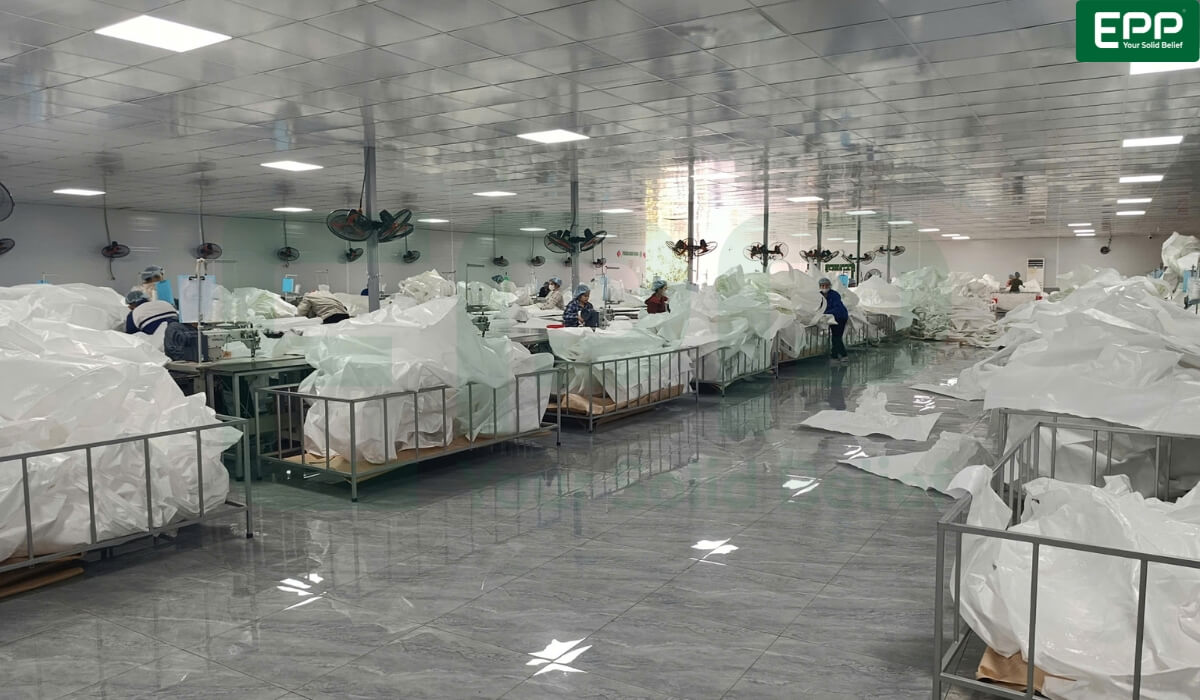
EPP Vietnam factory for producing certified bulk bags for export demand.
Chronological Summary: Key Milestones in history of FIBC bags
| Era / Decade | Material & Engineering Breakthrough | Key Industry Drivers & Milestones |
| 1950s – 1960s | PVC-coated nylon and polyester sheets with metal collar frames. | Introduced in Europe, Japan, and the US as alternatives to steel drums. |
| Mid-1960s | Invention of high-tensile extruded Woven Polypropylene (PP) fabric. | Significantly reduced container weight, lowered manufacturing costs, and enabled flat-folding storage. |
| 1970s | Development of multi-loop lifting designs and coated moisture-barrier fabrics. | 1973 Oil Crisis surge; millions of cement bags shipped from Europe to Middle East infrastructure projects. |
| 1980s | Founding of FIBCA (1983); US DOT approval for hazardous dry chemicals. | Established safety factor standards (SF 5:1 single-trip and SF 6:1 multi-trip) and handling guidelines. |
| 1990s – 2000s | Electrostatic Type C (groundable) and Type D dissipative fabrics; cleanroom production. | Implementation of IEC 61340-4-4 static standards; expansion into pharma and food-grade supply chains. |
| 2010s – 2026+ | 30%+ PCR recycled PP integration, mono-material designs, cleanroom automation. | Transition to Southeast Asian production hubs like Vietnam; adoption of Net-Zero circular packaging models. |
Frequently Asked Questions (FAQs)
When were FIBC bulk bags first invented?
FIBC bulk bags were first introduced in the late 1950s and early 1960s across Europe, Japan, and the United States. Early versions were made from heavy PVC-coated nylon before switching to lightweight woven polypropylene in the mid-1960s.
Why did woven polypropylene replace PVC in the history of FIBC bags?
Woven polypropylene (PP) replaced PVC because it delivered superior tensile strength at a fraction of the raw material weight and production cost. Woven PP allowed empty bulk bags to be folded flat for low-cost transport and storage while safely supporting heavy industrial payloads.
What historical event accelerated the global adoption of FIBC jumbo bags?
The 1973 Middle East oil crisis significantly accelerated global adoption. Massive infrastructure projects required shipping millions of metric tons of cement from Europe to the Middle East, establishing woven PP super sacks as the global standard for dry bulk logistics.
Conclusion
Tracing the history of FIBC bags highlights an impressive evolution from rigid, heavy PVC containers into highly engineered, lightweight, and static-protective packaging. Today, Bulk bags remain an indispensable link in global trade, continually adapting to meet modern demands for automation, strict food safety, and environmental sustainability.
Looking for factory-direct, export-certified bulk packaging to optimize your supply chain? Contact EPP Vietnam today to consult with our packaging engineers and receive customized factory quotes!
Website: epp.vn
Alibaba website: https://eppvietnam.trustpass.alibaba.com/
Email: [email protected] Hotline/ Whatsapps: +84 986 002 888