
Navigating international customs compliance is a critical step in optimizing global supply chain logistics for Flexible Intermediate Bulk Containers (FIBCs). Correctly determining the PP jumbo bags HS code directly impacts import duty calculations and legal compliance at destination ports. Misidentifying product codes can lead to unexpected trade friction, including cargo holds and severe financial penalties.
For procurement managers, logistics specialists, and international buyers, mastering bulk bag tariff structures is essential for accurate cost estimation and smooth customs entry. Working alongside an experienced exporter like EPP Vietnam ensures your product specification sheets, commercial invoices, and shipping documentation are fully aligned with global trade standards and regional customs expectations.

Accurate PP jumbo bags HS code classification ensures fast customs clearance and transparent import duty calculations.
What Is the HS Code for PP Jumbo Bags and FIBC Bags?
What Does HS 6305 Cover?
The Harmonized System maintained by the World Customs Organization (WCO) classifies goods into chapters and headings. For woven bulk packaging, the standard classification hierarchy falls under Chapter 63:
- Chapter 63: Other made-up textile articles; sets; worn clothing and worn textile articles; rags.
- Heading 6305: Sacks and bags, of a kind used for the packing of goods.
- Subheading 6305.32: Flexible intermediate bulk containers (FIBC / Jumbo Bags / Super Sacks) of man-made textile materials.
Official WCO trade documentation explicitly defines subheading 6305.32 as the global 6-digit standard for heavy-duty bulk packaging engineered for industrial material handling. According to the WCO HS Nomenclature, whether you refer to the product as a super sack or polypropylene jumbo bag HS code, the first six digits remain internationally harmonized as 6305.32 across all WCO member nations.
HS 6305.32 vs 6305.33 — Why the Distinction Matters
A common point of confusion among international buyers is distinguishing between HS code 6305.32 and HS code 6305.33. While both subheadings belong to Heading 6305 for man-made textile sacks, their functional engineering, payload capacity, and tariff definitions differ significantly:
| Parameter | HS Code 6305.32 (FIBC / Jumbo Bags) | HS Code 6305.33 (Small PP Woven Sacks) |
| Tariff Definition | Flexible intermediate bulk containers | Other sacks/bags of PE or PP strip |
| Payload Capacity | 500 kg to 2,500+ kg (Bulk storage) | 5 kg to 50 kg (Retail/Small bulk) |
| Lifting Structure | Integrated corner or cross-corner loops | Standard sewn seams without lifting loops |
| Fabric Specification | Heavy-duty woven PP (120 – 240+ GSM) | Light-to-medium PP fabric (50 – 90 GSM) |
Misclassifying a 1,000 kg industrial bulk bag under 6305.33 instead of 6305.32 is a frequent error. Customs authorities inspect lifting mechanisms and load capacity to verify whether an item meets the official trade definition of a flexible intermediate bulk container.
Why “PP Jumbo Bag” Is Not Enough to Determine the Final Tariff Code
While the 6-digit PP jumbo bags HS code of 6305.32 is universally recognized, importers cannot file customs declarations using only six digits. Customs agencies require national tariff extensions (8 to 10 digits) to determine exact duty rates, anti-dumping measures, trade preference eligibility, and sales taxes.
Factors such as whether the woven fabric is plain, coated with a polypropylene film, equipped with a polyethylene inner liner, or designed for hazardous materials influence the final national tariff code. Understanding these structural variations is essential when evaluating different types of FIBC bags produced by EPP Vietnam.
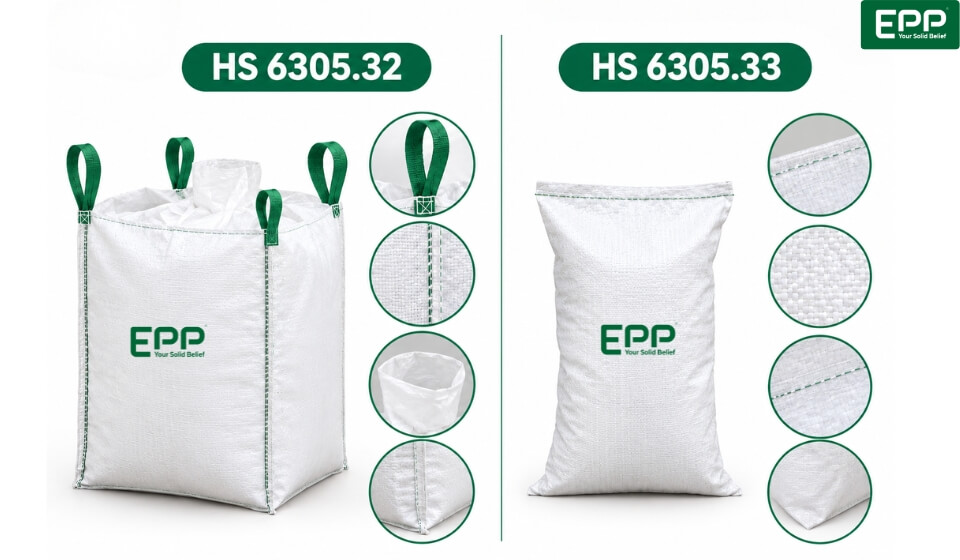
Structural elements like heavy-duty woven fabric and lifting loops distinguish FIBC bags under HS 6305.32 from standard PP sacks.
Why Does the PP Jumbo Bags HS Code Differ by Country?
The 6-Digit HS Code Is Internationally Harmonized
The World Customs Organization administers the Harmonized System to ensure that member countries apply identical 6-digit headings for international goods. Therefore, when sourcing flexible intermediate bulk container HS code products from Vietnam, the primary 6-digit sequence 6305.32 remains unchanged whether shipping to North America, Europe, Asia, or Australia.
National Tariff Codes Add Additional Digits
Beyond the universal 6-digit level, individual countries establish national statistical and duty subheadings. These extensions allow customs authorities to track trade volumes, apply specific tariff rates, and collect targeted trade data.
- United States (US HTS): The US International Trade Commission (USITC) Harmonized Tariff Schedule lists 6305.32.00, which further breaks down into 10-digit statistical codes based on unit weight, such as 6305.32.00.10 (weighing 1 kg or more each) and 6305.32.00.20 (weighing less than 1 kg).
- Australia (Australian Customs Tariff): The Federal Register of Legislation classifies bulk containers under 6305.32.00 for man-made textile flexible intermediate bulk containers.
- Japan (Japan Customs Tariff): Japan Customs categorizes FIBC packaging under tariff line 6305.32-000.
- European Union (EU TARIC / Combined Nomenclature): The EU applies 8-digit CN codes (e.g., 6305 32 11 or 6305 32 81) depending on whether the fabric is knitted, crocheted, or woven, and whether specific lamination processes apply.
Because tariff schedules undergo periodic revisions, importers should verify the applicable destination schedule prior to shipment dispatch. To ensure proper duty treatment, procurement managers should always consult their local customs broker rather than relying solely on generalized online databases.
Examples of Country-Specific Tariff Structures
When preparing commercial invoices and customs entries, understanding national nomenclature helps prevent customs line-item rejections. For instance, an importer shipping heavy-duty construction packaging such as an FIBC builder bag to the United States will use HTS 6305.32.00.10, whereas the same bag entering European ports will be filed under the appropriate EU CN 8-digit subheading.
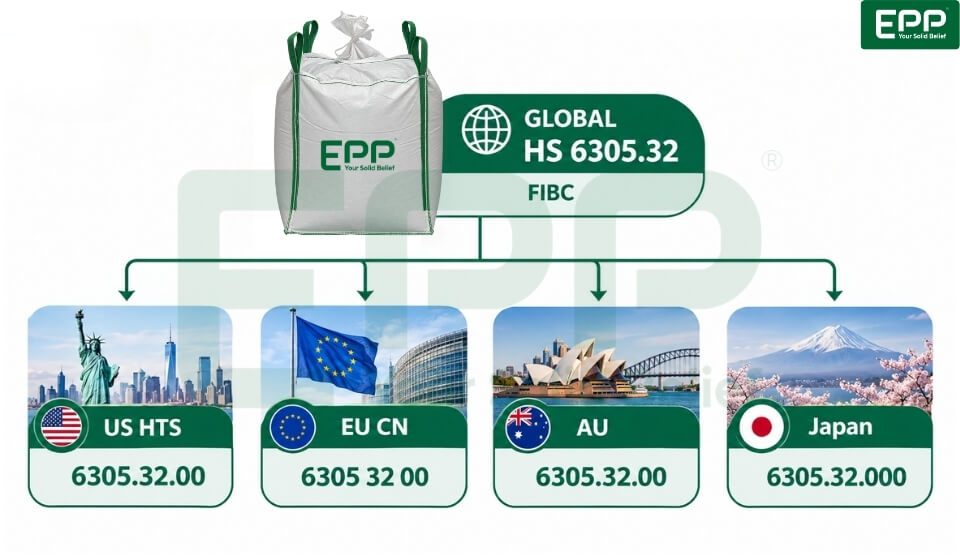
While HS 6305.32 is harmonized globally, national customs authorities add statistical extensions for regional duty enforcement.
Common PP Jumbo Bags HS Code Mistakes to Avoid
Mistake 1 — Treating 6305.32 as a Universal 8- or 10-Digit Code
Assuming that a full 8-digit code provided by a Vietnamese supplier automatically applies in the destination country is a major operational mistake. While the 6-digit prefix 6305.32 is universal, the remaining 2 to 4 digits are determined by destination tariff laws. Always verify the national tariff schedule of the importing nation.
Mistake 2 — Confusing FIBCs with Other PP Woven Bags
Declaring heavy-duty bulk bags under HS code 6305.33 (small PP sacks) or HS Code 3923 (articles for the conveyance or packing of goods, of plastics) is a frequent error. Chapter 39 covers extruded plastic articles (like polyethylene film rolls or rigid buckets), whereas Heading 6305 specifically covers woven textile packaging. Declaring FIBCs under Chapter 39 can result in severe tariff misdeclaration penalties.
Mistake 3 — Copying Another Shipment’s HS Code Without Verification
Relying blindly on historical import data from third-party trade databases can be risky. Global trade records show that past shipments of similar products have occasionally been declared under non-standard codes such as 6305.32.90, 6305.33.90, or 3923.29. A past declaration does not guarantee legal correctness; importers must verify their current national tariff schedule.
Mistake 4 — Assuming Certification Determines HS Classification
A common misconception is that obtaining an international safety certification automatically alters a product’s tariff code. Product safety standards (such as UN dangerous goods certification, BRCGS food-grade packaging standards, or IEC anti-static performance tests) do not override fundamental WCO tariff definitions. An FIBC retains its primary polypropylene jumbo bag HS code of 6305.32 regardless of whether it carries a UN certification label. For technical testing context, you can review our guide on testing methods for UN-certified bulk bags.
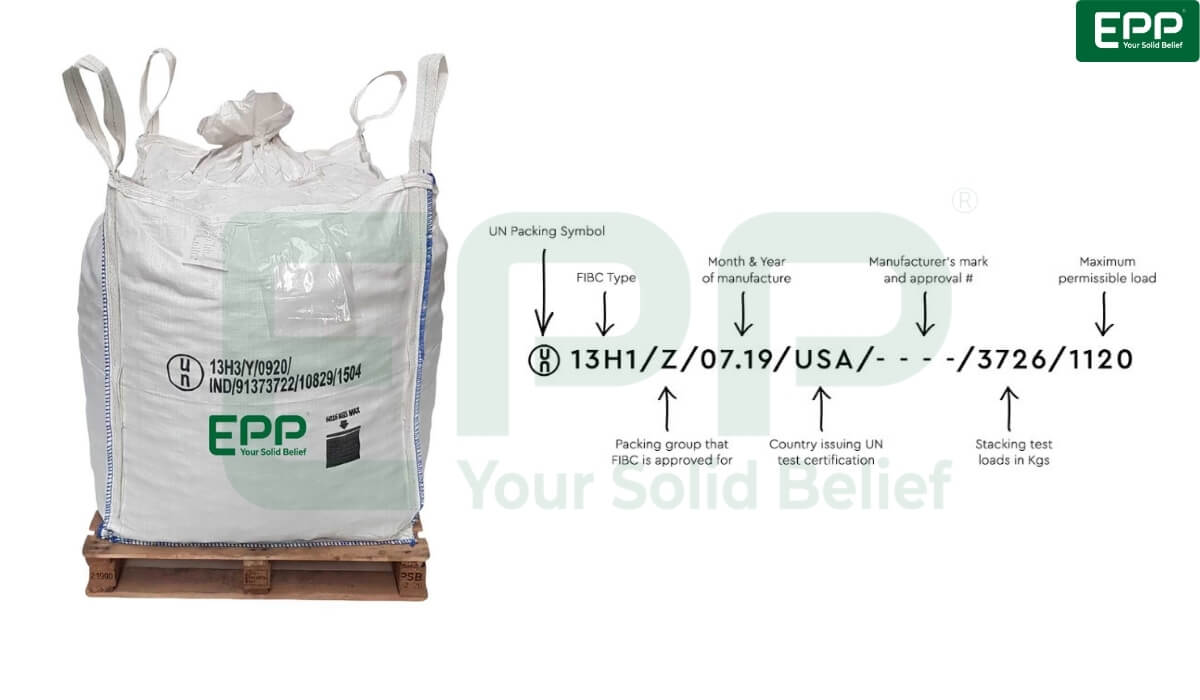
UN chemical bags for hazadous goods and UN marking explaination
Mistake 5 — Using Outdated Tariff Information
Tariff rates, trade preferences, and statistical subheadings change periodically. Customs authorities update national schedules annually. Failing to verify current tariff listings prior to importing can result in unexpected duty liabilities.
PP Jumbo Bags HS Code — FAQs for International Buyers
Can the HS code affect import duty?
Yes. The assigned FIBC tariff code determines the baseline customs duty rate, eligibility for Free Trade Agreement preferences, anti-dumping duties, and applicable import sales taxes.
Should an importer use the HS code provided by the supplier?
The supplier’s code should serve as a reference starting point. The legal responsibility for accurate import classification rests with the importer of record, who must confirm the code with a local customs broker or customs authority.
Does a UN-certified FIBC have a different HS code?
No. UN dangerous goods certification verifies structural performance and drop-test compliance, but it does not change the fundamental tariff classification. UN-certified FIBCs remain classified under 6305.32.
How can I verify the correct HS code before importing?
Review the manufacturer’s technical specification sheet, check the destination country’s official tariff database, consult a licensed customs broker, or apply for an advance binding tariff ruling from customs authorities. Outdoor applications also require evaluating technical parameters like UV protection; learn more in our article on why we need UV stabilization on FIBC bags.
Does adding an inner PE liner change the PP jumbo bags HS code?
Generally, adding a polyethylene inner liner, baffle structure, or surface coating does not alter the core 6-digit jumbo bag HSN code / HS code of 6305.32. However, certain national customs administrations may use these technical features to differentiate 8- or 10-digit statistical subheadings.

Ensuring smooth customs clearance for FIBC bulk bags relies on accurate product classification and consistent documentation. While 6305.32 serves as the universal 6-digit standard, navigating 8- to 10-digit national tariff codes requires precise product specifications and coordination with local customs brokers. Verifying construction details and destination tariff schedules before shipping eliminates misclassification risks and optimizes import duties.
Partner with EPP Vietnam for fully compliant bulk packaging solutions. Contact our export engineering team today to request custom technical datasheets, full export documentation support, and competitive quotes tailored to your destination market.
Website: epp.vn
Alibaba website: https://eppvietnam.trustpass.alibaba.com/
Email: [email protected] Hotline/ Whatsapps: +84 986 002 888