
Transporting hazardous powders, corrosive chemicals, and toxic minerals globally demands uncompromising packaging integrity. In the bulk packaging industry, UN-certified bulk bags serve as a primary containment barrier engineered to prevent environmental disasters, chemical spills, and severe worker injuries during international transit. Because these bags carry hazardous goods, every UN FIBC design type must undergo rigorous laboratory validation rather than relying on basic tensile strength estimates.
Understanding UN FIBC testing protocols is essential for EHS managers and procurement directors aiming to ensure regulatory compliance and supply chain safety. In this technical guide, EPP Vietnam breaks down the standardized testing methods, regulatory requirements, and verification protocols needed to evaluate and source high-performance UN big bags.
Why UN-Certified Bulk Bags Require Rigorous Laboratory Testing?
Unlike standard industrial FIBCs used for non-hazardous materials like grain or construction debris, UN approved bulk bags are subject to strict legal mandates established by the UN Recommendations on the Transport of Dangerous Goods (Chapter 6.5).

UN-certified bulk bags and Standard FIBCs
1. Regulatory Mandates Across Transport Modes
Hazardous material transport is governed internationally by specific modal regulations:
- IMDG Code: Mandatory for maritime transport of hazardous bulk cargo.
- ADR / RID: Governing European road and rail transport of dangerous goods.
- DOT (49 CFR) & IATA: Regulating US domestic transit and global air freight.
Compliance with these codes requires a valid UN packaging test report issued by an accredited laboratory. Without certified packaging, dangerous goods shipments face severe port rejections, heavy municipal fines, and immediate impoundment.
2. UN FIBC Tests Are Performed as a System
A critical principle of flexible IBC testing is that UN FIBC testing evaluates the bag as a complete, integrated system. An approval is never granted to fabric or lift loops in isolation.
The test specimen—including its specific fabric weight (GSM), coating thickness, thread type, UN packaging code, inner liner gauge, and discharge spout construction—must pass the full battery of tests as an identical unit. Any change during the standardized FIBC manufacturing process—such as altering fabric GSM, replacing an inner liner, or changing seam construction—invalidates the original design type approval.

The 6 Core Standardized Tests for UN-Certified Bulk Bags
According to international UN regulations (and accredited testing bodies such as Labordata), a UN specification FIBC design type must successfully pass 6 standardized laboratory tests before receiving official UN marking authorization.
1. FIBC Top Lift Test
Standard commercial bags utilize a 5:1 Safety Factor (SF). In contrast, the UN bag top lift test mandates a 6:1 safety factor for single-trip UN rated FIBC designs.
During the FIBC top lift test, the bag is filled to its rated Safe Working Load (SWL) with a simulant material. A hydraulic press or top hoist applies a vertical force equivalent to six times the SWL for a minimum duration of 5 minutes. To withstand these extreme tensile forces, manufacturers utilize reinforced loop structures and specialized jumbo bag sewing technology to prevent seam separation.
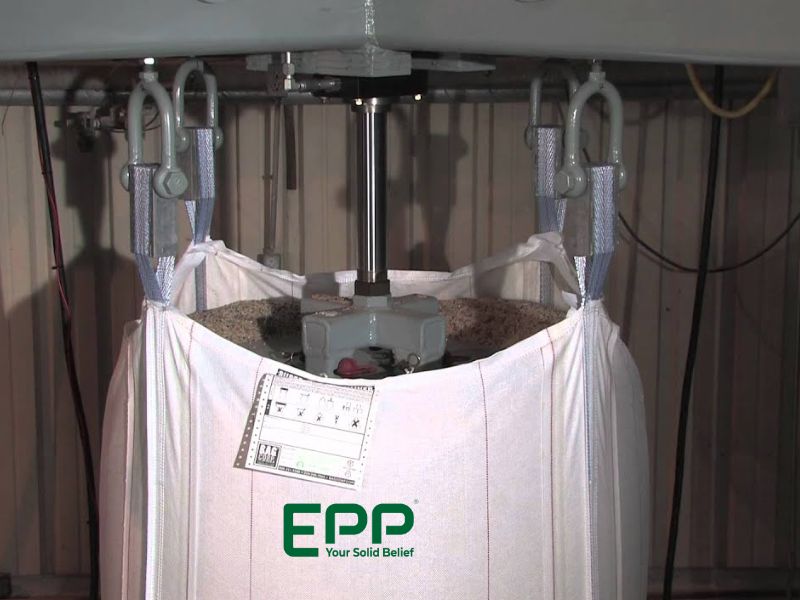
Rigorous UN big bag top lift test under accredited laboratory conditions for UN compliance.
2. FIBC Drop Test
The UN bag drop test measures structural integrity during accidental falls from transport equipment or forklift tines. The drop height is strictly determined by the assigned Packing Group:
- Packing Group I (Designator X – High Danger): 1.2 meter drop height.
- Packing Group II (Designator Y – Medium Danger): 0.9 meters drop height.
- Packing Group III (Designator Z – Low Danger): 0.8 meters drop height.
To pass the FIBC drop test, the bag must retain its contents completely without any loss or fabric rupture upon impact against a smooth, rigid, non-resilient target surface.
3. FIBC Stacking Test
In multi-tier warehouses and ocean freight containers, bulk bags experience continuous top loads. The UN bag stacking test simulates extreme vertical pressure over an extended period.
A top load force equivalent to 1.8 times the combined maximum permissible gross mass of all similar bags stacked on top is applied for 24 hours. The FIBC stacking test passes if there is no structural instability, excessive deformation, or loss of contents.
4. FIBC Topple Test
The UN bag topple test evaluates container resilience when a bag is accidentally knocked over from an upright position. The bag is placed on a platform and tipped over onto its top or side from heights matching its Packaging Group criteria (1.2 m, 0.9 m, or 0.8 m).
The FIBC topple test requires zero spillage or seam failure following the impact.
5. FIBC Righting Test
If a bag tips over during handling, operators often attempt to pull it upright using forklift tines hooked through only two loops.
During the UN bag righting test, a fully loaded bag lying on its side is hoisted upright using only two lift loops (for bags designed with four top lifting loops). The FIBC righting test passes if there is no damage or tearing to the loops, fabric, or lifting points.
6. FIBC Tear Test
The UN bag tear test evaluates the fabric’s resistance to tear propagation if punctured or damaged during transit.
A 100 mm knife cut is made at a 45° angle on the side wall of a fully loaded bag. The bag is then subjected to a vertical top lift load equal to twice its SWL for at least 5 minutes. To pass the FIBC tear test, the cut must not propagate or extend by more than 25% of its original length.

UN Testing vs ISO 21898: What Is the Difference?
A frequent point of confusion in bulk packaging procurement is the distinction between standard ISO 21898 testing for standard FIBC bulk bags and UN compliance testing.
| Technical Parameter | Standard ISO 21898 Packaging | UN-Certified Bulk Bags |
| Primary Scope | Non-hazardous bulk materials | Dangerous goods |
| Safety Factor (SF) | 5:1 (Single-trip) / 6:1 (Multi-trip) | 6:1 mandatory |
| Regulatory Authority | ISO Standards Committee | UN Model Regulations |
| Drop & Topple Testing | Optional / Not required | Mandatory 6-Test Battery across all Packaging Groups |
| Traceability & Marking | Manufacturer internal batch code | Official UN marking & UN test certificate |
Common Mistakes When Buying UN-Certified Bulk Bags
Navigating UN bulk bag certification requirements requires attention to detail. Procurement teams often make costly mistakes during the sourcing process:
- Assuming “UN bag” means universal approval: No single bag is approved for all dangerous goods. A bag certified for Packaging Group III solid materials (Z designator) cannot legally carry high-hazard Packaging Group I chemicals (X designator).
- Checking only the printed UN mark: Printing a UN packaging code on a bag does not make it compliant. Official codes printed via the flexo printing process on jumbo bags must match the exact string listed on a valid test report FIBC issued by an accredited independent agency like Labordata.
- Assuming one test covers every configuration: A design type approval applies strictly to the exact dimensions, fabric weight, seam stitching, and loop design tested in the laboratory. Changing dimensions or loop construction voids the original jumbo bag testing validation.
- Changing liner or coating specifications: Ordering a bag with a different liner gauge or omitting an internal coating from the tested design type voids compliance. The liner acts as a critical component during impact and drop tests.
- Omitting product specifications: Failing to specify product bulk density, hazard class, and packing group when contacting a UN FIBC supplier often results in incorrect bag engineering.
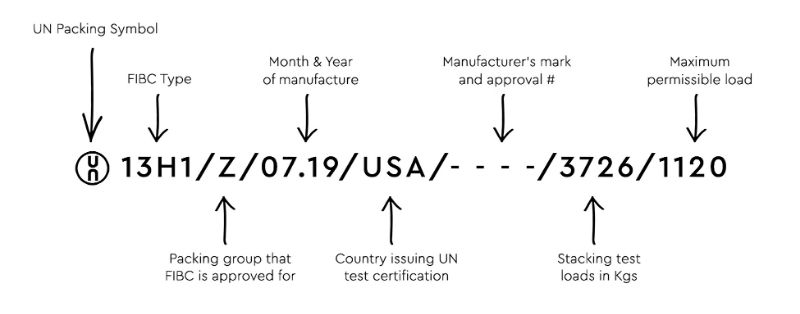
Mandatory UN certification marking label detailing packaging group and load capacity.
Frequently Asked Questions About UN FIBC Testing
Do UN FIBCs require a vibration test?
According to UN Chapter 6.5 (Labordata standard), the 6 core tests are mandatory worldwide. However, if you are exporting dangerous goods into or within the United States, US DOT regulations require a 60-minute vibration test in addition to the standard 6 UN tests.
What is the difference between 13H1 and 13H4?
These represent specific UN packaging code categories for flexible IBCs:
- 13H1 FIBC: Woven polypropylene, uncoated, without liner.
- 13H2 FIBC: Woven polypropylene, coated, without liner.
- 13H3 FIBC: Woven polypropylene, uncoated, with liner.
- 13H4 FIBC: Woven polypropylene, coated, with liner.
What does X, Y, and Z mean on UN packaging?
These letters denote the Packaging Group approval level:
- X: Approved for Packaging Groups I, II, and III (Highest hazard level).
- Y: Approved for Packaging Groups II and III (Medium hazard level).
- Z: Approved for Packaging Group III only (Lower hazard level).
Does every bag with a UN mark have the same test requirements?
No. Test parameters (such as drop heights and top-load weights) vary based on the assigned Packaging Group and the specific bulk density of the intended payload.
Partner with EPP Vietnam for Fully Tested UN FIBC Solutions
Sourcing compliant UN-Certified Bulk Bags requires complete supply chain transparency and technical precision. As a global packaging supply partner, EPP Vietnam connects international clients with top-tier, certified manufacturing facilities across Vietnam.
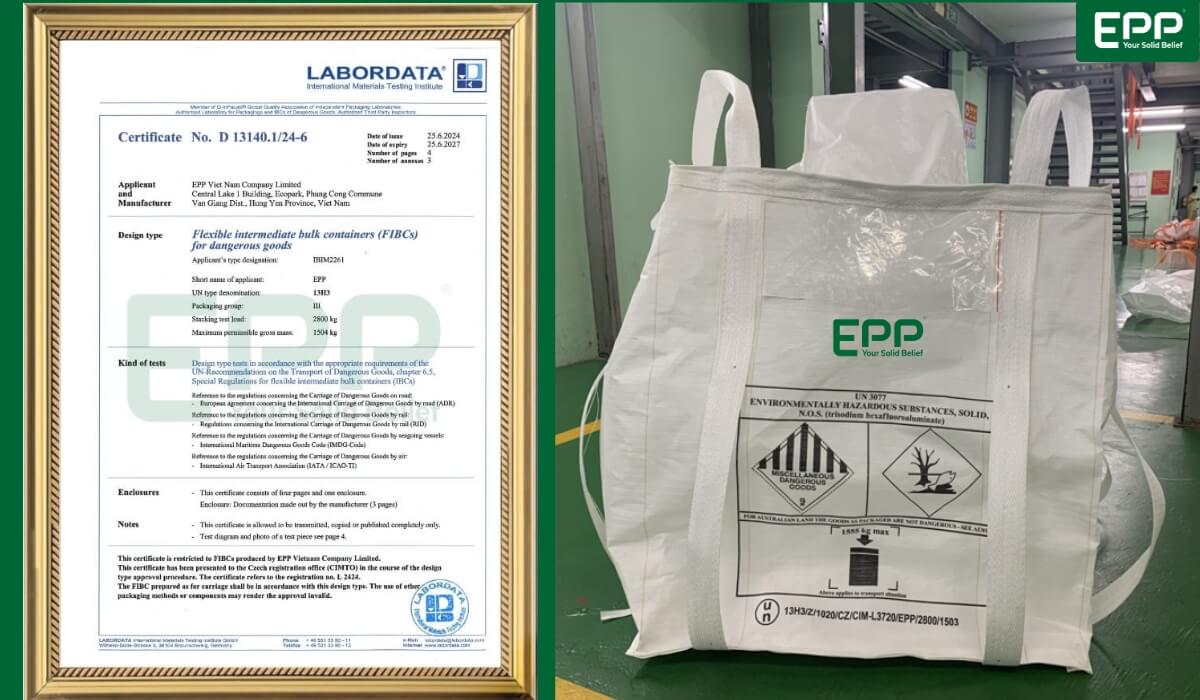
Un certification and Export-ready UN-certified bulk bags supplied by EPP Vietnam.
We provide comprehensive QA oversight, independent lab verification (working with certified test reports), and customized UN-certified FIBC bulk bags engineered to meet all international dangerous goods transport regulations.
Contact EPP Vietnam today for technical spec verification, test report documentation, and competitive international quotes.
Website: epp.vn
Alibaba website: https://eppvietnam.trustpass.alibaba.com/
Email: [email protected] Hotline/ Whatsapps: +84 986 002 888