If you are asking how much soil in a bulk bag, the most accurate answer is: there is no universal quantity. A bulk bag is a packaging format, not a fixed measurement. The actual amount of soil depends on the bag’s stated volume or net weight, the soil’s bulk density, moisture content and filling condition.
As a leasing jumbo bag supplier from Vietnam, EPP Vietnam has spent over two decades connecting agricultural distributors, and civil contractors with heavy-duty, certified FIBC solutions. Understanding how soil characteristics interact with bulk packaging ensures you order the exact material volume required while avoiding costly transportation or job-site structural failures.
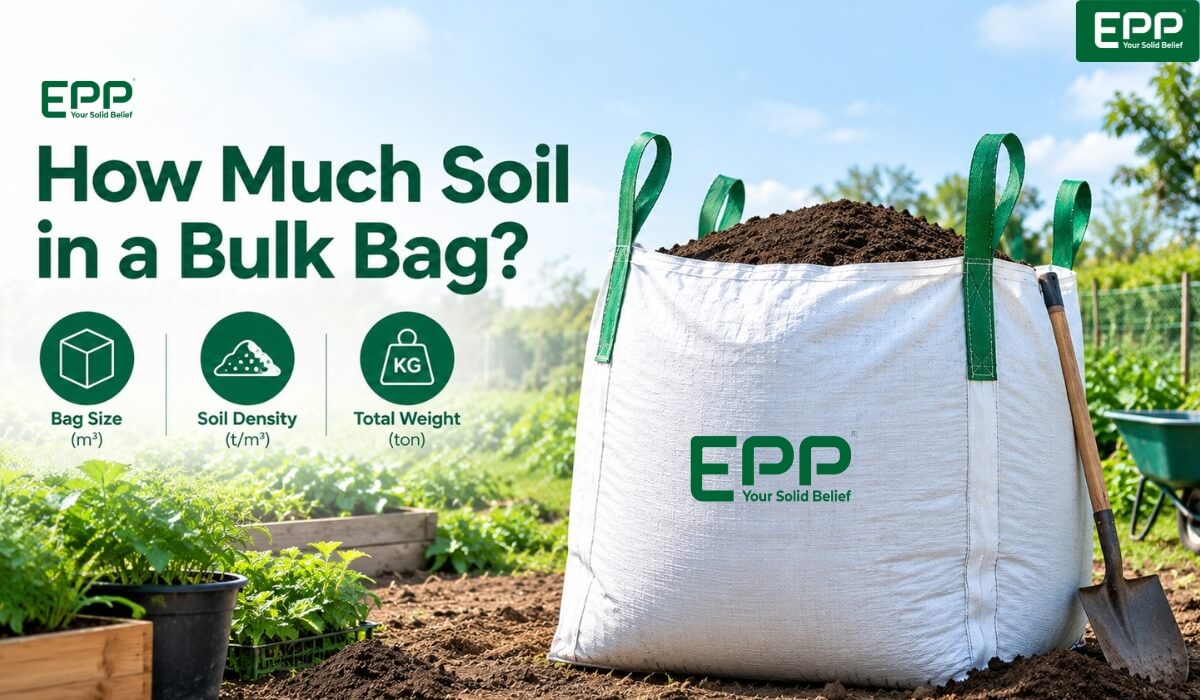
How much soil is in a bulk bag?
Quick Answer: How Much Soil in a Bulk Bag?
For fast site estimations, use these industry-wide broad market averages:
- Volume Range: Standard soil bulk bags hold between 0.60 to 0.75 cubic metres (600 to 750 litres / ~0.8 to 1.0 cubic yards).
- Weight Range: Typically packed between 800 kg and 850 kg (standard builders bags) up to 1,000 kg (1 metric tonne).
- Ground Coverage: One standard bulk bag covers roughly 12 to 14 square metres at a standard spreading depth of 50 mm (2 inches).
| Bulk Bag Nominal Rating | Average Soil Volume (m³) | Volume in Litres | Coverage @ 50mm Depth | 25kg Bag Equivalent |
| 800 kg Mini-Bulk | ~0.57 – 0.61 m³ | 570 – 610 L | ~11.5 – 12.2 m² | 32 bags |
| 850 kg Builders Bag | ~0.61 – 0.68 m³ | 610 – 680 L | ~12.2 – 13.6 m² | 34 bags |
| 1,000 kg (1 Tonne) Jumbo Bag | ~0.70 – 0.75 m³ | 700 – 750 L | ~14.0 – 15.0 m² | 40 bags |
| 1,200 kg Heavy Contractor Bag | ~0.80 – 0.88 m³ | 800 – 880 L | ~16.0 – 17.6 m² | 48 bags |
How Big Is a Bulk Bag of Soil?
The outer footprint of a bulk bag varies based on the target payload, transport method, and geographic market. Commercial suppliers choose specific bag cuts to fit standardized wooden pallets and optimize shipping container space:
- Standard Builders Bag: 85 x 85 x 85 cm ( ~0.61 m³)
- Standard 1-Tonne Bag: 90 x 90 x 90 cm (~0.73 m³)
- Large FIBC Bag: 95 x 95 x 100 cm (~0.90 m³)
Because woven polypropylene is a flexible material, these bags do not remain rigid cubes when filled. When dense material like topsoil is dropped into the bag, the sides flex outward, slightly expanding the footprint while reducing vertical height.
In global trade, regional terminology can cause confusion. North American suppliers often refer to “cubic yard bags,” while European, UK, and Australian markets use “tonne bags,” “builders bags,” or “bulka bags.”
Regardless of the terminology, selecting the correct bag construction is critical to maintaining safe handling. Discover how topsoil bulk bags are specifically engineered with specialized loop reinforced stitching to handle dense topsoil without tearing during crane or forklift transit.
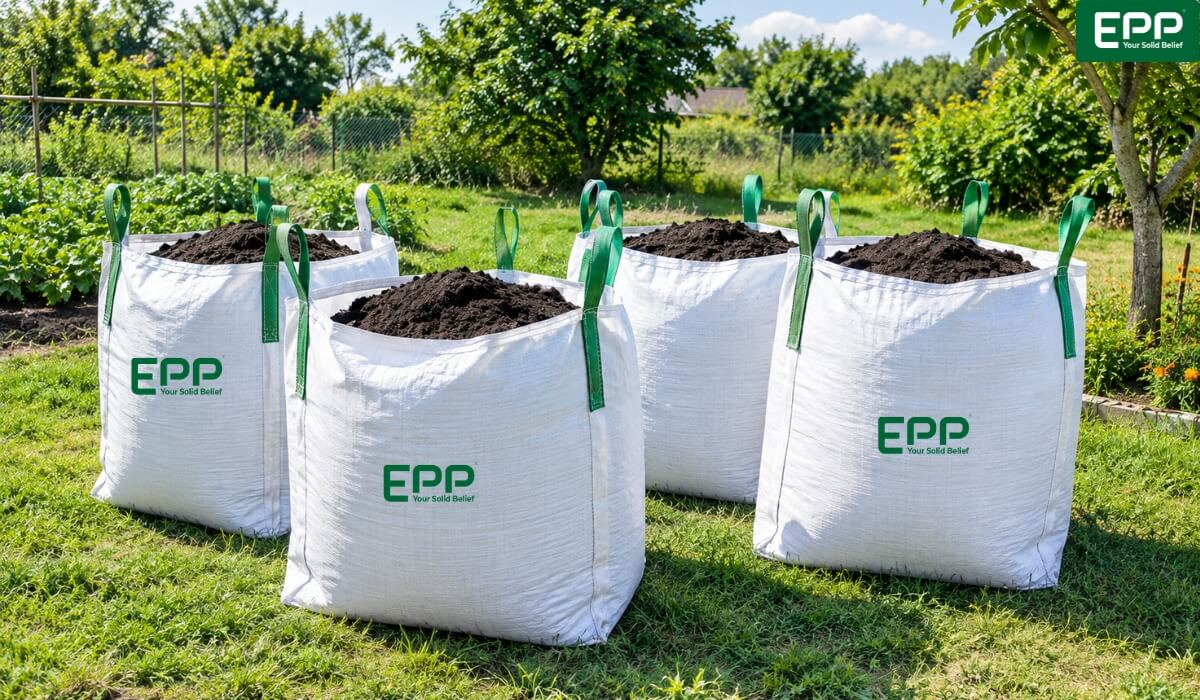
Landscaping topsoil bulk bag positioned for site spreading
Why Two Bulk Bags Don’t Weigh the Same?
The relationship between weight, volume, and density is governed by a straightforward formula:
Weight (kg) = Usable Volume (m³) × Soil Bulk Density (kg/m³)
Soil is a dynamic mixture of organic matter, minerals, air pockets, and water. As moisture content changes, the density fluctuates dramatically:
- Dry Screened Topsoil: Density ranges from 1,100 kg/m³ to 1,250 kg/m³. A 0.7 m³ bag weighs roughly 770–875 kg.
- Enriched Garden Loam (Damp): Density ranges from 1,300 kg/m³ to 1,450 kg/m³. A 0.7 m³ bag weighs roughly 910–1,015 kg.
- Saturated / Wet Clay Heavy Soil: Density spikes to 1,600 kg/m³ to 1,800 kg/m³. At this density, just 0.55 m³ of soil reaches the 1,000 kg safe weight limit.
If uncontained soil stockpiles sit outdoors during heavy rain, water replaces the air pockets between soil particles. When a bag filling line fills a bulk bag to a target weight limit of 1,000 kg with wet soil, you receive significantly less usable volume (m³) of soil than if the soil were dry.
This density principle applies across all bulk transport commodities. For instance, you can examine how moisture and stacking density alter timber shipping in our technical breakdown of how many logs in a tonne bag.
How Many Cubic Metres in a Bulk Bag of Topsoil?
A standard bulk bag of topsoil contains 0.65 to 0.70 cubic metres (m³) of usable soil (roughly 650 to 700 litres).
Why doesn’t a 1m x 1m x 1m bag hold 1 full cubic metre of soil?
It comes down to weight and safety limits:
- Weight: Damp topsoil is heavy, weighing around 1.3 to 1.4 tonnes per cubic metre.
- Safety Limits: Most standard crane arms, delivery trucks, and site forklifts have a safe lifting limit of 1 tonne (1,000 kg).
If suppliers filled a 1 m³ bag to the very top with wet soil, it would weigh nearly 1.4 tonnes—making it too heavy to lift safely and likely to break the bag. To stay within safety limits, packagers fill the bag to around 0.7 m³, leaving safe headroom at the top.
Commercial distributors interested in high-volume sourcing can buy tonne bags directly through EPP Vietnam’s global export channels. To better understand how bulk bag design choices affect commercial pricing structures across industries, explore our analysis on a cashew nuts big bag.
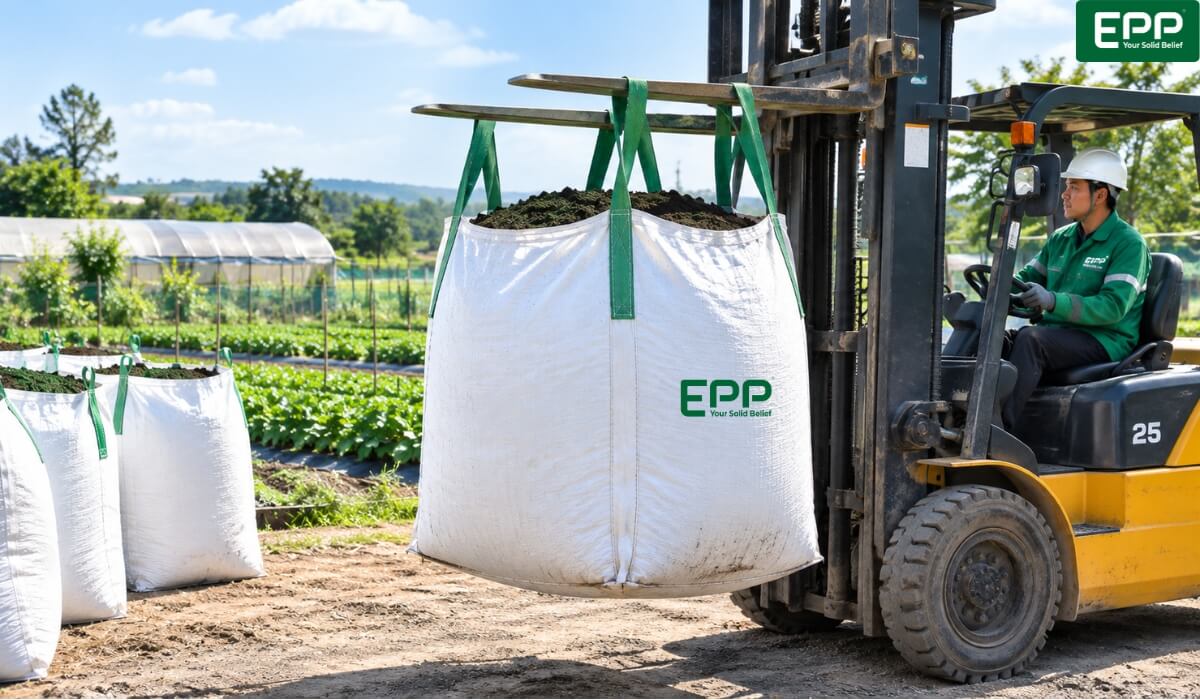
Forklift transporting a heavy-duty FIBC jumbo bulk bag for soil.
Frequently Asked Questions (FAQs)
How much topsoil in a bulk bag compared to loose tip soil?
One standard bulk bag holds roughly 0.7 m³ (around 850 kg) of topsoil. A standard 20-tonne commercial tipper truck delivers roughly 14 m³ of loose soil, which is equivalent to 20 bulk bags.
While loose tipping is often cheaper per tonne for large site builds, bulk bags keep job sites contained, prevent rainwater runoff, and allow crane arms to lift material directly over garden walls or fences.
How many 25kg small bags of soil equal one bulk bag?
The conversion depends on the total mass rating of the bulk bag:
- An 850 kg bulk bag equals 34 small 25 kg bags.
- A 1 tonne bag equals 40 small 25 kg bags.
Using a single bulk bag drastically reduces single-use plastic waste on job sites compared to dozens of retail bags. For an expanded breakdown of retail vs. bulk procurement economics, read our guide on soil ton bags vs small bags.
Can soil bulk bags be left outside in the rain?
Standard woven polypropylene jumbo bags are water-resistant but porous. Leaving filled soil bags uncovered in heavy rain allows water to seep through the woven fabric. This drastically increases the overall weight without increasing usable soil volume, leaches out valuable soil nutrients, and makes handling messy. It is best practice to cover stored bulk bags with a waterproof tarp.
Do soil bulk bags need a PE liner?
No. Standard topsoil and organic compost require breathable woven polypropylene fabric to allow air exchange and prevent moisture stagnating. Polyethylene (PE) inner liners are generally reserved for fine powders, hygroscopic chemicals, or food items that require strict moisture barriers.
How much area does a bulk bag of topsoil cover?
- At a standard garden preparation depth of 50 mm (2 inches), one bulk bag covers 12 to 14 m².
- At a turf sub-base depth of 100 mm (4 inches), one bulk bag covers 6 to 7 m².
- At a light top-dressing depth of 25 mm (1 inch), one bulk bag covers 24 to 28 m².
Understanding how much soil in a bulk bag comes down to recognizing that a bulk bag is a flexible packaging format rather than a fixed, universal measurement unit. Depending on the specific bag dimensions and the moisture content of the soil inside, a standard bag typically yields 0.60 to 0.75 cubic metres of spreadable material and weighs between 800 kg and 1,000 kg.
By calculating your site’s surface area, accounting for natural soil settlement, and selecting certified packaging, you can ensure smooth project execution without material shortages or freight issues. As the leading jumbo bag supplier from Vietnam, EPP Vietnam delivers engineered, high-integrity FIBC solutions tailored to the rigorous demands of global aggregate, soil, and landscaping distributors.
Website: epp.vn
Alibaba website: https://eppvietnam.trustpass.alibaba.com/
Email: [email protected] Hotline/ Whatsapps: +84 986 002 888