Understanding how pp bags are made is essential for procurement managers and agricultural exporters sourcing durable bulk packaging. Polypropylene woven bags provide high tensile strength and puncture resistance for carrying 25 kg to 50 kg across global supply chains.
As a leading FIBC and agricultural packaging supplier in Vietnam, EPP Vietnam partners with top manufacturing facilities to deliver high-performance woven polypropylene bags, BOPP laminated packaging, and industrial bulk sacks. This guide covers raw material formulations, tape extrusion, circular weaving, lamination options, printing methods, conversion sewing, quality testing, and B2B verification criteria.
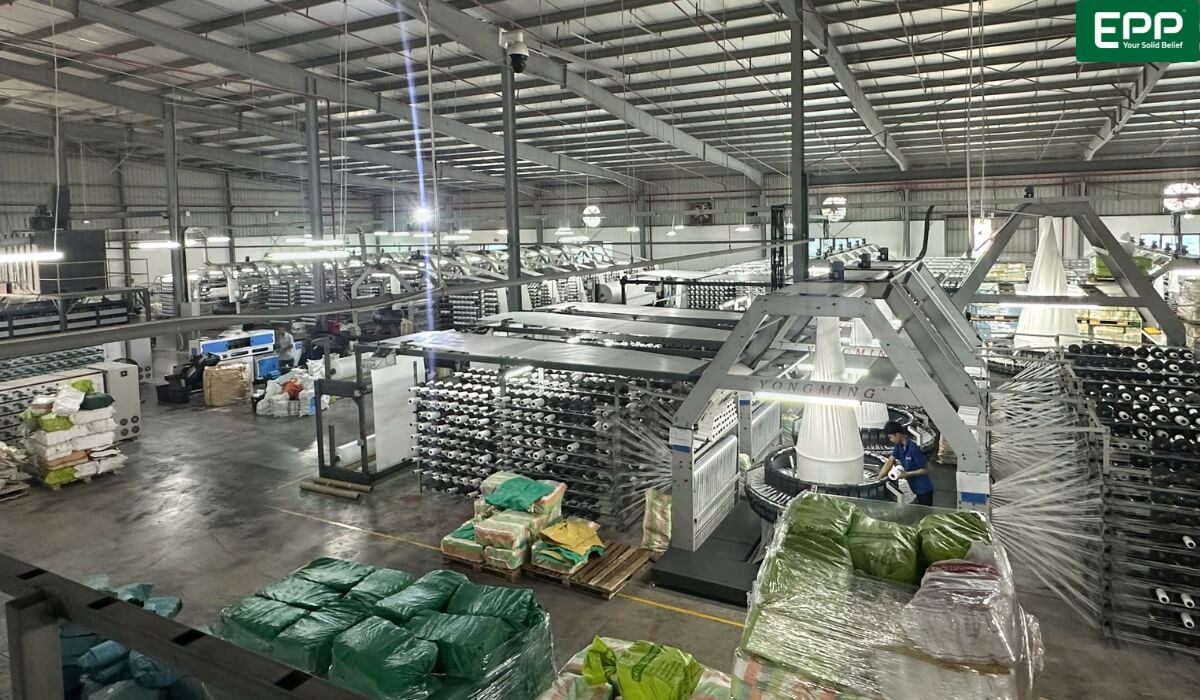
One of EPP Vietnam’s PP woven bag manufacturer partner.
What Raw Materials Are Used to Make PP Woven Bags?
The performance, load capacity, and weather resistance of woven polypropylene packaging depend heavily on its core pp woven bags raw material formulation.
Virgin Polypropylene (PP) Resin Pellets: 100% virgin PP polymer resin provides high tensile strength, controlled melt flow index (MFI 2.5 to 4.5 g/10min), and uniform thread consistency. Virgin resin ensures structural integrity without the brittleness associated with low-grade recycled plastic.
UV Stabilizer Masterbatch: Hindered Amine Light Stabilizers (HALS) added at 1.5% to 3% concentration protect the polymer chains from sun degradation, extending outdoor storage life.
Calcium Carbonate (CaCO3) Filler: Calcium carbonate additives control fabric stiffness, reduce thermal shrinkage during extrusion, and optimize production economics.
Color Masterbatches: High-pigment masterbatch pellets deliver specific fabric colors (opaque white, yellow, transparent, or custom brand hues) while maintaining uniform opacity.
How PP Bags Are Made: Step-by-Step Production Process
Manufacturing industrial PP woven bags involves converting raw plastic resin into high-tensile woven tubular fabric, which is then laminated, printed, and sewn into finished bags.
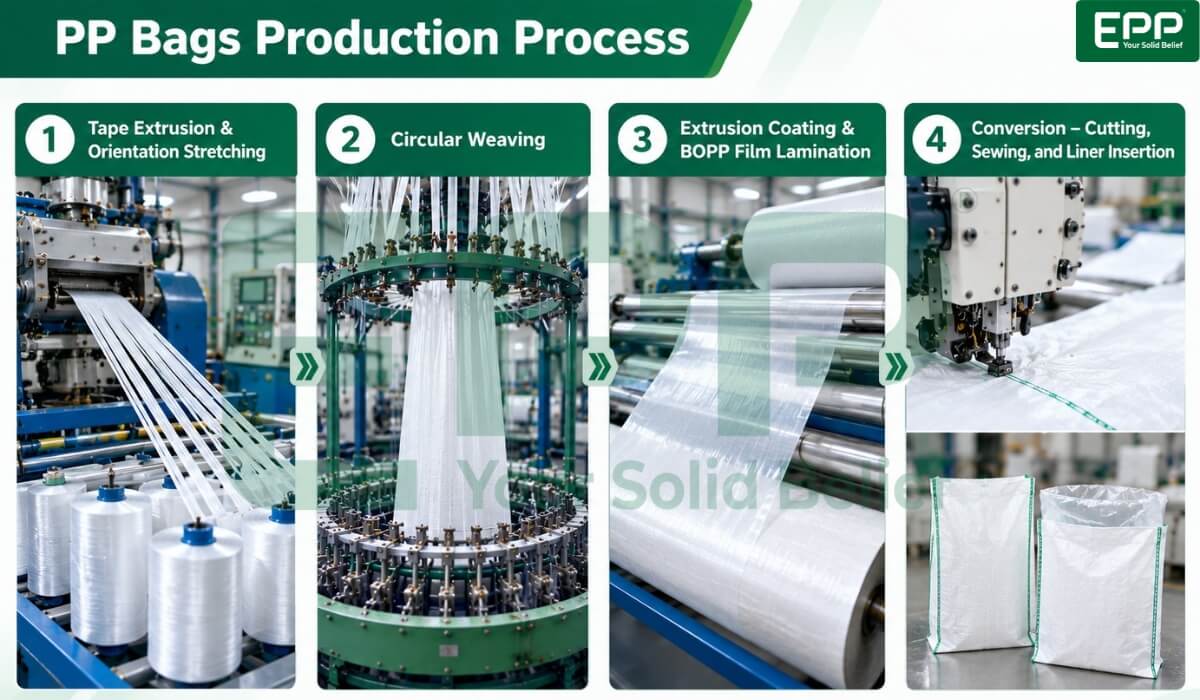
Four key steps in the PP woven bag production process, from tape extrusion to final bag conversion.
Step 1: Tape Extrusion & Orientation Stretching
Raw PP pellets and masterbatch additives enter a heated extruder barrel, melting at 230°C to 270°C. The molten polymer is forced through a flat T-die to form a continuous thin film, which is cooled in a water bath.
Slitting knives divide the film into narrow flat tapes (2.5 mm to 4.0 mm wide). These tapes pass over heated plates at 140°C to 180°C and are stretched at a 1:4 to 1:6 ratio, aligning the polymer chains to increase tensile strength (greater than or equal to 4.5 g/denier). The finished flat yarns are wound onto bobbins.
Step 2: Circular Weaving
Bobbins are loaded onto circular looms where warp (vertical) and weft (horizontal) tapes interlace to form a continuous tube of woven fabric. Standard industrial weave counts range from 8×8 to 12×12 tapes per inch. For large-scale protective covers or custom packaging conversion, buyers can explore our high-tensile woven polypropylene fabric options.
(Gợi ý hình ảnh 2: High-speed tape extrusion line drawing high-tensile polypropylene flat yarns onto bobbins at EPP Vietnam. Alt text: PP tape extrusion and orientation stretching line for woven bag production)
Step 3: Extrusion Coating & BOPP Film Lamination
Uncoated woven fabric features tiny gaps between intersecting tapes. To make bags fully waterproof and leak-proof, an extrusion lamination layer (18 to 25 microns of molten PE/PP) is applied to seal the surface.
For high-end consumer or retail agricultural packaging, Biaxially Oriented Polypropylene (BOPP) film is laminated onto the woven fabric. To review structural differences and barrier properties between standard coatings and photo-quality film layers, read our comparative guide on coated PP woven bags vs BOPP laminated bags.
Step 4: Conversion – Cutting, Sewing, and Liner Insertion
Automatic cutting machines convert tubular fabric rolls into individual bag lengths. Bags are then folded at the bottom (single or double fold) and stitched using high-tenacity polyester thread.
For fine powders or moisture-sensitive chemicals, a high-density polyethylene (HDPE) or low-density polyethylene (LDPE) inner liner is inserted inside the bag prior to final bottom stitching.

EPP Vietnam manufacturing facility producing high quality woven sacks for export
How Does Printing Affect PP Woven Bag Production?
Printing transforms plain industrial sacks into branded commercial packaging, but the chosen printing method on PP bags directly dictates production stages, equipment setup, and graphic resolution:
Direct Flexographic Printing: Flexo printing applies fast-drying ink directly onto uncoated or coated PP fabric in 1 to 6 colors. It is integrated into automated cut-and-sew lines, making it cost-effective for standard fertilizer, animal feed, and agricultural sacks.
Rotogravure BOPP Printing: In this process, reverse printing is executed on a transparent BOPP film using high-definition gravure cylinders (up to 8-10 colors) before the film is laminated onto the woven PP fabric. The ink layer is trapped between the film and fabric, making the design scratch-proof, waterproof, and visually striking.
How Quality Is Checked During PP Woven Bag Production?
High-speed production requires strict quality assurance testing at every manufacturing stage to prevent field seam splits or product contamination:
- Tensile & Elongation Testing: Samples of extruded tapes, woven fabric, and bottom seams are tested on universal tensile equipment to ensure warp/weft breaking strength meets 400 N to 800 N specifications.
- Drop Impact Testing: Filled bags (loaded with 25 kg to 50 kg test material) are dropped from heights of 1.2 m to 2.0 m at flat, side, and seam angles to confirm structural seam integrity.
- UV Accelerated Weathering: Fabric specimens undergo accelerated ultraviolet exposure in QUV testing chambers for 200 to 500 hours to verify that UV stabilizer levels prevent outdoor fabric degradation.
- Food Safety & Hygiene Inspection: Food-grade packaging undergoes clean-room air blowing, metal detection, and microbiological testing to comply with BRCGS and FDA requirements.
After passing quality testing, all scrap material generated during edge trimming is collected and recycled. To learn more about environmental lifecycle management and sustainable disposal, review our guide on whether woven polypropylene bags are recyclable.
How Can Buyers Verify PP Woven Bag Quality?
When sourcing bulk PP woven bags from international suppliers, B2B buyers can verify product quality using this technical evaluation checklist:
[ ] 100% Virgin Polymer Declaration: Confirm that the manufacturer uses virgin PP resin without unauthorized recycled fillers that compromise fabric elasticity.
[ ] Certified UV Stabilization: Request laboratory test reports proving HALS additive content (1.5% to 3%) for outdoor UV protection.
[ ] Stitch Count & Thread Specification: Verify bottom seam stitching density (typically 12 to 15 stitches per 10 cm) and polyester thread denier ratings.
[ ] Factory Quality Certifications: Ensure the production facility holds audited ISO 9001:2015 and BRCGS Packaging (Food Safety) certifications.
Commercial buyers looking for reliable, factory-direct packaging solutions can review our complete catalog of custom PP woven bags supplied by EPP Vietnam.
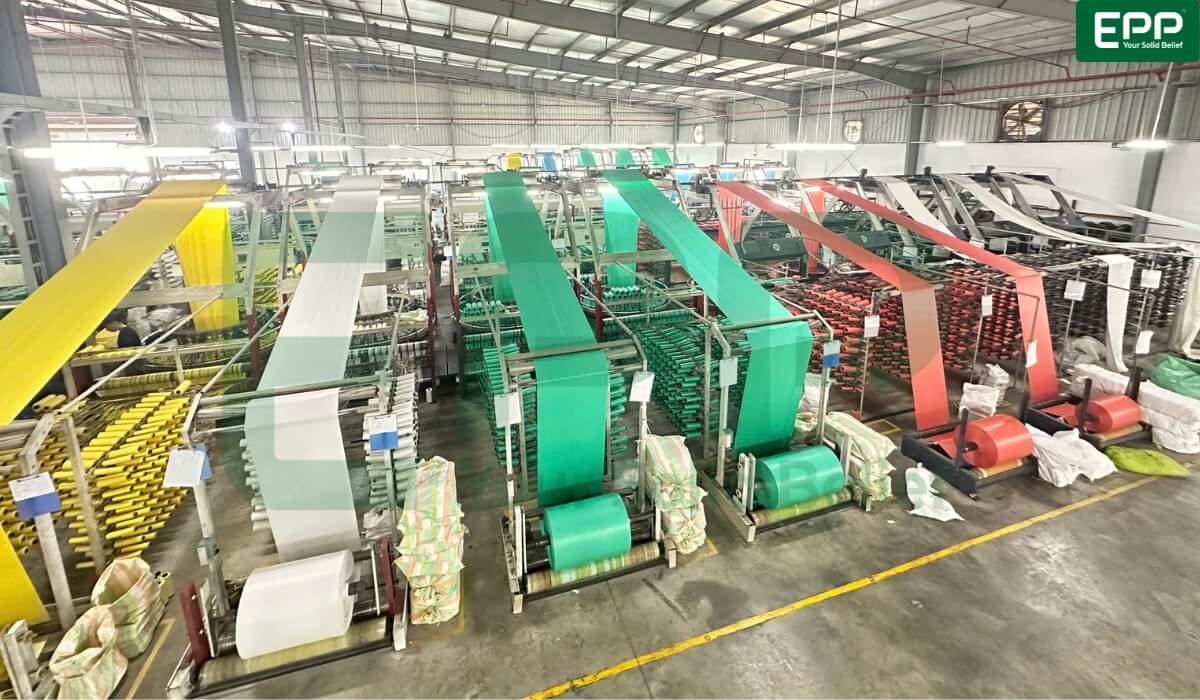
Modern high speed circular weaving loom factory at EPP Vietnam.
Frequently Asked Questions About How PP Bags Are Made
What raw materials are used to manufacture high-strength PP woven bags?
High-strength PP woven bags are primarily manufactured from 100% virgin polypropylene (PP) resin pellets, combined with functional masterbatch additives including UV stabilizers (HALS), calcium carbonate (CaCO3) fillers for structural rigidity, and color pigments.
What is the difference between heat cutting and cold cutting in PP bag conversion?
Heat cutting uses a heated blade to melt and seal the cut edges of unlaminated fabric, preventing the woven threads from fraying. Cold mechanical cutting uses a sharp steel blade and is applied to coated or BOPP laminated fabrics where the lamination layer already binds the threads together.
How does BOPP lamination improve the performance of woven PP bags?
BOPP (Biaxially Oriented Polypropylene) lamination adds an impermeable protective film onto the woven fabric. This provides 100% moisture resistance, prevents powder leakage, enhances tear strength, and allows for high-definition, photo-quality rotogravure printing that elevates brand appeal.
Partner with EPP Vietnam for Certified Industrial PP Bags
Understanding how pp bags are made helps B2B buyers select the correct fabric weight, coating structure, and seam construction for their products. EPP Vietnam combines supply chain expertise, state-of-the-art circular weaving technology, and audited quality systems to deliver zero-defect industrial packaging solutions worldwide.
We supply fully customizable PP woven bag specifications:
- Custom load capacities from 10 kg, 25 kg, and 50 kg sacks to 1,000 kg+ FIBC bulk bags.
- High-definition 6-color flexographic printing and 8-to-10-color BOPP rotogravure lamination.
- ISO 9001:2015 and BRCGS Grade A certified supply with competitive B2B pricing.
Contact our technical sales team today to request product samples, laboratory datasheets, or direct supply quotes:
Website: epp.vn | eppvietnam.trustpass.alibaba.com
Phone / WhatsApp: +84 986 002 888
Email: [email protected]