When sourcing topsoil, compost, or soil amendments for commercial landscaping, agricultural distribution, or construction site preparation, choosing the right packaging format is one of the most critical decisions a procurement manager or contractor can make.
Commercial buyers frequently weigh the advantages of high-capacity flexible intermediate bulk containers against traditional retail packaging. Evaluating Soil Ton Bags vs. Small Soil Bags reveals significant disparities in operational throughput, waste reduction, and total cost per cubic meter.
As a leading FIBC supplier in Vietnam, EPP Vietnam manufactures engineered bulk packaging solutions designed to streamline international logistics, protect organic soil formulations, and maximize profit margins for commercial buyers worldwide.
Soil Ton Bags vs. Small Soil Bags: What Is the Difference?
Selecting the optimal packaging format for topsoil or garden soil is a strategic decision that directly affects project budgets and job-site speed. Choosing between high-capacity Soil Ton Bags (FIBC bulk bags) and standard Small Soil Bags (typically 20kg–25kg or 40L–50L plastic sacks) involves comparing structural design, material capacity, and equipment requirements.
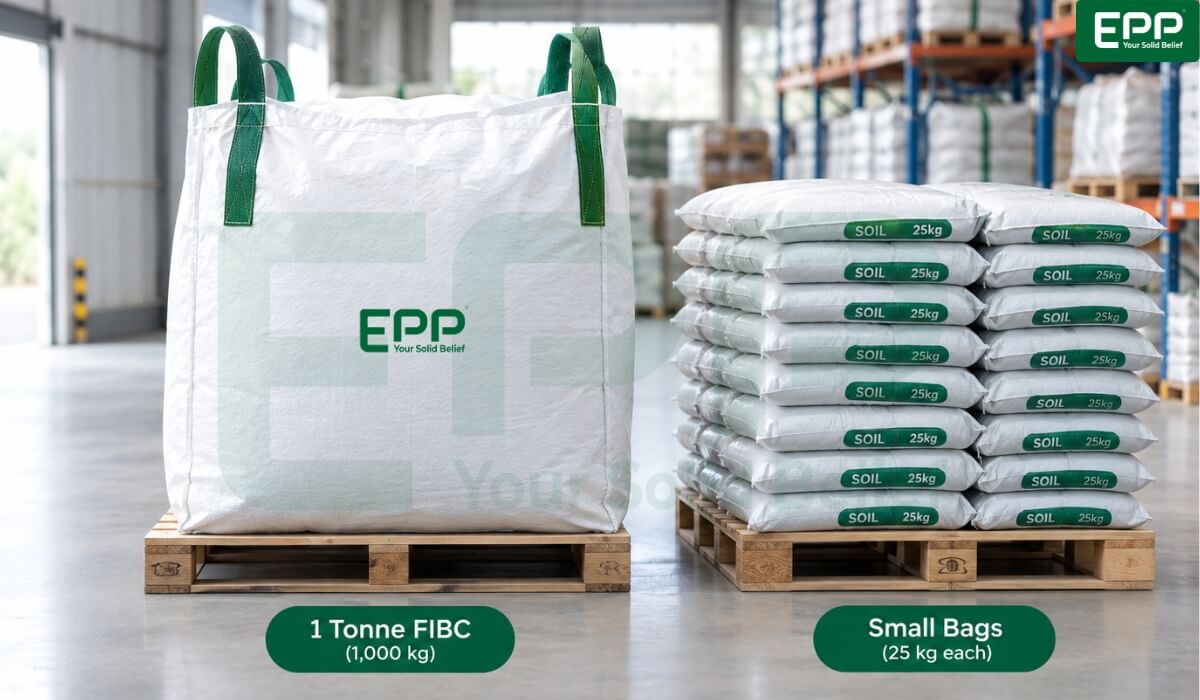
Comparing high-capacity Soil Ton Bags vs. Small Soil Bags helps procurement managers optimize total packaging and labor expenditure.
- Soil Ton Bags (FIBC Bulk Bags): Manufactured from heavy-duty woven polypropylene, these large industrial sacks are engineered to hold 800kg to 1,500kg of material. Equipped with corner or cross-corner lifting loops, topsoil tonne bags require mechanical equipment—such as forklifts, telehandlers, or excavators—for moving and offloading.
- Small Soil Bags: Produced using sealed multilayer polyethylene (PE) or lightweight woven polypropylene bags, these small bags of soil usually hold 20kg to 25kg. They are designed for manual lifting, retail shelving, and precise hand application in tight residential spaces.
Understanding broader agricultural packaging trends—such as common methods of farm produce preservation nowadays—helps procurement teams select protective packaging solutions that maintain moisture balance and prevent material degradation.
How Do You Calculate Exact Soil Density and Volume Conversions?
Accurately evaluating the choice between Soil Ton Bags vs. Small Soil Bags requires a precise understanding of soil weight, bulk volume, and moisture variability. Estimating material needs purely by bag count without accounting for bulk density leads to budget overruns and equipment mismatch.
The Impact of Soil Density and Moisture Content
Soil weight fluctuates significantly depending on organic composition, compaction, and water retention. The core engineering formula used to determine bulk soil mass is:
Weight (kg) = Volume (m³) x Bulk Density (kg/m³)
Typical bulk density reference ranges include:
- Dry Organic Compost / Potting Soil: 1,100 kg/m³
- Standard Screened Topsoil: 1,300 – 1,400 kg/m³
- Wet Clay / Compacted Landscaping Soil: 1,600 – 1,800 kg/m³
When sourcing heavy topsoil, review dedicated specifications for top soil bulk bags to ensure safe working load (SWL) limits are maintained under high moisture conditions.

Conversion Math: How Many 25kg Bags Equal One Ton Bag?
Standard small bags of soil typically weigh 25kg. Evaluating the volumetric equivalence between Soil Ton Bags vs. Small Soil Bags demonstrates:
1 Soil Ton Bag (1,000 kg capacity) = 40 Small Soil Bags (25 kg each)
In terms of volumetric coverage, 1 cubic meter (1.0 m³) of screened topsoil at a standard depth of 50mm (0.05m) covers approximately 20 m² of garden beds.
To understand how bulk bags handle varying material volumes across different commodities, compare these figures with calculations in our guide on how many logs in a tonne bag or review how much soil in a bulk bag for complete dimensional breakdowns.
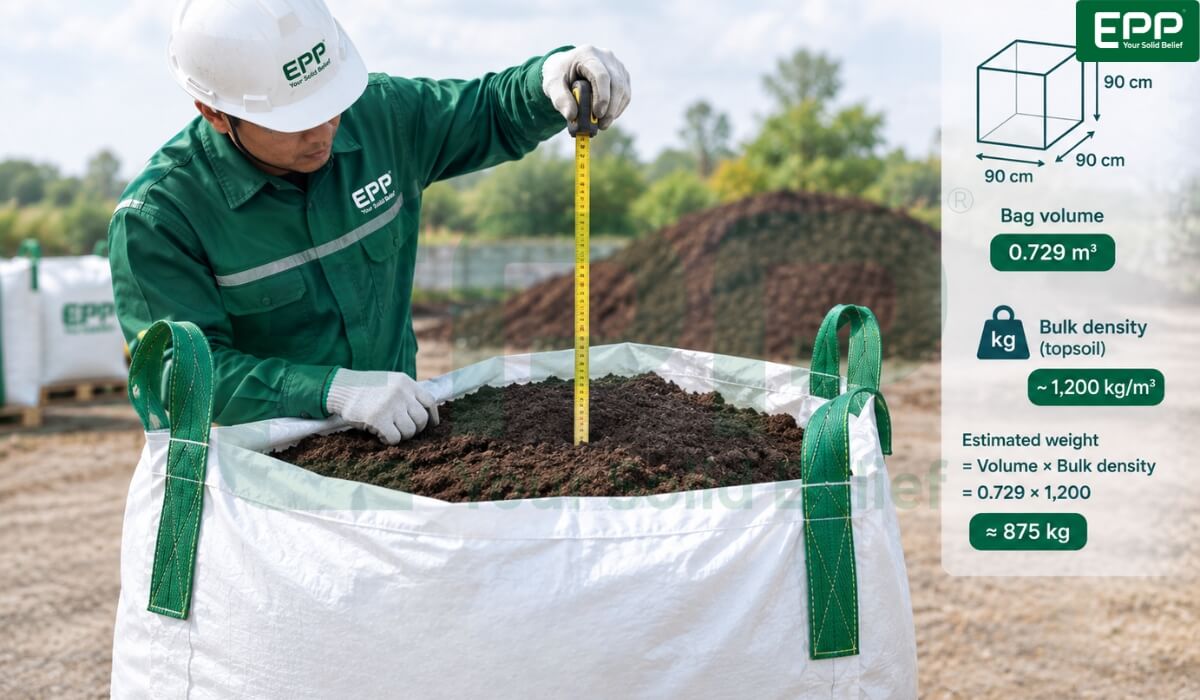
Accurate bulk density calculations ensure that Soil Ton Bags do not exceed safe working load limits during transport.
Soil Ton Bags vs. Small Soil Bags: Which Is More Cost-Effective?
Determining whether Soil Ton Bags vs. Small Soil Bags offer lower total expenditure requires looking past the individual sticker price and examining total landed cost across packaging, labor, freight, and waste management.
| Operational & Financial Factor | Soil Ton Bags (1,000kg FIBC) | Small Soil Bags (25kg Sacks) |
| Packaging Cost per Metric Ton | Lower ($12 – $20 total for 1 Bulk Bag) | Higher ($30 – $48 total for 40 Small Sacks) |
| Unloading & Job-Site Labor | Fast (3–5 mins with Forklift/Excavator) | Slow (35–45 mins of manual hand-carrying) |
| Container & Freight Space Efficiency | High (95% full container optimization) | Moderate (75–80% due to pallet gaps) |
| Job-Site Plastic Waste Footprint | Minimal (1 single-trip PP FIBC bag) | High (40 single-use PE bags discarded) |
Packaging Material Cost Savings
Manufacturing 40 individual 25kg plastic sacks requires significantly more cumulative film, printing ink, and edge heat-sealing than producing a single 1-tonne FIBC bulk bag. On a per-ton basis, raw packaging materials for small bags cost more than a single heavy-duty ton bag.
Labor Efficiency and Handling Velocity
Unloading a metric ton of soil packed in 25kg soil bags requires workers to manually lift, carry, and slice open 40 separate items. Conversely, a single machine operator using a bottom-discharge FIBC soil bag can position and dump 1.0 m³ of topsoil directly into a truck bed or planter in under three minutes. Furthermore, stacking bulk soil bags inside 40ft High Cube containers maximizes vertical payload, substantially reducing ocean shipping rates per metric ton.
Which Soil Bag Should You Choose for Your Project?
Choosing between Soil Ton Bags vs. Small Soil Bags depends directly on project scale, available machinery, site accessibility, and distribution goals.
Choose Soil Ton Bags For:
- Commercial Landscaping & Construction Sites: Infrastructure projects, park developments, and highway greening requiring high-volume bulk soil handling.
- Agricultural Importers & Soil Distributors: Businesses receiving full container loads (FCL) for B2B distribution or commercial mixing facilities.
- Mechanized Job Sites: Projects equipped with forklifts, telehandlers, hoists, or excavators.
Choose Small Soil Bags For:
- Retail Garden Centers & DIY Consumers: Homeowners working on small planter boxes, potted plants, or small residential patches.
- Restricted Access Urban Locations: Indoor gardens, high-rise rooftops, or backyard areas where heavy equipment cannot enter.
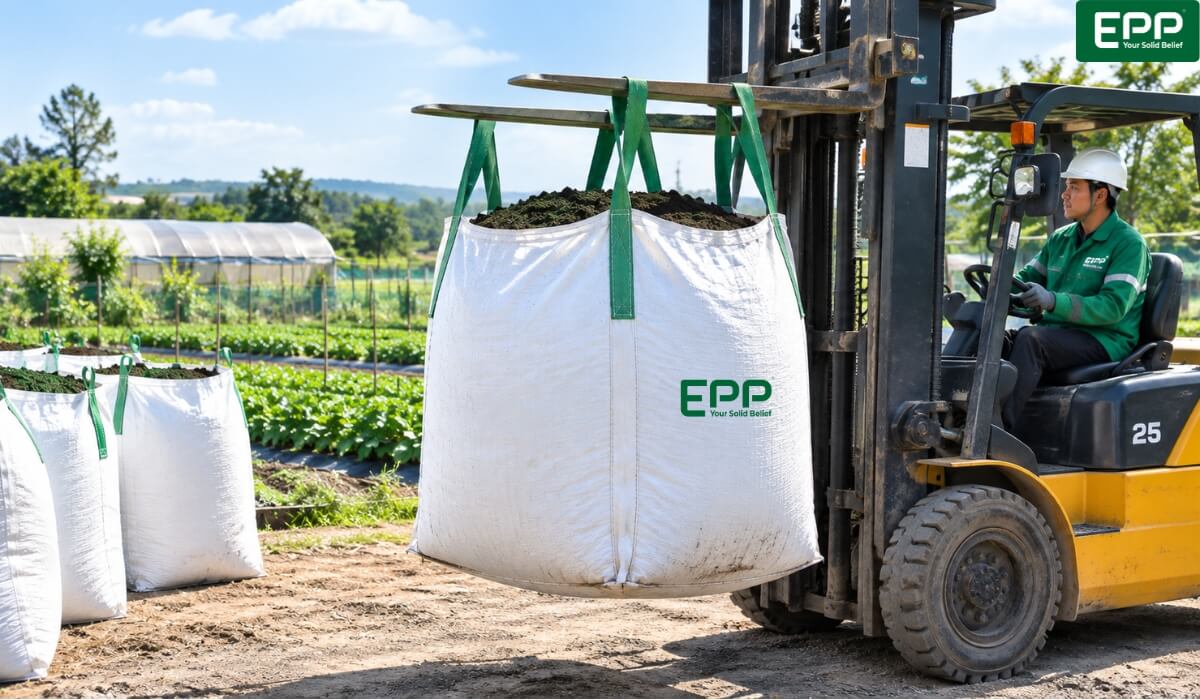
Forklift transporting a heavy-duty FIBC jumbo bulk bag for soil.
FAQs About Soil Ton Bags and Small Soil Bags
Is a soil ton bag always one tonne?
Not always. While the term “ton bag” commonly refers to an FIBC bulk bag with dimensions around 90 x 90 x 90 cm designed to hold roughly 1,000 kg, the actual filled weight depends entirely on the soil’s bulk density and moisture level. Dry potting soil in a standard bulk bag may weigh only 700 kg – 800 kg, whereas saturated topsoil or wet clay in the exact same bag can exceed 1,400 kg.
Can soil bulk bags be stored outside?
Yes, provided they are produced using UV-stabilized woven polypropylene. EPP Vietnam’s UV-treated FIBC soil bags resist degradation under sunlight for extended periods. However, for long-term outdoor storage, covering bags with a tarp is recommended to prevent rain from excessively dampening the soil inside.
How many 25kg soil bags are in a ton bag?
There are exactly 40 individual 25kg soil bags in a 1,000kg (1 metric tonne) bulk bag.
Are soil ton bags cheaper than small soil bags?
Yes. For commercial purchases exceeding 1.0 m³ of soil, Soil Ton Bags cost significantly less on a per-ton basis. They reduce overall packaging production costs by about 25% and drastically lower labor expenses associated with offloading and manual bag slicing.

Final Recommendation: Make the Right Choice for Your Operations
When evaluating Soil Ton Bags vs. Small Soil Bags, the business conclusion is straightforward: Soil Ton Bags cost significantly less per metric ton for commercial landscaping, construction projects, and bulk agricultural distribution due to reduced packaging materials, lower freight costs, and faster mechanical handling. Small soil bags remain ideal primarily for retail garden centers and manual DIY applications.
Ready to lower your bulk soil packaging costs?
Contact EPP Vietnam today to receive factory-direct pricing, request free FIBC samples, and consult with our technical packaging engineers:
Website: epp.vn
Alibaba website: https://eppvietnam.trustpass.alibaba.com/
Email: [email protected] Hotline/ Whatsapps: +84 986 002 888