Standard industrial FIBCs cannot meet the stringent hygienic criteria needed for direct food contact. Using non-compliant packaging risks severe chemical contamination, foreign body infestation, and costly batch recalls that destroy brand reputation.
Whether you are a procurement manager or QA director, sourcing high-quality Food Grade Bulk Bags requires a deep understanding of international safety regulations. In this comprehensive guide, EPP Vietnam breaks down technical specifications, hygiene standards, and global compliance guidelines for food grade FIBC packaging.
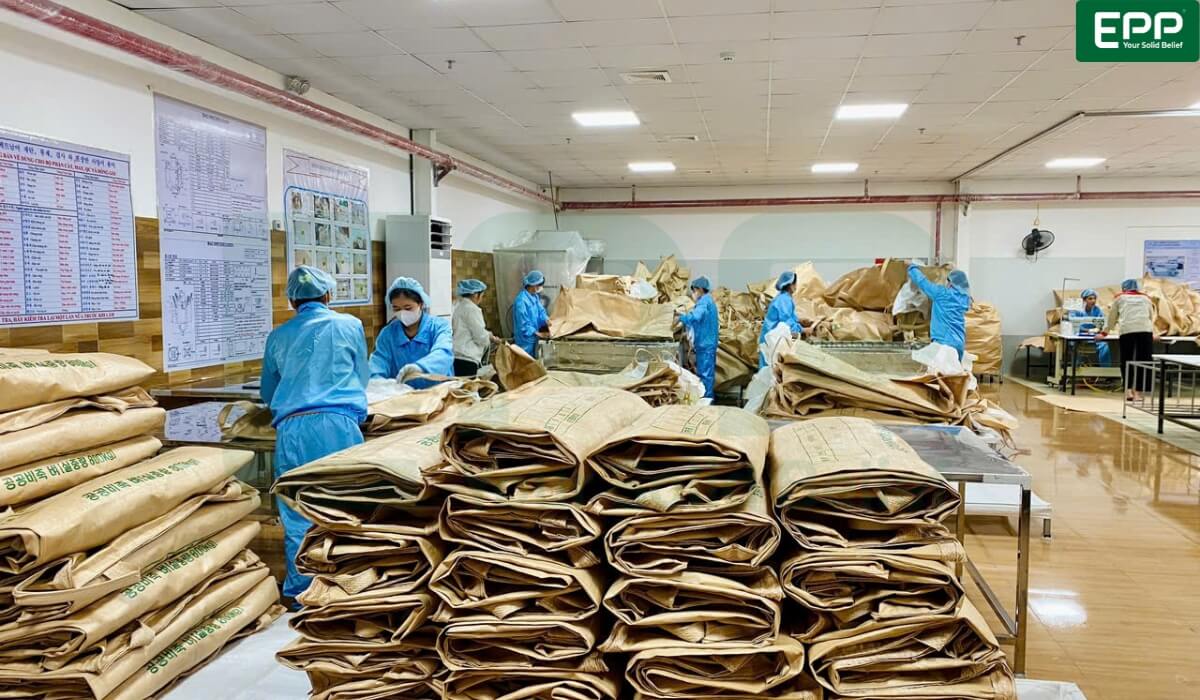
Cleanroom manufacturing and inspection floor at EPP Vietnam adhering to BRCGS food-safety standards
What Defined True Food Grade Bulk Bags?
Not every big bag is suitable for raw ingredients. A true food grade bulk bag must strictly adhere to specific raw material standards and hygienic manufacturing conditions to prevent contamination.
1. 100% Virgin Polypropylene Resin
A compliant food grade FIBC must be manufactured exclusively from 100% virgin polypropylene bulk bags material. No recycled plastics (regrind resin) or unapproved additives are permitted. This guarantees that food contact polypropylene bulk bags do not leach harmful heavy metals or unknown chemical residues into your product.
2. FDA Compliant Bulk Bags & Raw Material Standards
All raw polymers, color masterbatches, and anti-UV additives used in food-safe bulk bags must meet strict regulatory frameworks. This includes FDA compliant bulk bags guidelines under FDA 21 CFR 177.1520, as well as EU food contact FIBC regulations under EU 10/2011 FIBC standards for migration limits.
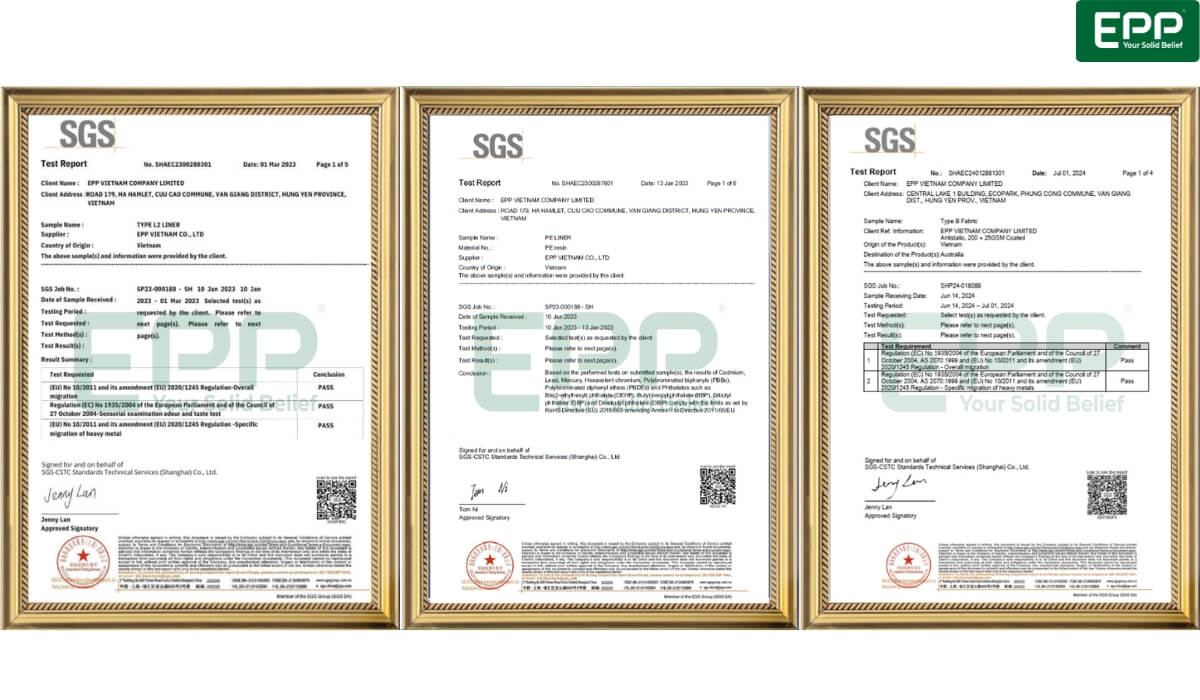
Some Food-grade Certificates from EPP Vietnam
3. Hygienic Cleanroom Manufacturing
A true cleanroom FIBC is produced in a fully enclosed, positive-pressure facility equipped with air filtration. Workers must wear full protective clothing, hairnets, and pass through air showers to enter the production floor. This rigorous contamination control prevents pest intrusion, human hair, dust, and airborne debris from entering the food grade jumbo bags.
Key Food Safety Certifications You Must Verify for Food Grade Bulk Bags
When choosing a food grade bulk bag supplier, relying solely on self-declarations is a major risk. You must audit and verify international third-party certifications and laboratory compliance reports.
| Certification / Testing | Scope & Regulatory Body | Primary Application | Key Compliance & Testing Criteria |
| BRCGS Packaging Materials | Global Standard (GFSI Recognized) | High-care direct food contact packaging | Evaluates facility hygiene, cleanroom standards, and hazard control (Grade A/AA required). |
| FSSC 22000 / HACCP | ISO 22000 & ISO 22002-4 | Risk management in food ingredient packaging | Implements preventive measures against physical, chemical, and biological contamination. |
| FDA 21 CFR 177.1520 / EU 10/2011 | US FDA & European Union Plastics Directives | FDA food contact FIBC & EU food contact FIBC | Mandates 100% virgin PP polymers and establishes strict overall migration limits (OML). |
| Overall Migration Testing (OMT) | EN 1186 / FDA Extraction Standards | Chemical safety & non-transfer verification | Lab testing verifying chemical transfer to food simulants stays well below allowable limits (< 10 mg/dm²). |
| RoHS & Heavy Metal Testing | EU Directive 2011/65/EU & CONEG Limits | Heavy metal risk enforcement in food grade FIBC bags | Guarantees total concentration of Lead, Cadmium, Mercury, and Hexavalent Chromium is below 100 ppm. |
| Food Contact Declaration FIBC | Quality Assurance Documentation | Regulatory verification for global shipments | Official declaration backed by lab-verified migration testing FIBC and heavy metal test reports. |
Critical Engineering Features for Food-Grade FIBCs
Engineering a reliable food grade super sacks system involves specialized features designed to prevent powder leakage and contamination.
1. Ultrasonic Fabric Cutting & Metal Detection
To eliminate thread fraying, premium Food Grade Bulk Bags use ultrasonic cutting blades that seal fabric edges automatically. Furthermore, every completed super sack passes through sensitive in-line metal detectors to guarantee zero metallic fragments remain inside.
2. Sift Proof Seams for Fine Powders
Preventing leakage of fine powders like starches, milk powder, or spices requires specialized sift proof seams. Manufacturers use felt cord or specialized filler cord stitching along the seams to seal microscopic needle holes.
3. Food Grade PE Liner & Barrier Options
For hygroscopic products, inserting a food grade PE liner or food contact liner is mandatory. Options include:
- Form Fit Liner: Shaped precisely to the internal dimensions of the food-safe FIBC, eliminating folds and maximizing discharge speed.
- Aluminum Foil Liner: Provides maximum moisture, oxygen, and light barriers for sensitive ingredients.

How to Match Food Products with the Right FIBC Design?
Selecting the optimal custom Food Grade Bulk Bags depend entirely on the physical characteristics of your product.
1. Fine Powders (Powdered Milk, Flour, Cocoa, Starch)
Fine materials require tight dust containment. The ideal configuration includes a hygienic FIBC with sift proof seams paired with a form fit liner or food-grade liner. Using a food grade bulk bag with an inflatable spout clamp connection ensures dust-free filling and unloading.
2. Granular & Solid Foods (Sugar, Salt, Beans, Seeds)
Free-flowing solids perform exceptionally well in standard food grade jumbo bags. A 4-panel or U-panel food grade FIBC manufacturer specification with an uncoated fabric and standard discharge spout allows smooth gravity flow.
3. Space-Optimized Storage (Baffle Food Bags)
When shipping long distances in sea containers, baffle food bags (Q-bags) utilize internal fabric baffles to maintain a square shape after filling. This prevents bulging, increases container space utilization by up to 25%, and provides exceptional stability for bulk bags for food products.
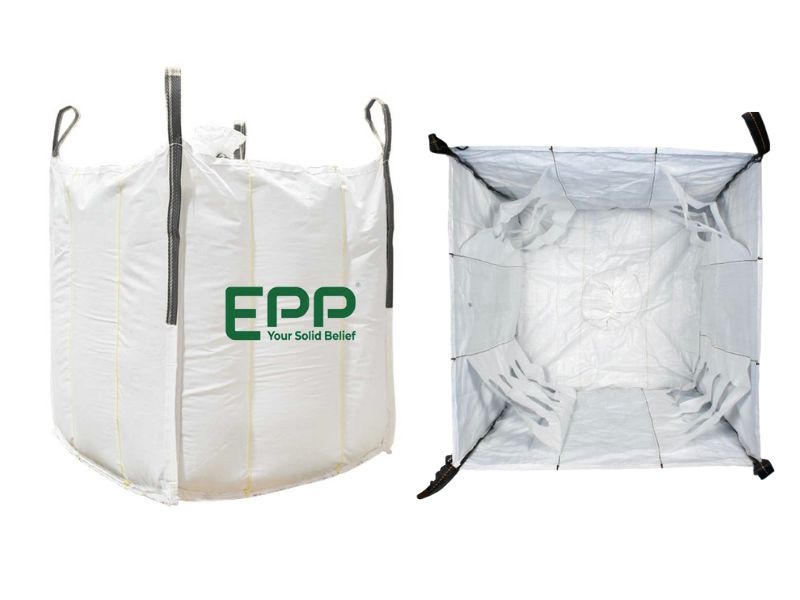
Space-saving baffle bulk bags maintaining structural shape for efficient container loading.
Verification Checklist for QA & Procurement Managers
Before issuing a purchase order to a food grade bulk bag supplier, your QA team should verify the following food grade bulk bag specifications:
- Verify Facility Certification: Ensure the manufacturing facility holds a valid BRCGS or FSSC 22000 certificate. Note: Confirm the certificate covers the specific manufacturing site.
- Review Material COA: Request a Certificate of Analysis confirming 100% virgin resin and FDA compliant bulk bags raw materials.
- Inspect Batch Traceability: Confirm that every food grade bulk bag features a unique lot number for complete batch traceability from resin to final delivery.
- Validate Migration & Heavy Metal Reports: Check third-party lab results for overall migration limits and RoHS heavy metal thresholds (< 100 ppm).
Common Pitfalls When Sourcing Food Grade Bulk Bags
Confusing Facility Certification with Product Approval: A common error is assuming any bag made by a certified factory is automatically food grade. Always verify that your specific food grade FIBC bags were produced under full cleanroom protocols.
Ignoring Sift-Proofing for Fine Powders: Ordering bulk bags for food ingredients without sift proof seams or an internal bulk bag liner leads to dust leakage, loss of product, and potential contamination during shipping.
Choosing Price Over Traceability: Sourcing low-cost bags without clear batch traceability can compromise your entire supply chain if a quality audit occurs.

Frequently Asked Questions (FAQs)
What is the difference between standard bulk bags and food grade bulk bags?
Standard bulk bags are intended for non-edible industrial materials and may contain recycled resins. In contrast, a food grade bulk bag is made exclusively from 100% virgin PP resin in a certified cleanroom environment (BRCGS/FSSC 22000), ensuring strict contamination control and zero chemical leaching.
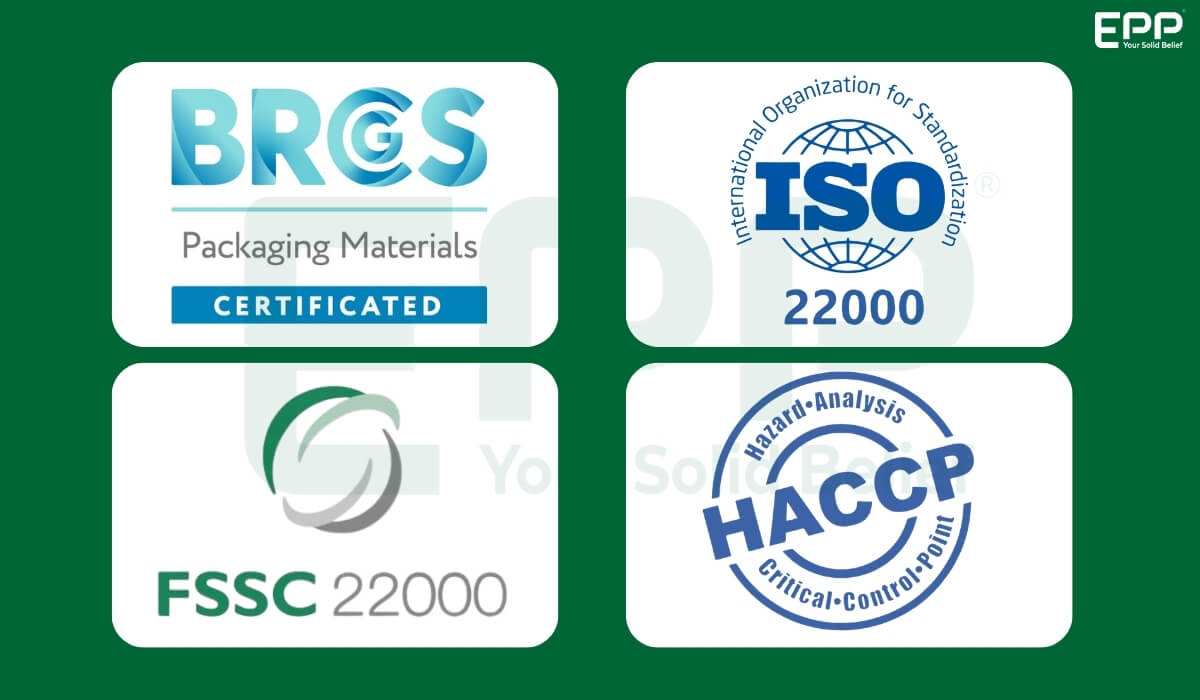
List of certification for food-safe packaging
Does BRCGS certify the individual FIBC bag or the manufacturing facility?
BRCGS certifies the manufacturing facility’s hygiene systems, cleanroom protocols, and management processes—not the individual bag itself. Buyers must ensure their chosen food grade FIBC supplier manufactures their specific order within that certified facility.
Can food grade bulk bags be reused?
While heavy-duty multi-trip FIBCs exist, food safety compliance standards strongly advise using single-trip food grade super sacks (SF 5:1) for direct contact with ingredients to eliminate cross-contamination risks between batches.
Do Food Grade FIBC Bags Need a Liner?
Not always. Granular products like sugar or beans can be loaded directly into a coated or uncoated food grade FIBC. However, fine powders or moisture-sensitive ingredients require an internal FIBC liner, food grade PE liner, or form fit liner to ensure total moisture protection and dust containment.
Partner with EPP Vietnam for Certified Food Grade FIBC Solutions
Sourcing reliable food grade bulk bags for food ingredients requires complete transparency, strict quality assurance, and uncompromised compliance. As a premier global packaging supply partner, EPP Vietnam connects international food processors with top-tier, certified manufacturing facilities across Vietnam.
We provide full QA oversight, independent audit verification, and customized food grade FIBC bags designed specifically to protect your products and pass every food safety audit.
🌐Website:https://epp.vn// https://eppvietnam.trustpass.alibaba.com/
📲Contact us: +84 986 002 888 – [email protected]