Accurately calculating bulk bag coverage and weight is an essential operational requirement for civil engineering contractors, commercial landscapers, and building material distributors. Determining the precise balance between material volume, density, and physical footprint prevents job site delays, eliminates costly material overruns, and optimizes shipping logistics.
Beyond site calculations, understanding how heavy aggregates interact with flexible packaging is critical for logistics safety. Selecting an improperly rated container for dense materials like moist sand or crushed granite risks structural failure during transport or overhead crane lifting.
How to calculate Bulk Bag Coverage and Weight for aggregates?
What Is a Bulk Bag and Standard Industry Specifications?
A bulk bag—also known as a jumbo bag, FIBC, or big bag—is an industrial-grade flexible container manufactured from woven polypropylene (PP) fabric. Designed to hold and transport dry flowable materials, these heavy-duty containers are widely available as specialized mini bulk bags for sale and large-format FIBCs, effectively replacing traditional rigid drums across global supply chains.
Commercial packaging specifications vary by region and material type:
- 800 kg to 850 kg Bags: The standard weight rating across European and UK builders’ merchants. Often referred to as “half-tonne” or “mini-bulk” equivalents, these bags are optimized for domestic delivery vehicles fitted with lighter crane arms.
- 1 Metric Tonne (1,000 kg) Bags: The global industrial standard. Engineered to hold 1,000 kg (2,204 lbs) of high-density aggregates, topsoil, or industrial minerals.
- US Short Ton (2,000 lbs) Bags: Standard across North American supply chains, matching regional DOT axle-weight regulations.
Every commercial big bag must display a certified SWL (Safe Working Load) rating alongside its SF (Safety Factor). Single-trip bags typically carry an SF rating of 5:1 (tested to withstand five times their rated SWL before structural failure), whereas multi-trip reusable bags demand a 6:1 rating.
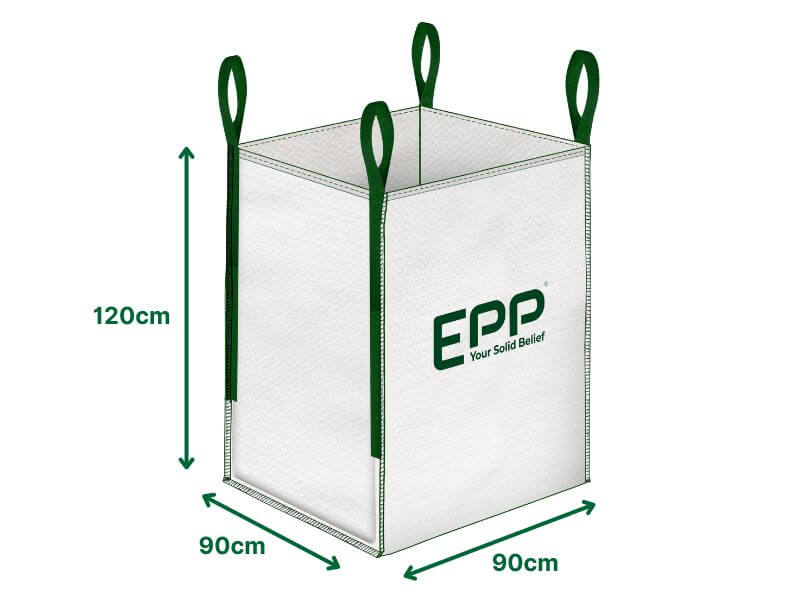
Standard 1000kg FIBC Bulk Bag specifications and dimensions.
Understanding Bulk Bag Coverage and Weight Across Common Aggregates
Calculating material coverage requires balancing three interconnected variables: bag weight, material bulk density, and applied depth. Because different aggregates feature varying particle sizes, moisture contents, and compaction rates, a one-tonne bag of pea gravel will cover a significantly different surface area than a one-tonne bag of damp sharp sand.
Evaluating bulk bag coverage and weight starts with identifying the bulk density of the specific material being spread. Loose, dry materials occupy more volume per tonne, whereas fine, saturated materials pack tightly and add significant deadweight. If you are budgeting for landscape or site preparation projects, reviewing overall material expenses like how much bulk bags of gravel cost is essential for accurate forecasting.
How Much Does a Bulk Bag of Stones Cover?
For decorative stones, river pebbles, and crushed slate, coverage depends directly on the lay depth. When asking how much does a bulk bag of stones cover, the industry standard for decorative garden stones (10mm to 20mm particle size) is a depth of 50mm (2 inches).
At this standard 50mm depth:
- An 850 kg bulk bag of stones covers approximately 10 to 12 square meters
- A 1,000 kg (1 Tonne) bulk bag of stones covers approximately 13 to 14 square meters
If the stone is laid at a deeper 75mm (3 inches) layer—typically required for driveways or high-traffic footpaths to prevent sub-base exposure—coverage drops to approximately 6 to 7 m² per 850 kg bag.
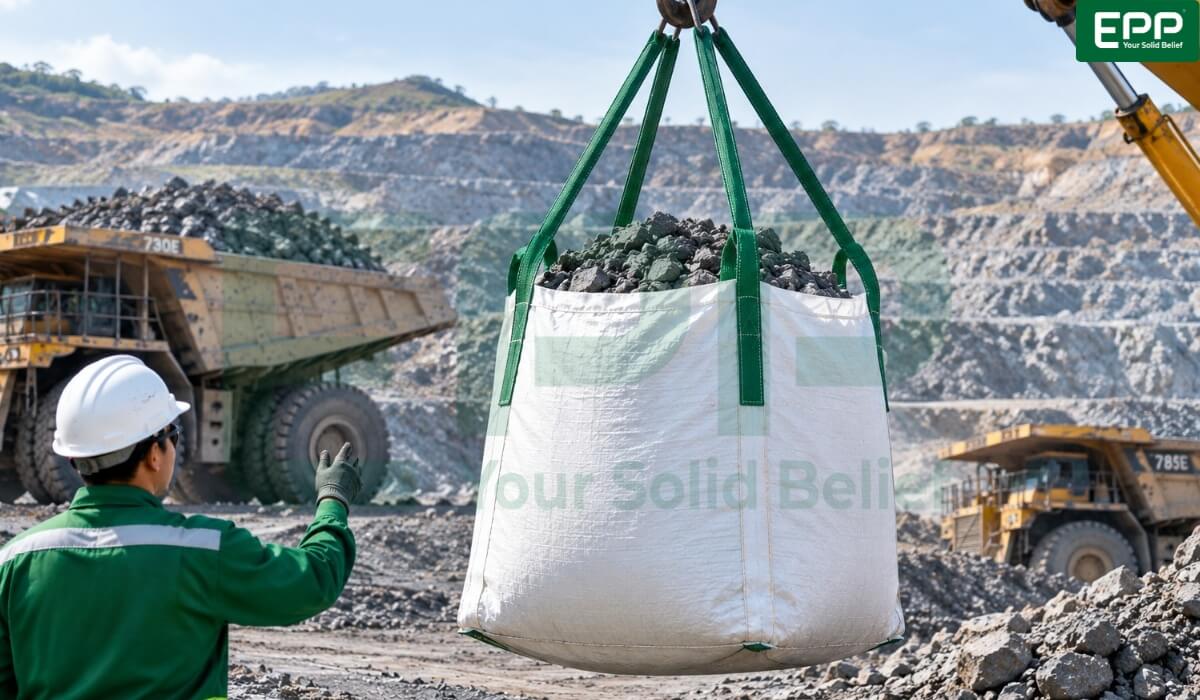
Filled bulk bag of stone for mining sector
Gravel & Sand Coverage and Weight Breakdown
Aggregate density dictates how much physical space a given weight will occupy:
How big is a bulk bag of gravel & coverage limits?
Decorative 20mm gravel has an average loose bulk density of 1.50 t/m³. A standard gravel bulk bag weighing 850 kg yields roughly 0.56 m³ of material. When determining gravel bulk bag coverage, an 850 kg bag covers roughly 11.3 m² at a 50mm depth.
How much does a tonne of gravel cover?
When calculating how much does a tonne of gravel cover, a full 1,000 kg (1 Tonne) bag spread at a 50mm thickness covers approximately 13.3 m².
How much gravel in a jumbo bag & sharp sand bulk bag weight?
Standard dry building sand weighs roughly 1.60 t/m³, but sharp sand bulk bag weight jumps to 1.90 t/m³ or higher when wet. Consequently, an 850 kg bag of moist sharp sand offers less physical volume (~0.44 m³) and covers only 8.5 to 9 m² at a 50mm depth (also referred to in logistics as big bag sand weight).
How many small bags of gravel/sand in a bulk bag?
Common procurement queries include how many bags of sand in a bulk bag or how many small bags of gravel in a bulk bag. Standard pre-packed retail sacks weigh 25 kg. Therefore:
- An 800 kg bulk bag equals 32 small 25kg bags.
- An 850 kg bulk bag equals 34 small 25kg bags.
- A 1,000 kg (1 Tonne) bulk bag equals 40 small 25kg bags.
For precise concrete or mortar mixing on site, contractors often calculate exact binder ratios, such as how many bags of cement to a bulk bag of sand.
| Aggregate Material | Average Bulk Density (t/m³) | 850 kg Bag Coverage (@ 50mm Depth) | 1,000 kg Bag Coverage (@ 50mm Depth) | 25kg Bags Equivalent (per 1t) |
| Decorative Gravel (10-20mm) | ~1.50 t/m³ | 11.3 m² | 13.3 m² | 40 bags |
| Crushed Limestone / Aggregate | ~1.60 – 1.90 t/m³ | 8.9 – 10.6 m² | 10.5 – 12.5 m² | 40 bags |
| Dry Building Sand | ~1.60 t/m³ | 10.6 m² | 12.5 m² | 40 bags |
| Moist Sharp Sand | ~1.90 t/m³ | 8.9 m² | 10.5 m² | 40 bags |
| Plum Slate Chipping | ~1.40 t/m³ | 12.1 m² | 14.2 m² | 40 bags |
Step-by-Step Mathematical Formula to Calculate Aggregate Coverage
To eliminate guesswork during site preparation, follow this standardized three-step calculation to determine total tonnage and required bulk bag counts.
Project specifications often require adjusting overall volume calculations to account for bulk bag coverage and weight variables such as material settling, site compaction, and ground absorption.
Step 1: Calculate Surface Area and Volume
Measure the project length and width in meters to find total area, then convert the desired layer depth from millimeters to meters (e.g., 50mm = 0.05m).
Volume (m³) = Length (m) x Width (m) x Depth (m)
Example: A driveway measuring 10m long by 4m wide requiring a 50mm gravel layer:
10m x 4m x 0.05m = 2.0 m³ of material
Step 2: Convert Volume to Weight Based on Bulk Density
Multiply the total volume by the density factor of your chosen aggregate.
Weight (Tonnes) = Volume (m³) x Bulk Density (t/m³)
Example: Using gravel (1.5 t/m³):
2.0 m³ x 1.5 t/m³ = 3.0 Metric Tonnes
Step 3: Apply Compaction and Sub-Base Loss Buffer
Aggregates settled under roller compaction or laid onto soft soil fill microscopic voids, reducing effective coverage height. Always add a 10% to 15% wastage buffer:
3.0 Tonnes x 1.10 = 3.3 Tonnes total requirement
Final Order: Purchase 4 x 1,000 kg Bulk Bags or 4 x 850 kg Bulk Bags (rounded up to ensure complete coverage).
The Impact of Material Density on FIBC Packaging Integrity
While end-users focus on ground coverage, packaging engineers and material shippers must evaluate how material behavior impacts container safety. The physical properties of heavy aggregates place severe mechanical stress on woven polypropylene structures.
Analyzing bulk bag coverage and weight requirements helps packaging designers select the appropriate fabric weight (GSM) and seam construction to handle dynamic stresses during transport.
Fabric GSM & Coating Selection
Heavy Sand, Gravel & Stones require high-density fabric construction:
- Fabric GSM (Grams per Square Meter): Heavy construction materials (density > 1.5 t/m³) demand uncoated woven fabric ranging from 160 GSM to 220 GSM. Higher GSM values prevent tear propagation when jagged, crushed stone edges shift during transport.
- Coated vs. Uncoated Fabric: Standard dry aggregates use breathable uncoated fabric. Fine sands or wet materials require a 15 to 30 GSM polypropylene lamination (coating) or an internal PE Polyethylene Liner (40–80 microns thick) to stop fine particles from sifting through seam micro-gaps and keep moisture out.
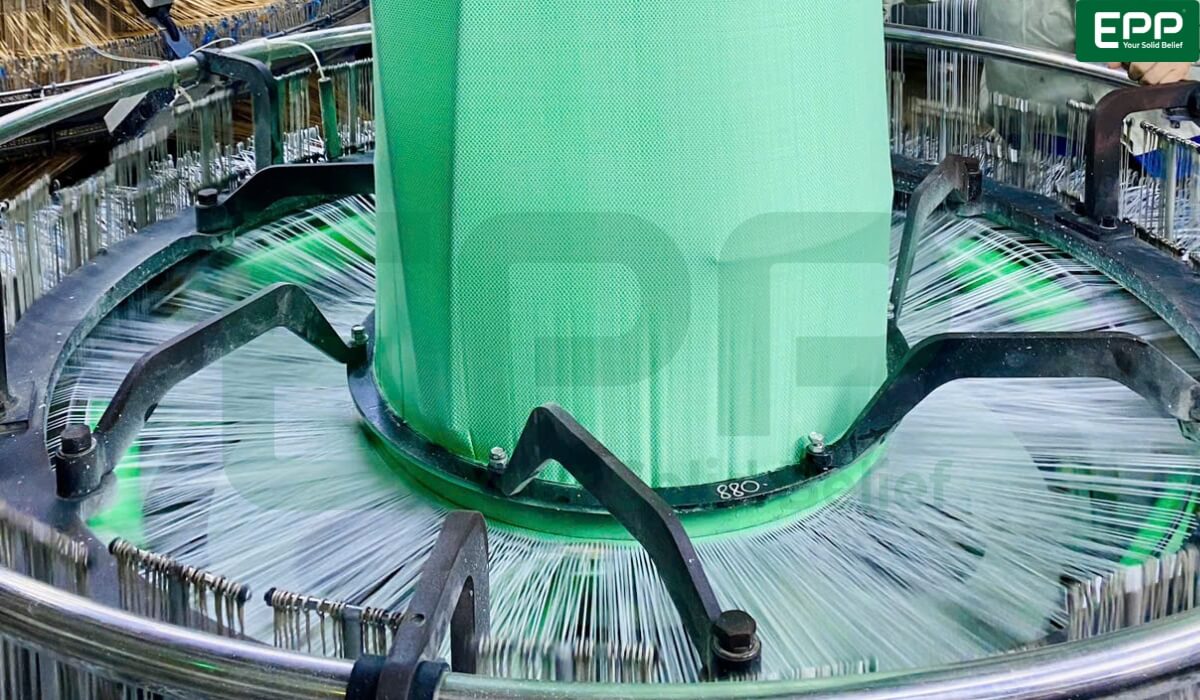
Heavy-duty woven polypropylene (PP) fabric structure
Loop Design and Structural Baffles
- Lifting Loop Configurations: Standard 4-loop bags (Corner Loops or Cross-Corner Loops) distribute structural weight evenly. Cross-corner loops—stitched across the corners of the bag body—remain standing upright, making them easier for forklift tines or crane hooks to engage on busy construction sites.
Ensuring International Quality & Compliance
Sourcing bulk bags of aggregates for export or industrial distribution requires strict adherence to international packaging standards. Selecting certified packaging ensures that bags will not burst under load or degrade under severe weather exposure.
Many global distributors evaluate manufacturing origins, turning to the top 3 global hubs for sand big bags to ensure cost efficiency and strict quality compliance. FIBC supplier must verify that bulk bag coverage and weight specs match certified safe working load limits before releasing bulk packaging into international freight channels.
International Standards & Testing Protocols
EPP Vietnam enforces strict technical compliance through certified partner manufacturing facilities:
- ISO 21898: The governing global standard for non-dangerous goods FIBCs. Mandates rigorous cyclical top-lift testing, compression stacking tests, and drop resistance tests.
- UV Stabilization (ASTM G154 ): Untreated polypropylene degrades rapidly under ultraviolet radiation. Commercial bulk bags incorporate 300-hour UV additive treatments to retain at least 50% of original tensile strength after prolonged outdoor storage.
EPP Vietnam Quality Assurance
As a leading global supply chain partner and sourcing controller, EPP Vietnam manages rigorous pre-shipment quality control. From testing raw PP resin tensile strength to verifying seam stitching density and factory UV dosing, EPP Vietnam ensures that every production batch meets strict international buyer specifications.
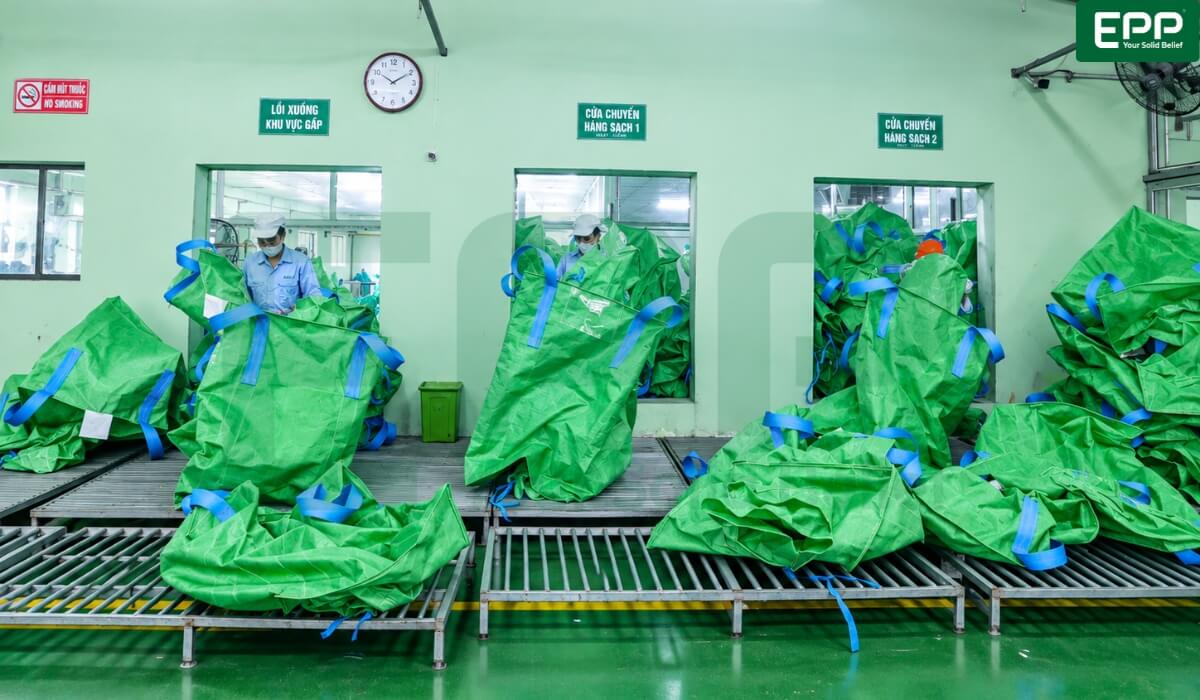
Quality Control Team before Shipment from EPP Vietnam
Frequently Asked Questions (FAQs)
How many bags of sand are in a bulk bag?
A standard 850 kg bulk bag contains the equivalent of 34 individual 25kg pre-packed sand bags. A 1,000 kg (1 Tonne) bulk bag contains exactly 40 individual 25kg bags.
What weight is a bulk bag of gravel?
When asking what weight is a bulk bag of gravel, in commercial trade a bulk bag typically weighs between 800 kg and 1,000 kg (1 Metric Tonne), depending on the supplier’s packaging standard and regional transport limits.
How much aggregate is in a bulk bag?
If you are wondering how much aggregate in a bulk bag or how much gravel in a jumbo bag, a standard 90 x 90 x 90 cm bulk bag holds approximately 0.6 to 0.75 cubic meters (m³) of material, depending on particle packing and moisture content.
What is the typical sharp sand bulk bag weight?
Commercial sharp sand bulk bag weight is usually packed to either 850 kg or 1,000 kg. Because sharp sand holds water easily, wet sharp sand is denser than dry sand, offering slightly less physical volume per bag at the same total weight.
Partner with EPP Vietnam for Optimized Bulk Packaging Solutions
Selecting the correct Bulk Bag Coverage and Weight requires a balance of material physics, structural bag engineering, and international supply chain compliance. Whether you are distributing building aggregates, packaging industrial minerals, or sourcing high-volume FIBC inventory, EPP Vietnam provides expert technical guidance and reliable, high-quality manufacturing oversight.
Contact EPP Vietnam’s technical packaging team to request custom FIBC specifications, review laboratory test reports, or receive a competitive quotation tailored to your global distribution requirements.
Website: epp.vn
Alibaba website: https://eppvietnam.trustpass.alibaba.com/
Email: [email protected] Hotline/ Whatsapps: +84 986 002 888