
1-ton sand bags—known across the construction trade as Flexible Intermediate Bulk Containers (FIBCs), super sacks—are the standard unitized delivery method for commercial masonry, municipal infrastructure, and aggregate supply. Yet, procurement officers and jobsite managers frequently debate a core question during budget planning: Are 1-ton sand bags truly cost-effective, or does the packaging overhead eat into project margins?
At first glance, buying engineered FIBC bags adds a direct packaging expense compared to tipping loose sand from a rear dump truck. However, experienced site managers understand that evaluating true project expenditure requires looking past the unit price of an empty bag. When factoring in material waste elimination, offloading speeds, crane staging, and site safety, 1-ton sand bags consistently lower total jobsite costs.
1. How Many Ways to Transport Sand?
Matching the sand delivery model to site access limitations and equipment availability is crucial for project budgeting. In commercial logistics, sand is transported using three primary methods:
Option 1: Loose Bulk Truckloads
Sand is loaded directly into the bed of a rear-tipping dump truck and dropped onto the ground at a designated staging area.
Operational Reality: There is zero packaging expense, and initial offloading takes seconds. However, delivery is strictly limited to where a heavy truck can drive. The resulting sand pile is immediately vulnerable to heavy rain washouts, wind drift, and ground contamination.
Option 2: Small 25kg / 50kg Sacks (50 lb Bags )
Sand is pre-bagged into plastic or multi-wall sacks, stacked on pallets, and shipped via flatbed trailers.
Operational Reality: Individual 25kg sacks are easy for workers to carry through doorways or up stairwells. However, moving 1 ton of material requires manually handling, carrying, cutting, and disposing of 40 individual sacks—a labor-intensive process that inflates jobsite payroll hours.
Option 3: 1-Ton FIBC Bulk Bags
Sand is unitized in heavy-duty 1 ton woven polypropylene containers (800kg to 1000kg) and transported on flatbed trailers equipped with hydraulic boom cranes or telehandlers.
Operational Reality: A crane truck can lift 1-ton sand bags over perimeter fences, onto upper scaffold decks, or directly next to mortar mixing stations. While mechanical lifting equipment is required on site, manual handling is virtually eliminated
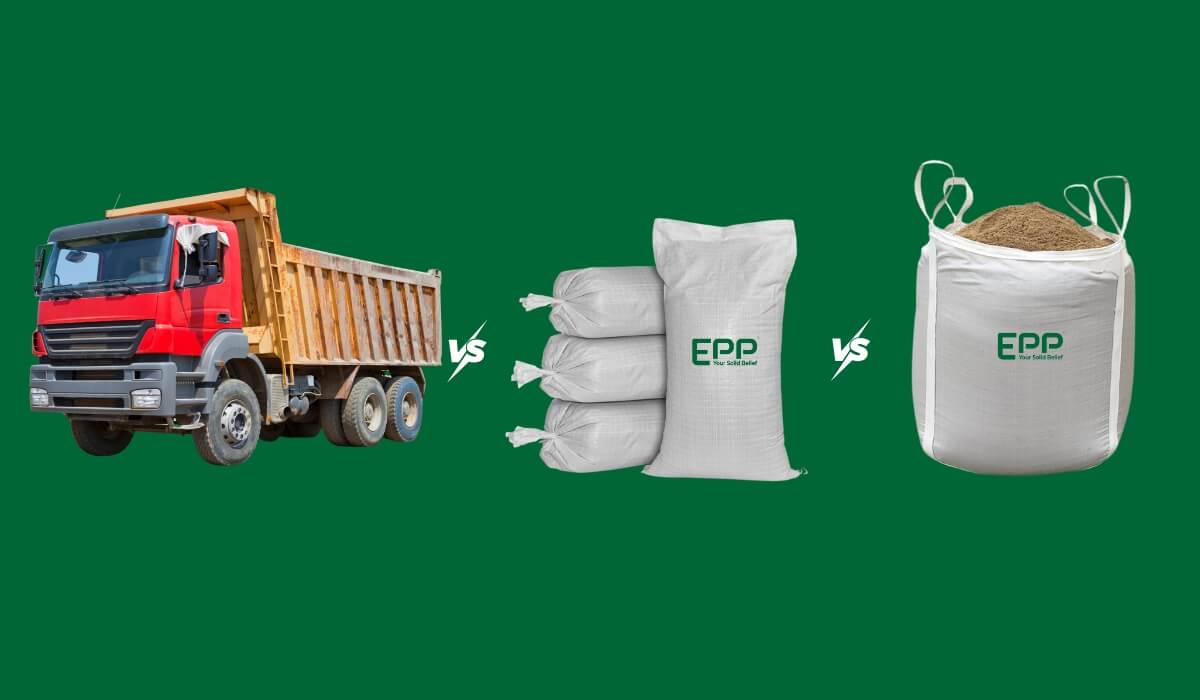
Three standard jobsite methods for delivering and staging sand
2. Upfront Price vs Total Jobsite Cost of 1-Ton Sand Bags
A frequent mistake in aggregate procurement is confusing unit bag cost with Total Cost of Ownership (TCO) on the jobsite.
The Initial Packaging Cost
An industrial 1-ton FIBC bag typically costs $3.00 to $6.00 USD at wholesale, depending on fabric GSM (140-220GSM), loop configuration, coating, and UV protection. Comparing a $3.00–$6.00 packaging fee per ton against loose aggregate (which carries a $0 packaging fee) gives the false impression that bulk bags are expensive.

Using heavy-duty 1-ton sand bags reduces manual shoveling labor
The Hidden Financial Losses of Loose Sand
Field audits across civil and commercial jobsites demonstrate significant hidden expenses associated with loose aggregate piles:
- Material Washout & Spillage Loss: On open construction sites, 10% to 20% of loose tipped sand is permanently lost. Rain sweeps fine sand into storm drains, wind blows away dry dust, and heavy machinery crushes the bottom layer into underlying soil.
- Manual Cleanup & Labor Overhead: Scattered sand clogs driveways and access corridors. Site managers must assign workers to shovel scattered sand back into piles and sweep pavements to avoid local municipal fines.
- Contaminated Inventory: Once loose sand mixes with mud, clay, or gravel at the base of the pile, it fails quality specifications for high-grade mortar or concrete and must be discarded.
When factoring in a 15% loss alongside worker hours spent shoveling and cleaning, “cheap” loose sand often adds $12.00 to $20.00 per ton in extra jobsite overhead—far exceeding the initial $3.00–$6.00 cost of an FIBC bag.
3. Why 1-Ton Sand Bags Can Save Cost
Utilizing certified bulk bags for sand addresses critical jobsite bottlenecks by replacing manual shoveling with swift mechanical hoisting.
1. Accelerated Offloading & Crane Staging
A telehandler or boom crane operator can offload and position a 1-ton bulk bag in under 60 seconds. Moving that same volume using 25kg sacks requires workers to manually move 40 individual units, shifting labor away from actual construction work.
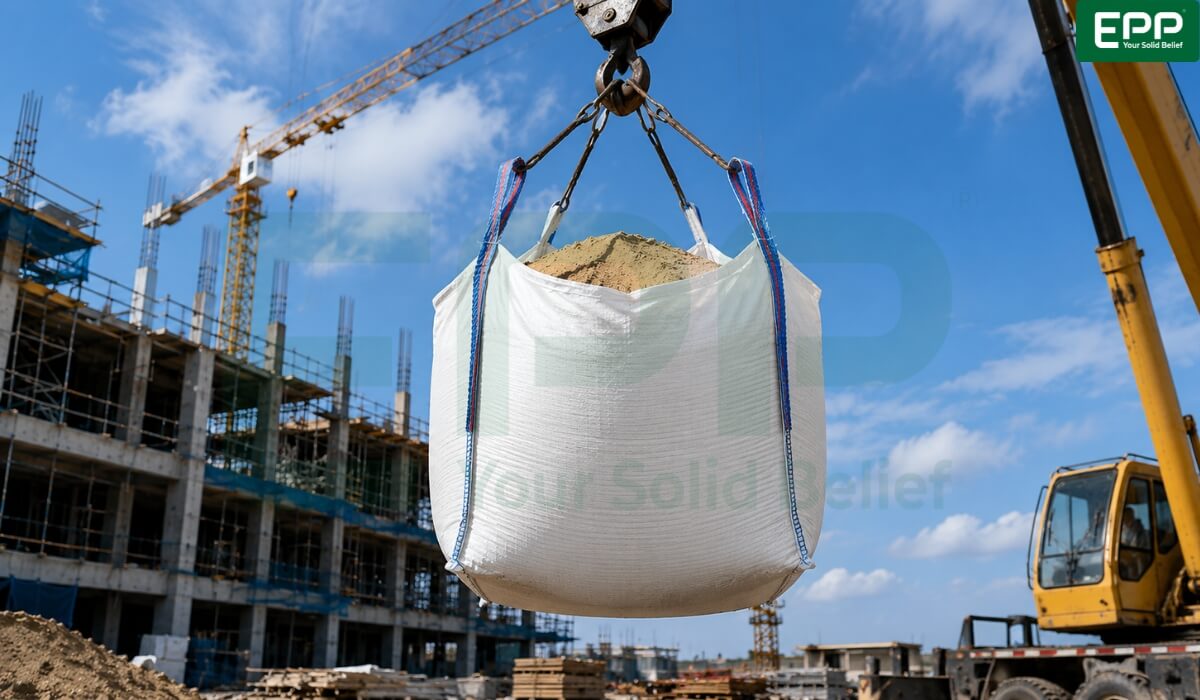
A crane hoisting a 1-ton FIBC sand bag for fast, precision staging on a jobsite
2. Complete Material Protection
Heavy-duty woven polypropylene insulates sand from rain and moisture. For coarse, sharp, or heavy aggregate, using reinforced sharp sand bulk bags prevents fabric fraying and punctures during transit.
3. Streamlined Batching & Mix Ratios
Pre-measured 1000kg bulk containers allow site supervisors to maintain consistent mix proportions without on-site scale weighing. To keep batching on schedule and eliminate guesswork, contractors frequently calculate how many bags of cement to a bulk bag of sand when staging materials near mixing plants.
4. Reduced Urban Site Penalties
In crowded city centers where street space is tight, loose sand piles often spill onto sidewalks and trigger municipal obstruction fines. 1-ton bulk bags keep aggregate contained within a compact 3×3 ft vertical footprint.
4. How to Buy 1-Ton Sand Bags at a More Competitive Price?
For aggregate suppliers, packaging distributors, and large contractors, buying 1-ton sand bagsthrough retail channels introduces multiple pricing markups. Sourcing packaging directly from experienced industrial manufacturers unlocks substantial cost savings.
1. Source Directly from Experienced FIBC supplier
Importing container-load quantities directly from high-volume production hubs cuts per-unit packaging costs by 30% to 50% compared to local distributor rates. Establishing a direct relationship with a specialized distributor like EPP Vietnam allows procurement teams to tailor fabric GSM, loop styles, and safety factors (5:1 single-trip vs. 6:1 multi-trip) to match specific delivery needs while trimming middleman margins.
To secure competitive unit pricing without sacrificing ISO 21898 quality standards, buyers frequently source from the top global hubs for builder bags for sand.
2. Optimize Specification & Fabric Weight (GSM)
Over-specifying bulk bags increases unit costs unnecessarily. Standard dry sand can be handled safely using uncoated 140GSM to 160GSM fabric with standard corner loops. Reserving heavy lamination, PE inner liners, or baffle structures for specialized dry chemicals or fine powders keeps baseline bag costs low.

3. Accurately Calculate Coverage & Container Freight
To maximize shipping container payload and avoid under-ordering, site planners should calculate bulk bag coverage and weight for sand, gravel & stones prior to finalizing factory purchase orders.
5. Summary & Final Verdict
Determining whether 1-ton sand bags are cheap or expensive requires looking beyond the cost of an empty bag to evaluate total project ROI.
| Feature / Metric | Loose Bulk Truckload | Small 25kg Sacks | 1-Ton FIBC Bulk Bags |
| Initial Packaging Unit Price | $0.00 | Low (Per individual sack) | Medium ($3.00–$6.00) |
| Offloading Method | Gravity Dump Tipping | Manual Hand Carry | Crane / Forklift Hoist |
| Staging & Handling Speed | Fast (Drop only) | Very Slow | Fast & Precise |
| Material Loss & Spillage | High (10%-20%) | Moderate (Torn sacks) | Near Zero ($0\%$) |
| Weather & Mud Protection | Poor | Moderate | High |
| Overall Jobsite ROI | Moderate | Low | Highest Overall |
Final Verdict
1-ton sand bags are not expensive—they are the most cost-effective aggregate transport method for modern construction logistics. While tipping loose sand appears cheaper upfront, the hidden costs of material washouts, manual shoveling, site cleanup, and lost time make loose sand far more expensive per installed ton. Utilizing certified 1-ton FIBC bulk bags protects material quality, speeds up jobsite staging, and maximizes total project profitability.
Partner with a leading FIBC bag supplier to secure factory-direct pricing, custom fabric GSM options, and dependable global shipping. Contact EPP Vietnam today to request technical product specifications, order custom sample swatches, or receive a competitive wholesale quote for your distribution supply chain.
Website: epp.vn
Alibaba website: https://eppvietnam.trustpass.alibaba.com/
Email: [email protected] Hotline/ Whatsapps: +84 986 002 888