Selecting the right FIBC bags for resins—from virgin pellets to fine powders—is a critical engineering decision to prevent static explosions, fiber contamination, and moisture degradation. As a leading FIBC bag supplier in Vietnam, EPP Vietnam connects global plastics producers with an audited Southeast Asian manufacturing network with over 20 years of industry leadership. We deliver custom, ISO-certified bulk packaging engineered to safeguard resin purity and optimize ocean container payloads.
Why Do Plastic Resins Demand Specialized FIBC Bags?
Plastic resins possess unique physical and chemical characteristics that make standard commercial bulk bags unsuitable for high-speed industrial handling.
High Electrostatic Discharge Risks During Pneumatic Transfer
Filling and discharging resin pellets or powders using pneumatic conveying systems generates significant friction. This rapid movement creates static electricity measuring thousands of volts. In environments containing combustible polymer dust or flammable solvent vapors, an ungrounded static spark can trigger catastrophic dust explosions. Compliance with IEC 61340-4-4 electrostatic safety standards is essential.
Zero-Tolerance for Fiber Shedding and Contamination
High-precision injection molding and thin-film extrusion demand 99.9% resin purity. Standard woven polypropylene (PP) fabric can shed loose fibers from raw cut edges during filling or discharge. If a single PP fiber enters a resin melt stream, it can block extruder nozzles, weaken structural integrity, or cause costly production shutdowns.
Moisture Sensitivity and Polymer Hydrolysis
Hygroscopic technical resins—such as Polyethylene Terephthalate (PET), Polyamide (PA/Nylon), Polycarbonate (PC), and Polyurethane (TPU)—absorb ambient moisture rapidly. If exposed to humidity exceeding 0.02% during ocean transit, these polymers undergo thermal hydrolysis during processing, destroying their mechanical properties.
Fluid-Like Bulging and Ocean Freight Inefficiency
Resin pellets act like fluid spheres under pressure. When loaded into standard non-baffled bulk bags, a 1,000 kg load pushes outward against the fabric walls, causing the bag to bulge into a circular shape. Bulging FIBC bags for resins reduce ocean container space utilization by 15% to 20% and create dangerous instability during multi-tier warehouse stacking.
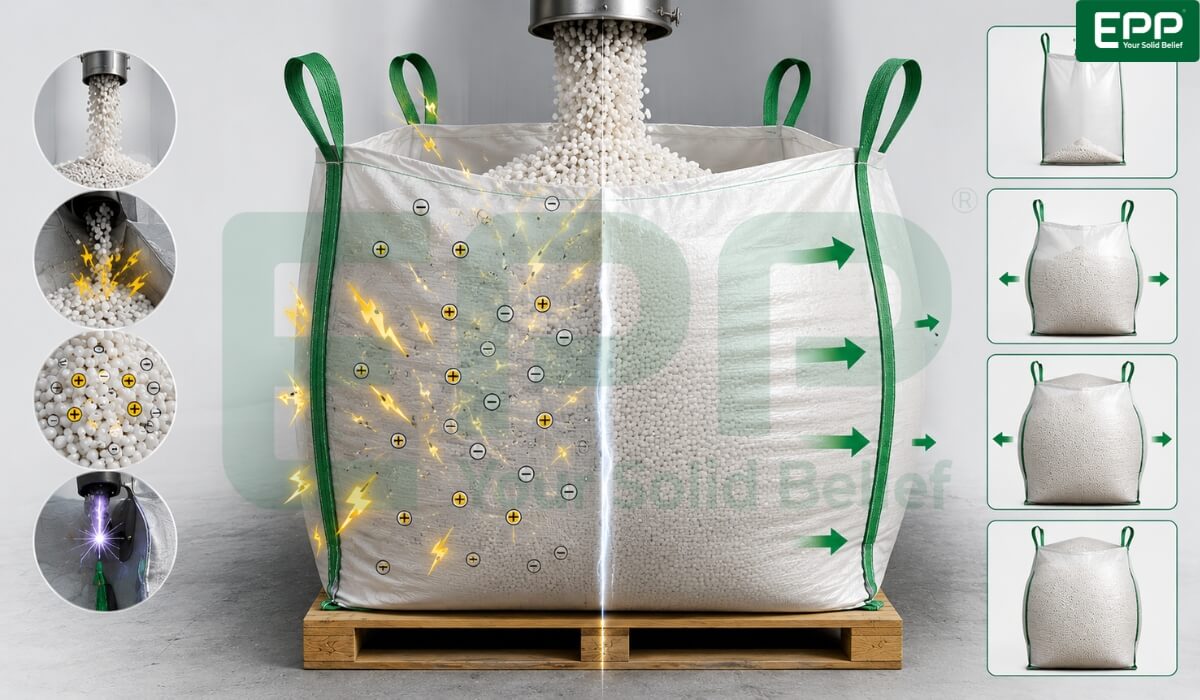
Static electricity generation and wall bulging dynamics when filling plastic resin into FIBCs
Core Structural Types of FIBC Bags for Resins
To safely store, transport, and discharge industrial plastic resins, FIBC bulk bags must be engineered with specific structural features to handle fluid-like pellet behavior, static electricity, fine powders, and moisture sensitivity.
Spout Top & Discharge Bottom Closures
Because plastic resins are packed, moved, and fed into processing machinery via automated, closed-loop systems, specialized filling and emptying mechanisms are standard requirements:
- Spout Top (Inlet Spout): Connects directly to automated resin filling chutes to maintain a dust-free, enclosed filling process.
- Discharge Bottom (Outlet Spout): Enables controlled, safe emptying into hoppers or pneumatic conveying systems without spilling raw materials or exposing workers to dust. Discover more tailored configurations in our custom spout top and discharge bottom jumbo bags.
Baffle Bulk Bags (Q-Bags) for Shape Maintenance
Free-flowing resin pellets naturally push outward against bag walls under pressure. Standard bulk bags bulge into an oval shape, wasting valuable space in shipping containers and creating warehouse stacking hazards.
- Internal Baffles: Fabric panels stitched across all four corners maintain a rigid, square footprint when fully loaded.
- Freight Optimization: Prevents wall bowing, maximizing payload capacity in 20ft and 40ft High-Cube shipping containers while enabling stable multi-tier warehouse stacking.
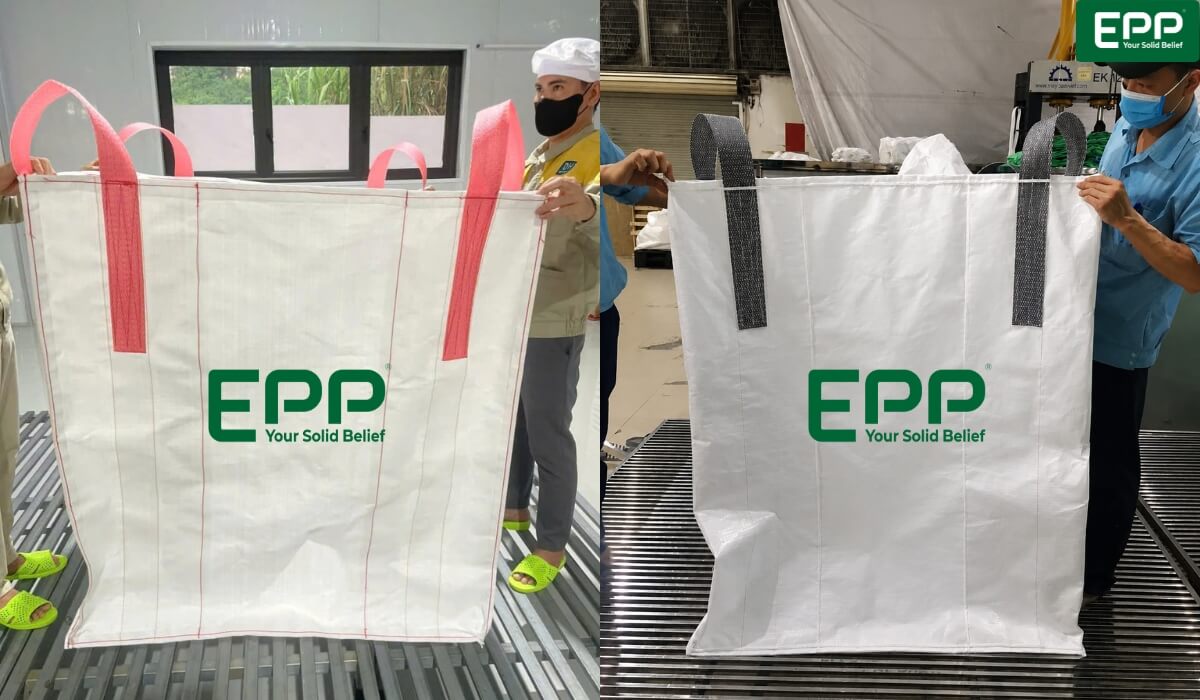
Baffle Q-bag from EPP Vietnam for maximizing sea container payload
Anti-Static FIBCs for Resin Powders
Handling plastic resins in fine powder form (such as PVC, PTFE, or specialty compounds) generates significant friction during pneumatic conveying, creating hazardous static electricity.
- Type B FIBC: Prevents high-energy brush discharges via a low-voltage coating (<6 kV). Ideal for dry, non-flammable resin powders.
- Type C FIBC (Groundable Conductive): Features interwoven carbon or silver threads that safely drain static charges to the earth (R < 10^8 Ohms) when grounded via dedicated tabs. Mandatory for flammable resin powders or solvent-heavy environments.
- Type D FIBC (Static Dissipative): Uses specialized crostran fibers to dissipate static electricity directly into the air via safe corona discharge without requiring a ground wire.
Barrier Liners for Maximum Protection
Hygroscopic technical polymers (such as PET, Polyamide/Nylon, and Polycarbonate) degrade quickly when exposed to ambient moisture or oxygen during long ocean transit.
- PE & Form-Fit Liners: Form-fitting internal polyethylene liners inside FIBC bags for resins isolate the resin from external moisture, dirt, and fine contaminants.
- Aluminum Foil Barrier Liners: Multi-layer metallic film liners provide near-zero moisture transmission rates (WVTR) to protect high-value, humidity-sensitive technical plastics. Learn more about choosing waterproof jumbo bags for moisture-sensitive polymers to protect critical material grades.
Matching FIBC Bag Specifications to Specific Plastic Resin Grades
Selecting the correct jumbo bag specification depends on resin geometry, purity requirements, and moisture sensitivity.
| Resin Category | Resin Examples | Primary Operational Risks | Recommended FIBC Specification |
| Commodity Virgin Pellets | LLDPE, HDPE, PP, PS | Wall bulging, freight volume loss, port delays | Baffle Q-Bag (Type A/B), Coated Fabric, Top Spout / Bottom Discharge, SWL 1,000 kg – 1,250 kg. |
| High-Purity / Food-Contact | Food-grade PET, Medical PP, Optical PC | Polymer contamination, loose PP fibers | Cleanroom Class 10,000 produced food grade bulk bags for resin, Ultrasonic Fabric Cut, Form-Fit PE Liner. |
| Hygroscopic Polymers | PET, PA/Nylon, PC, PBT, TPU | Hydrolysis, structural degradation from moisture | Baffle Bag with Form-Fit Aluminum Foil Liner, Heat-Sealed Bottom, Anti-Moisture Barrier. |
| Fine Polymer Powders | PVC Powder, PTFE, Fine Compounds | Dust explosion hazards, fine particulate sifting | Type C or Type D FIBC, Triple Sift-Proof Seam Thread (Felt/Cord), Swan-Neck Spout. |
Engineering high-volume tonne bags for global transport requires selecting appropriate Safe Working Loads (SWL) ranging from 500 kg to 2,000 kg, backed by a 5:1 (single-trip) or 6:1 (multi-trip) Safety Factor verified under ISO 21898 testing protocols.
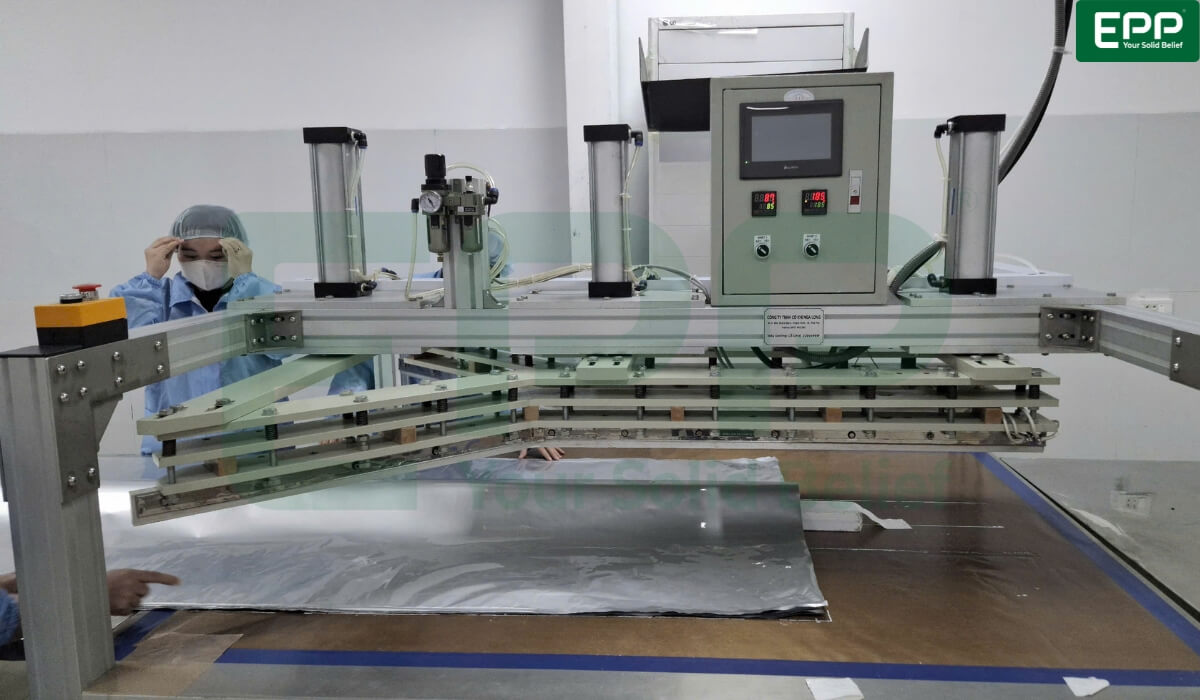
Producing aluminum liner for protecting hygroscopic resins from ambient humidity
FAQ about FIBC Bags for Resins
Q: Why should I choose Type C or Type D FIBCs instead of Type A for fine resin powders?
A: Fine polymer powders generate cloud dust during rapid filling. If static sparks occur, the dust cloud can ignite, causing an explosion. Type C (groundable) and Type D (dissipative) bags control static build-up, ensuring compliance with international ATEX and IEC safety directives.
Q: How do Baffle Bags (Q-Bags) reduce overall ocean freight costs for resin exporters?
A: Standard bulk bags bulge outward into an oval shape when filled with free-flowing pellets, leaving empty space in container corners. Baffle FIBC bags for resins maintain a square footprint, allowing shippers to fit more bags per container and maximize overall payload capacity.
Q: Can EPP Vietnam supply UN-certified bulk bags for hazardous resin compounds?
A: Yes. As Vietnam’s premier FIBC partner, EPP Vietnam supplies UN-certified FIBCs engineered for hazardous chemicals and polymer additives, tested to withstand drop, stack, tear, and top-lift stresses under international dangerous goods transport regulations.
Q: Are FIBC bags for resins recyclable after discharge?
A: Yes. Standard FIBCs made from 100% polypropylene (PP) are classified as Code 5 recyclable plastics. Bags equipped with un-laminated PP fabric and PE liners can be easily separated, washed, and re-pelletized into post-industrial recycled (PIR) resin. For closed-loop circular supply chains, EPP Vietnam offers 100% mono-material bag designs that streamline the recycling process without requiring manual component separation.
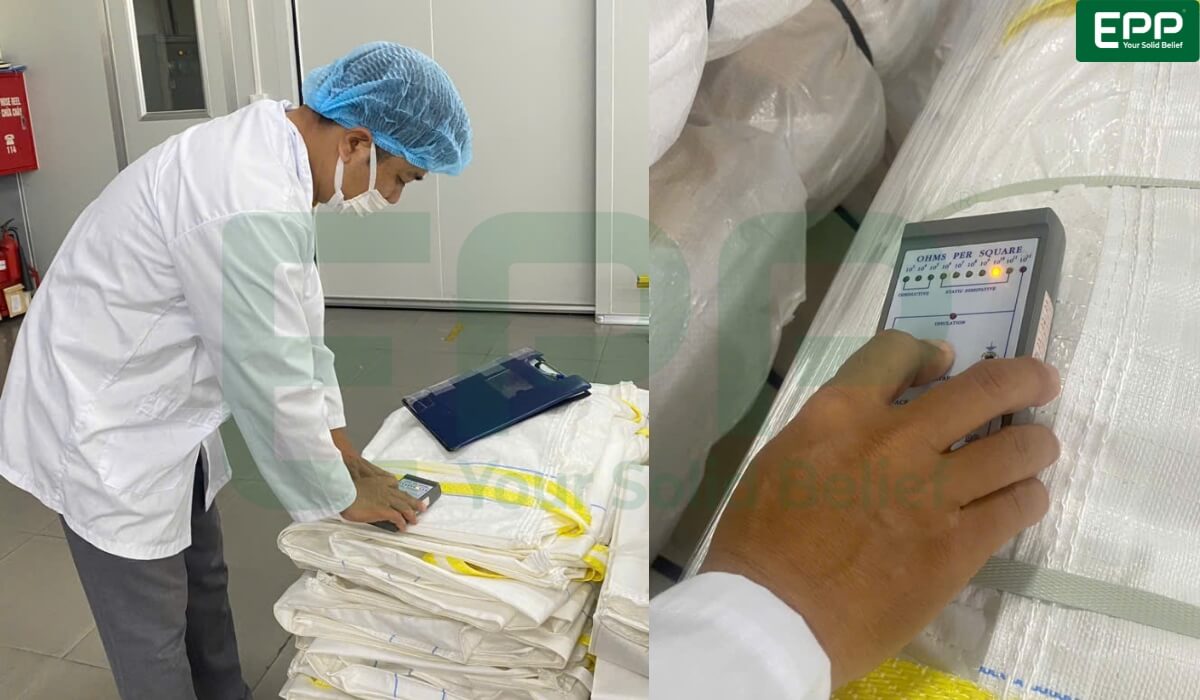
EPP Vietnam quality control engineer conducting static resistance test on Type D FIBC bag
Selecting the right FIBC bags for resins is more than an operational purchase—it is a strategic decision that protects raw material purity, safeguards facilities against static hazards, and optimizes global transport costs. From preventing fine-powder dust explosions with Type C and D conductive bags to maximizing ocean container space using Baffle Q-Bags, every technical specification directly impacts your supply chain performance and bottom line.
As the leading FIBC bag supplier in Vietnam, EPP Vietnam delivers end-to-end bulk packaging solutions tailored to the plastics industry. Backed by an audited network of certified manufacturing facilities holding ISO 9001:2015, BRCGS, ISO 22000, and UN certifications, we combine cleanroom precision with strict quality assurance to ensure your resin shipments arrive untainted and intact, anywhere in the world.
Ready to optimize your resin packaging strategy? Contact EPP Vietnam’s technical packaging engineering team today to review your material specifications, request custom samples, or receive a competitive B2B quote.
🌐 Website: https://epp.vn – https://eppvietnam.trustpass.alibaba.com
📲 +84 986 002 888 – [email protected]