
In global bulk logistics, choosing the wrong Flexible Intermediate Bulk Container (FIBC) specification can instantly disrupt factory throughput. A minor mismatch between an inlet configuration and a plant filling spout often results in severe powder dusting, material waste, static buildup hazards, or costly filling line downtime.
For procurement directors and packaging engineers across North America and global markets, optimizing bulk packaging begins at the top. Selecting the correct FIBC Bag Top Designs ensures seamless integration with automated filling equipment, protects sensitive raw materials from ambient contamination, and maintains workplace hygiene standards.
What is an FIBC Bag Top?
An FIBC bag top serves as the primary intake interface connecting your processing facility’s hopper, chute, or pneumatic filling arm directly to the interior volume of the bulk bag. It acts as the initial structural barrier controlling product flow, containment integrity, and filling stability.
Engineering the correct top specification requires balancing mechanical compatibility with material physics. At EPP Vietnam, our technical team works directly with plant managers to manufacture customized bulk bags tailored to specific automation requirements, safety factor ratings, and environmental exposures.
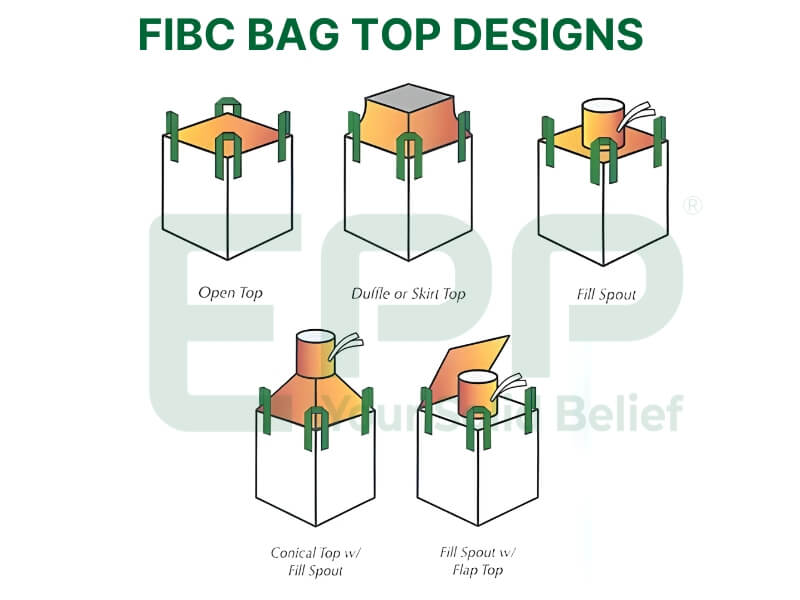
5 FIBC Bag Top Designs for various industrial filling systems
Why FIBC Bag Top Designs Matters?
Specifying an improper top entry format introduces several operational bottlenecks:
- Spill Resilience & Dust Mitigation: Ultrafine industrial powders (such as pharmaceutical APIs, starches, or calcium carbonate) easily escape through loose top closures, creating hazardous atmospheric dust concentrations and raw material losses.
- Filling Line Compatibility: Oversized or undersized inlet spouts cause mechanical binding, preventing pneumatic clamps from forming an airtight seal around the filling chute.
- Total Cost of Ownership : Over-specifying a complex top mechanism for low-grade aggregates wastes packaging budgets, while under-specifying for volatile chemicals invites product contamination and freight rejections.
Top 5 FIBC Bag Top Designs
1. Open Top
An Open Top bulk bag features an entirely unsealed upper boundary where the top edge of the four side panels forms a plain, hemmed opening without any cover fabric or spout attachment.
- Structural Features: Among other FIBC Bag Top Designs this is the simplest type; provides maximum unhindered access across the entire width of the container.
- Best For: Non-hygroscopic, low-value, or coarse materials such as construction scrap, gravel, metal turnings, and heavy agricultural waste.
- Filling Equipment: Ideal for manual shovel loading, overhead front-end loaders, or open-ended conveyor drop chutes.
- Pros & Cons: Offers the lowest initial purchasing cost per unit but provides zero protection against rainfall, ambient humidity, or dust emission.
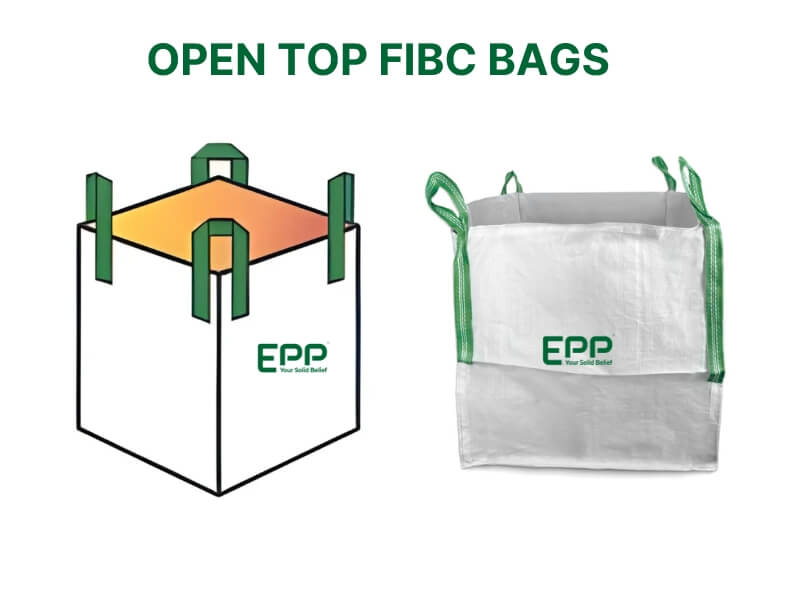
Heavy-duty polypropylene open-top FIBC bags with four lifting loops
2. Spout Top
A Spout Top incorporates a cylindrical fabric neck sewn directly into a flat top panel, forming a narrow, controllable entry point designed specifically for sealed filling operations.
- Technical Specs: Standard inlet spouts typically feature diameters ranging from 14-18 inches (35-45 cm) and lengths between 18-20 inches(45-50 cm). They feature specialized tie closures including swan-neck ties or drawstrings.
- Filling System Compatibility: Engineered specifically for high-speed automated and semi-automated filling lines equipped with inflatable spout seals or mechanical dust-collection collars.
- Performance Edge: To ensure zero dust migration during high-velocity filling, industrial facilities pair spout tops with high-grade coated polypropylene fabric produced under strict cleanroom conditions. To determine the right coating weight and fabric strength for your cargo, learn how to choose the correct fabric for FIBC bag configurations.
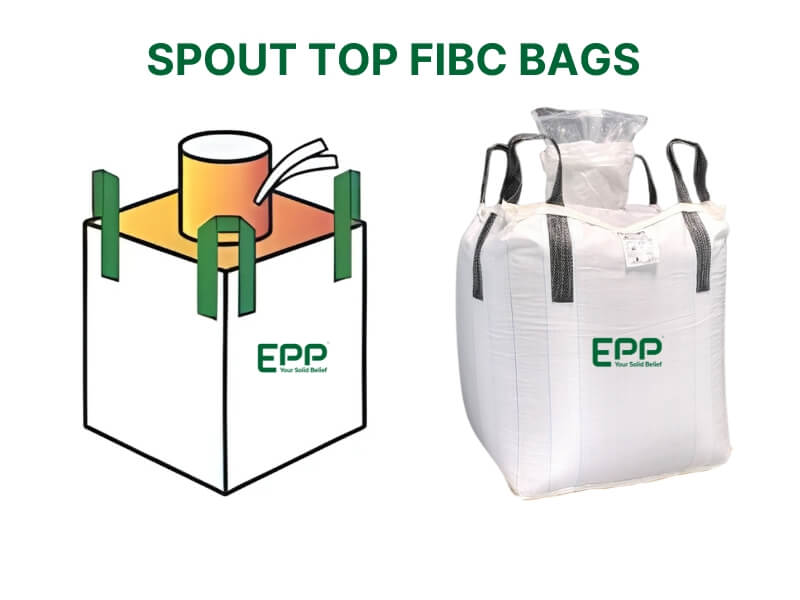
Spout-top jumbo bag engineered for secure, dust-controlled material filling
3. Duffle Top
A Duffle Top consists of a light-gauge polypropylene skirt sewn around the upper perimeter of the bag panels. The skirt opens to the full width of the bag base and features an integrated tie cord threaded through the top hem.
- Structural Features: Offers a flexible extended skirt—typically 20 to 30 inches (50-75 cm) in height—that pulls wide open during loading and folds down flat when tied shut.
- Best For: Operations handling inconsistent batch sizes, irregular bulk solids, or facilities lacking precise pneumatic spout alignment.
- Filling Equipment: Compatible with overhead hopper drops, gravity pipes, and semi-manual filling stations. While loading, operators ensure the lifting loops of FIBC bags are fully engaged on fork tines or automated hooks to maintain vertical stability during skirt closure.
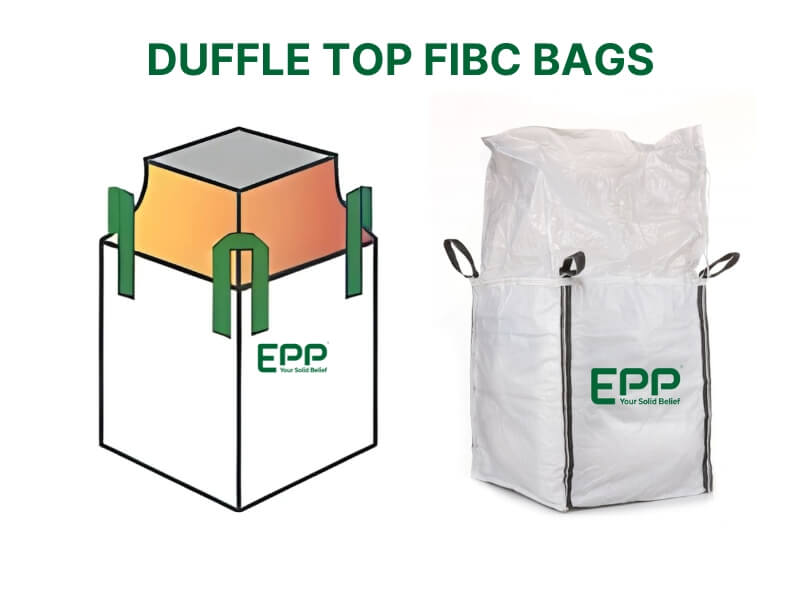
Duffle-top bulk bag designed for versatile loading and complete top protection
4. Conical Top
A Conical Top features a specialized dome-shaped upper panel that tapers inward toward a central filling spout, forming a cone structure above the square body of the bag.
- Structural Features: The angled geometry eliminates flat internal shoulders where cohesive powders naturally collect during filling.
- Best For: Ultra-fine, cohesive, or poor-flowing powders with high friction angles (such as hydrated lime, pigments, or fine starches) that tend to form bridges or crowns inside standard flat-top bags.
- Advantage: Maximizes volumetric fill density and maintains a clean, upright bag geometry for safe stacking during transit.
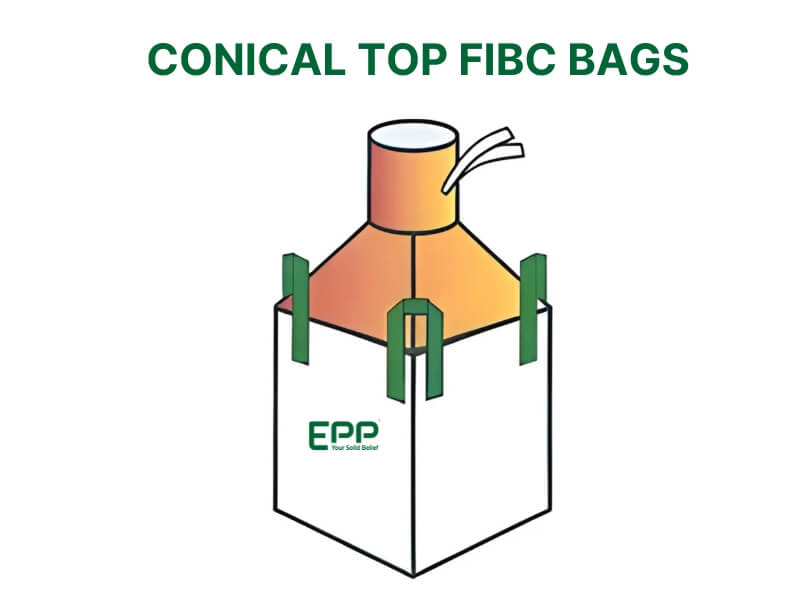
Conical Top FIBC Bulk Bag Design
5. Spout Top with Flap
A Spout Top with Flap builds upon the standard inlet spout design by adding an extra heavy-duty protective flap sewn over the entire top panel assembly.
- Structural Features: After the internal spout is filled and tied shut, a reinforced fabric flap ties down over the folded spout to shield it from external elements.
- Best For: High-value industrial chemicals, food-grade powders, or sensitive agricultural commodities stored in outdoor staging areas or shipped in open-top containers.
- Advantage: Provides secondary weather defense, prevents dirt accumulation inside the spout folds, and resists mechanical abrasion during international ocean freight.
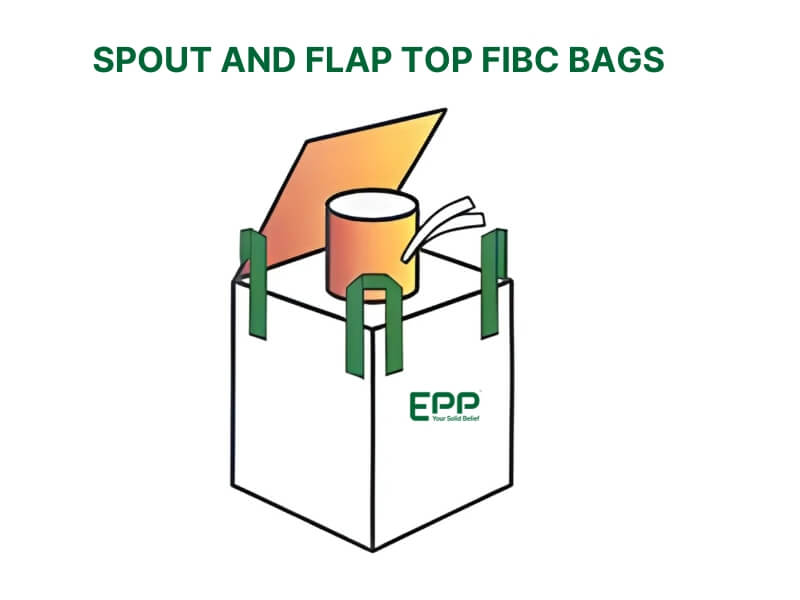
Spout and flap top FIBC bags from EPP Vietnam
Technical Comparison Matrix: FIBC Bag Top Designs
Evaluating top entry options across key operational criteria helps procurement managers quickly balance dust containment performance against capital expenditure:
| Feature / Criteria | Open Top | Spout Top | Duffle Top | Conical Top | Spout with Flap |
| Dust Containment | None | Excellent (100% Sealed) | Moderate | Excellent | Superior |
| Filling Speed | Slow / Manual | Fast (Automated) | Very Fast | Fast | Fast |
| Material Compatibility | Scrap, Gravel, Aggregates | Fine Powders, Pellets | Grains, Seeds, Minerals | Cohesive / Sticky Powders | High-Value Chemicals |
| Moisture Resistance | Minimal | High (Coated Fabric) | Moderate | High | Highest (Double Layer) |
How to Choose the Right FIBC Bag Top Designs for Your Filling System?
Step 1: Assess Material Characteristics
Evaluate particle size, bulk density, moisture sensitivity, and flowability. Fine powders require a fully enclosed Spout Top or Conical Top paired with felt sift-proofing or PE liners to eliminate dusting. Granular or non-sensitive goods handle efficiently in Duffle or Open Top configurations.
Step 2: Evaluate Existing Filling Equipment
Measure the outer diameter of your facility’s filling chute. As a rule of thumb, your FIBC inlet spout diameter should exceed the filling pipe’s outer diameter by 2 to 4 inches (5-10 cm) to allow fast sleeve positioning without binding or tearing the fabric.

FIBC spout-top loading stations equipped with automated scale systems.
Step 3: Match with Bottom Discharge & Lifting Requirements
Ensure your FIBC Bag Top Designs complements your unloading workflow. Connecting an automated Spout Top inlet with an improper discharge format creates operational delays at the customer end. Explore our technical breakdown of bulk bags bottoms to select the matching discharge spout, iris valve, or full-bottom drop mechanism for your application.
Step 4: Factory Quality & Compliance Verification
Verify that your supplier manufactures under certified ISO 9001:2015 quality management systems. For food and pharmaceutical operations, ensure top panel fabrication occurs in BRCGS-certified cleanrooms using 100% virgin polypropylene resin complying with US FDA and EU food-contact standards.
Conclusion
Selecting the ideal FIBC Bag Top Designs transforms raw bulk packaging into an integrated, dust-tight extension of your plant automation system. Whether your facility demands high-speed spout filling, full-width duffle access, or specialized conical geometry, matching your packaging specifications to your equipment lowers operational risk and protects cargo value.
Partner with EPP Vietnam to engineer high-performance bulk packaging built to international quality standards. Contact our B2B technical team today to review your machinery drawings, request sample specifications, or receive a competitive quote.
Website: epp.vn
Alibaba website: https://eppvietnam.trustpass.alibaba.com/
Email: [email protected] Hotline/ Whatsapps: +84 986 002 888