When sourcing industrial bulk packaging—such as FIBC jumbo bags—from global manufacturing hubs like Vietnam, securing your supply chain involves more than just selecting high-tensile fabric. It requires choosing a financial structure that protects your working capital.
The T/T payment method (Telegraphic Transfer) remains the most widely used cross-border payment mechanism in global B2B trade due to its speed and low processing fees. However, procurement managers frequently ask: Is T/T payment actually safe when placing high-value container orders with overseas suppliers?
The short answer is yes—provided it is structured correctly. When paired with strategic order milestones and verified manufacturing partners like EPP Vietnam, T/T offers a secure, highly efficient, and cost-effective alternative to costly bank guarantees.
What Is T/T Payment Method?
A T/T payment method (Telegraphic Transfer) is an electronic bank-to-bank wire transfer executed through the global SWIFT network. In B2B import-export transactions, it transfers funds directly from the buyer’s corporate bank account to the exporter’s account.

Telegraphic Transfer (T/T) wire payment process
In international FIBC procurement, T/T transactions are broadly categorized into three structures:
- 100% T/T in Advance: The importer pays the total contract value before production or shipment begins. (High risk for the buyer)
- T/T At Sight / Deferred: The importer settles payment after receiving and inspecting the physical cargo. (High risk for the seller)
- Split T/T (Deposit + Balance against B/L Copy): The buyer pays a partial deposit (typically 20% to 30%) to initiate production, paying the remaining balance upon receiving a scanned Bill of Lading (B/L). (Balanced risk profile)
How Does a T/T Payment Method Work?
Understanding the operational sequence of a split T/T transaction helps import teams maintain complete oversight of their funds and shipments.
Step 1: Contract Execution & Proforma Invoice (PI): Both parties sign the Sales Contract establishing the exact product specifications (e.g., U-Panel FIBC, Safe Working Load, GSM weight), Incoterms, and payment terms.
Step 2: Advance Deposit Remittance: The buyer wire-transfers a 30% deposit via SWIFT T/T. Upon bank confirmation, EPP Vietnam allocates virgin polypropylene resins and begins extrusion.
Step 3: Quality Control & Cargo Dispatch: Production completes, pass/fail lab testing is conducted, and the container is loaded and sealed at the factory.
Step 4: Bill of Lading Issuance: The shipping line issues the ocean Bill of Lading once the vessel departs the port of origin (e.g., Haiphong Port, Vietnam).
Step 5: Balance Transfer & Document Release: EPP Vietnam sends a scanned copy of the B/L along with commercial shipping documents. The buyer remits the remaining 70% balance via T/T payment method. Once funds clear, the original B/L is telex-released, granting the buyer title to the cargo.
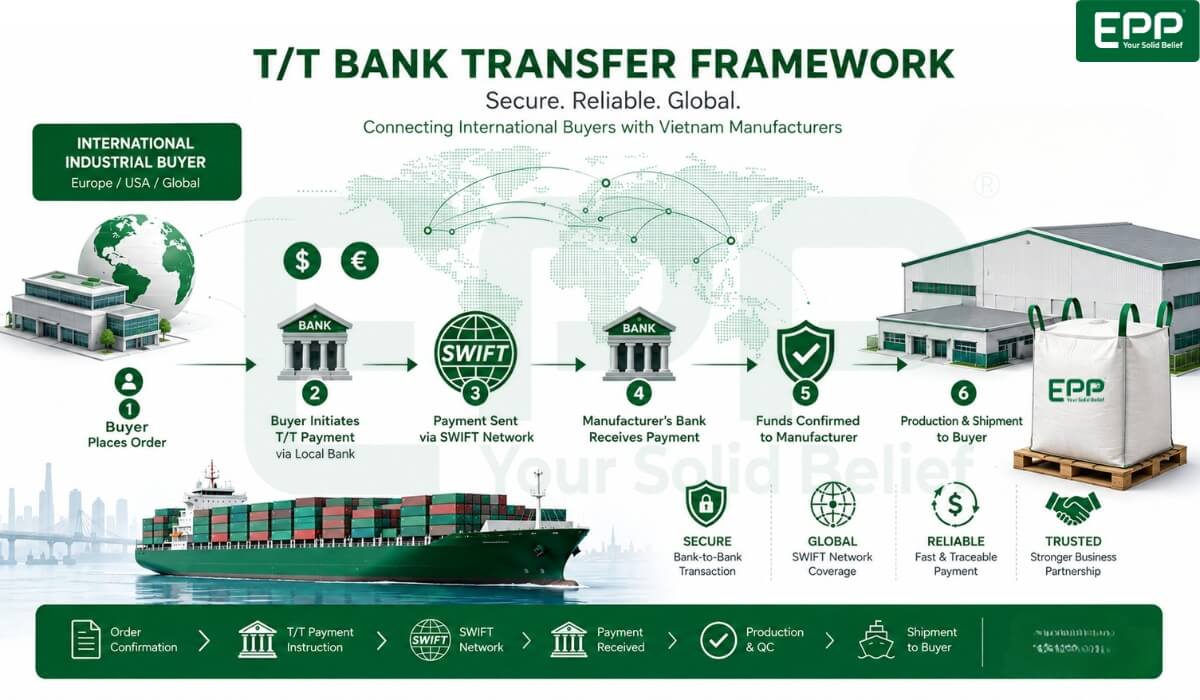
Global T/T wire transfer framework
Is that safe to use T/T payment method?
T/T is inherently neutral—it is a secure financial pipe. The security of a T/T transaction depends entirely on the payment structure and the reliability of your supplier. Under is the Commercial Risk Comparison Matrix:
| Payment Structure | Buyer Security | Exporter Security | Recommended Use Case |
| 100% T/T Advance | Low: Capital locked; vulnerable to delivery delays or non-performance. | High: Cash flow secured before raw material allocation. | Low-value sample orders or custom small-run prototyping. |
| 100% Deferred T/T | High: Cargo inspected before final payout. | Low: Vulnerable to buyer default after shipping. | Long-term strategic partners with established credit lines. |
| 30% Deposit / 70% vs B/L | High: Capital risk capped at 30%; cargo is confirmed onboard before final payout. | High: Production costs covered; retains title to cargo via B/L until paid. | Standard B2B Industry Benchmark for international container shipments. |
Integrating your payment terms with the correct shipping terms further protects your margin. Combining a 30/70 T/T structure with clear shipping terms gives you full control over freight costs and vessel scheduling. Learn how to structure these terms effectively by reading our detailed guides on the importance of FOB and CIF in incoterms, and selecting the right Incoterm for your bulk packaging supply chain.
Required Information for T/T Payment Method
A minor typo in banking instructions can lock funds in intermediary correspondent banks for days. To ensure smooth execution, verify that your wire instruction contains these exact details:
- Beneficiary Name: Must match the manufacturer’s registered corporate name exactly (e.g., EPP VIETNAM COMPANY LIMITED).
- Beneficiary Account Number / IBAN: Corporate multi-currency USD/EUR account number.
- Beneficiary Bank Name & Address: Full legal name and branch address of the receiving bank.
- SWIFT / BIC Code: The unique 8- or 11-character bank identifier code.
- Payment Reference / Remittance Details: Mandatory inclusion of the Commercial Invoice (CI) or Sales Contract number (e.g., PAYMENT FOR INVOICE #EPP-2026-888).
5 Expert Tips to Secure Your T/T Payment When Sourcing FIBC Bags
1. Adopt the Standard 30/70 Split Structure
Avoid paying 100% upfront to a new or unverified manufacturer. A 30% deposit covers initial resin procurement, while holding the 70% balance until receiving proof of shipment (scanned B/L) aligns both parties’ incentives.
2. Verify Factory Accreditation & Quality Standards
Mitigate product quality risk by auditing your supplier’s technical certifications before sending a deposit under T/T payment method. Reputable manufacturers operating out of major packaging hubs maintain rigorous international quality systems:
- ISO 9001:2015: Quality Management System for consistent manufacturing parameters.
- Food contact Certificates (FDA, HACCP, BRCGS,…): Essential for food-grade and pharmaceutical-grade fibc in vietnam procurement.
- UN Dangerous Goods Packaging Certification: Mandatory testing for transporting hazardous materials (UN Class 9).
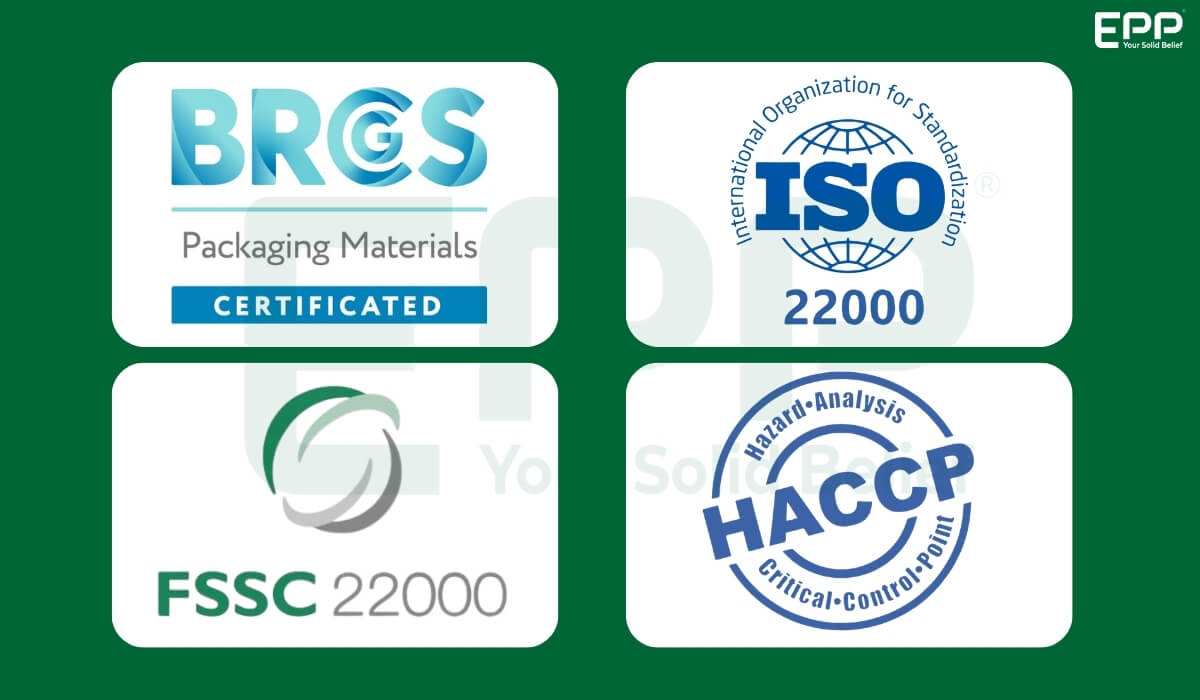
List of certification for food-safe packaging
3. Execute Dual-Channel Bank Verification
Before transmitting large wire payments, guard against corporate email compromise (phishing scams) by verifying banking details through an independent, secondary communication line (e.g., via direct phone call or secure video confirmation with your account executive).
4. Contractually Mandate Pre-Shipment Inspections
Include a clause in your Sales Contract stating that the 70% balance T/T payment method is contingent upon a successful third-party inspection (such as SGS or Intertek) or a factory-issued batch Quality Control (QC) report verifying fabric tensile strength, seam load tolerance, and safe working loads.
5. Check Fabric Batch Testing Reports
Ensure your supplier performs lab-tested quality control on every production run. At EPP Vietnam, every woven fabric roll undergoes rigorous tensile, elongation, and UV testing before sewing, giving you proof of product integrity before you transfer your final payment balance.
Who Should Use Telegraphic Transfer (T/T)?
T/T is not just a payment method; it is a competitive advantage when structured properly. It is ideal for:
- Cost-Conscious Importers: Letters of Credit (L/C) incur high bank commission fees, complex document discrepancies, and administrative delays. T/T minimizes banking overhead, lowering total landed costs.
- Time-Sensitive Supply Chains: SWIFT T/T transfers settle in 1 to 3 business days, keeping your production schedules moving without the multi-week approval cycles required by L/C issuing banks.
- Buyers Partnering with Vetted Supplier: Importers working with established, certified packaging partners can use T/T to build agile, long-term trade relationships with maximum speed and minimum friction.

A trusted B2B partnership with verified packaging suppliers.
Partner with EPP Vietnam for Secure Packaging Sourcing
At EPP Vietnam, we prioritize commercial transparency, financial security, and manufacturing precision. Whether you require standard U-Panel FIBC bulk bags, UN-certified hazardous waste containers, or specialized anti-static packaging, our commercial team supports flexible, secure T/T Payment Method and L/C payment structures tailored to your procurement policies.
Contact our export specialists today to discuss your technical specifications, request lab test reports, or receive a direct quote.

Website: epp.vn
Alibaba website: https://eppvietnam.trustpass.alibaba.com/
Email: [email protected] Hotline/ Whatsapps: +84 986 002 888