In international B2B trade, securing high-value transactions is just as important as ensuring product quality. When procurement managers and global supply chain directors import bulk products—such as FIBC jumbo bags—individual orders routinely reach tens or hundreds of thousands of dollars.
Navigating cross-border supplier relationships requires a payment structure that balances financial safety with operational efficiency. The L/C Payment Method (Letter of Credit) acts as the ultimate safeguard, placing neutral banking institutions between buyers and sellers to ensure smooth, secure global trade.
What Is the L/C Payment Method?
A Letter of Credit (L/C) is a binding financial contract issued by an importing buyer’s bank (the issuing bank). It guarantees that full payment will be released to the overseas exporter (the seller or beneficiary) only after the seller presents pre-agreed shipping and quality verification documents.
Instead of a buyer trusting an unknown foreign manufacturer, or a manufacturer shipping goods on credit, the bank takes on the payment risk.
L/C payment method secures international logistics transactions
How the L/C Payment Method Works?
International Letters of Credit operate under the Uniform Customs and Practice for Documentary Credits (UCP 600) rules established by the International Chamber of Commerce (ICC). This standardized framework ensures legal consistency across global jurisdictions.
Trade payment terms directly impact financial exposure. While some buyers consider traditional wire transfers, understanding Is that safe to use T/T payment method? reveals why advance cash deposits leave buyers vulnerable to supplier default or quality discrepancies. The L/C payment method shifts payment obligation from the buyer to the issuing bank under a structured, 6-step workflow:
- Contract Agreement: Buyer and seller sign a sales agreement stipulating payment via Letter of Credit.
- L/C Application: The buyer applies for an L/C at their local issuing bank using cash collateral or an established line of credit.
- L/C Verification: The issuing bank transmits the L/C to the seller’s advising bank (e.g., in Vietnam) for official authentication.
- Production & Freight: The seller manufactures the bulk packaging order, passes quality control, and ships the containerized goods.
- Document Submission: The seller submits all required commercial, shipping, and quality documents to the bank.
- Verification & Payout: The issuing bank verifies that every document matches the L/C terms 100%. Once confirmed, the bank releases the funds.
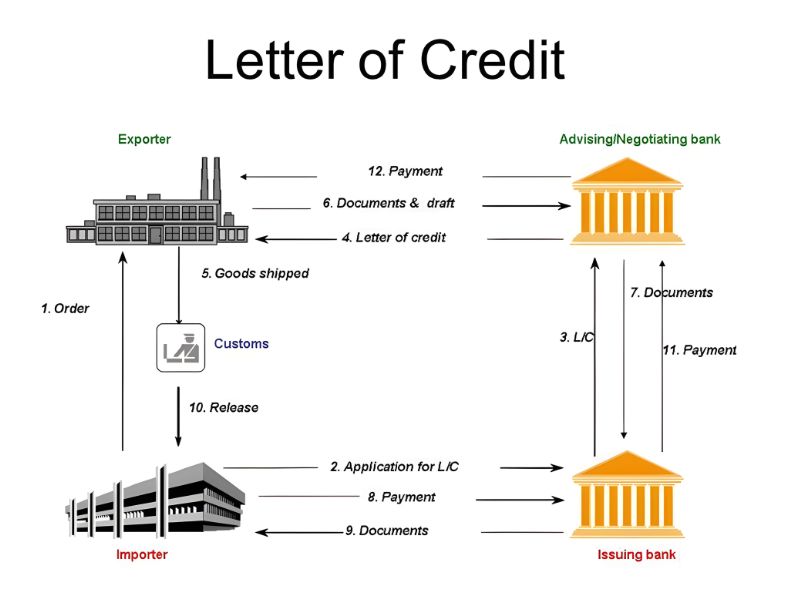
Process of a Letter of Credit under UCP 600 rules for secure B2B international trade
Key takeaway: In an L/C transaction, banks deal strictly in documents, not physical goods. If the paperwork complies with the L/C, payment is guaranteed by the bank.
Primary Types of L/C Payment Methods for Bulk Importers
Importers can choose from three main types of L/Cs, depending on their cash flow needs and supplier relationships:
1. Irrevocable L/C at Sight (Most Common)
- How it works: Once issued, the L/C cannot be canceled or modified without consent from all parties.
- Payment timing: The bank processes payment immediately (usually within 3–5 banking days) as soon as compliant documents are presented.
- Best for: Standard high-value bulk shipments where the supplier requires immediate payment upon dispatch.
2. Usance L/C (Deferred / Time L/C)
- How it works: Allows the buyer to receive the goods immediately upon document presentation while delaying actual payment.
- Payment timing: Payment is deferred for a fixed period (e.g., 30, 60, 90, or 120 days after the Bill of Lading date).
- Best for: Importers looking to preserve working capital or sell/process inventory before paying the bank.
3. Confirmed Letter of Credit
- How it works: A top-tier global bank (or the seller’s local bank) adds a second payment guarantee on top of the issuing bank’s guarantee.
- Payment timing: Follows standard sight or usance terms.
- Best for: Importing from or exporting to regions experiencing political or banking instability.
Essential Shipping Documents for L/C Compliance in FIBC Import
In an L/C transaction, banks deal strictly with documents, not goods. Even a minor typo or missing certificate can trigger a “discrepancy,” freezing fund releases and incurring bank penalties. When sourcing bulk packaging options like ton sacks for sale, strict document verification ensures you receive certified, structurally sound bags.
Standard Trade & Transport Documents
- Clean On-Board Bill of Lading (B/L): Official proof of cargo loading without notes of damaged packaging or missing goods.
- Commercial Invoice: Itemized bill detailing bag specifications, unit prices, and total value matching the exact L/C wording.
- Packing List: Detailed breakdown of total package counts, pallet dimensions, gross/net weight, and container numbers.
- Certificate of Origin (C/O): Proof of origin (e.g., Form E, Form EUR.1) to secure duty exemptions or preferential tariffs.

Checklist table of mandatory shipping papers required for L/C compliance in FIBC bulk bag imports
Packaging Quality & Technical Certificates
To prevent receiving sub-standard industrial bags, buyers specify quality certifications directly in the L/C terms:
- ISO 9001 / ISO 14001: Proof of standardized quality and environmental management at the factory.
- BRCGS Packaging Certificate: Essential for food-grade, agricultural, or pharmaceutical bulk packaging.
- UN Dangerous Goods Certificate: Mandatory when importing bags meant for hazardous chemicals or flammable powders.
- Factory Lab Test Reports: Certified reports proving Safe Working Load (SWL), fabric GSM, tensile strength, and safety factors (e.g., 5:1 or 6:1).
Combining L/C Payment Method with The Right Incoterm
An L/C payment clause must always be paired with an appropriate international commercial term. Selecting The Right Incoterm ensures clear division of freight costs, insurance liabilities, and document control.

Containerized FIBC bulk bags being loaded at a factory port for global dispatch under CIF/FOB L/C terms
| Incoterm + L/C | Operational Flow | Buyer Benefit | L/C Risk to Manage |
| L/C + FOB (Free On Board) | Buyer arranges ocean transport; seller delivers goods to the origin port vessel. | Direct control over ocean freight schedules and freight costs. | Freight forwarder delays in delivering the Bill of Lading to the seller can cause L/C presentation deadlines to be missed. |
| L/C + CIF (Cost, Insurance & Freight) | Seller handles transport and purchases marine insurance up to the destination port. | Turnkey logistics solution; seller secures transit insurance. | Seller must ensure the insurance policy explicitly matches the percentage coverage requested in the L/C. |
Risks and Hidden Costs of the L/C Payment Method
Although Letters of Credit provide maximum transaction safety, they come with administrative overhead and banking fees that buyers must manage.
Comparison: L/C Payment Method vs. Advance T/T Payment
| Feature | L/C Payment Method | Advance T/T (Wire Transfer) |
| Financial Security | Maximum: Bank guarantees payment | Low: Buyer bears full advance risk |
| Payment Trigger | Strict verified paper compliance | Upfront deposit paid before production |
| Quality Enforcement | Certificates required before fund release | Limited recourse if goods are sub-par |
| Cost & Banking Fees | 1% – 3% of total contract value | Low fixed wire transfer fees ($30 – $100) |
| Documentation Work | High (zero-tolerance for discrepancies) | Minimal (basic invoice & wire slip) |
Key Risks & Hidden Expenses to Keep in Mind
- Bank Fees: Issuance fees, advising fees, amendment fees, and credit line maintenance fees can add 1% to 3% to your order total.
- Discrepancy Penalties: If documents contain typos, mismatched descriptions, or late presentation dates, banks charge discrepancy penalties ($100–$250) and may refuse payment until corrected.
- Logistics Delays: Physical document processing and bank reviews take time, which can add 5 to 10 business days before goods can be released at the destination port.
Partnering with EPP Vietnam for Secure L/C Transactions
Successfully navigating an L/C transaction requires a manufacturing partner with an experienced export team. EPP Vietnam combines factory-direct bulk packaging production with international trade expertise, ensuring 100% clean document presentation under UCP 600 rules.
Whether you need food-grade BRCGS jumbo bags, UN-certified heavy-duty containers, or custom anti-static FIBCs, EPP Vietnam supports flexible, bank-guaranteed payment structures to secure your supply chain.
Contact EPP Vietnam today to review your technical bag specifications, request fabric samples, and structure a secure L/C transaction for your next bulk order.

Website: epp.vn
Alibaba website: https://eppvietnam.trustpass.alibaba.com/
Email: [email protected] Hotline/ Whatsapps: +84 986 002 888