Supply chain audits reveal that moisture damage during ocean freight and outdoor yard storage accounts for significant financial loss in the dry bulk solids sector. For procurement directors managing high-purity resins, food-grade starches, or fine powder, container sweat and atmospheric humidity pose constant threats to product integrity.
While Flexible Intermediate Bulk Containers (FIBCs) provide an efficient packaging solution, standard super sacks are not inherently waterproof. Microscopic weave gaps and needle perforations leave unlined containers vulnerable to water vapor transmission and hydrostatic pressure.
Eliminating moisture risk requires matching your cargo’s chemical properties with multi-layer barrier technologies. EPP Vietnam delivers custom-engineered, certified Waterproof Jumbo Bags manufactured under strict ISO quality frameworks to guarantee total payload protection across global trade routes.
Are the jumbo bags waterproof?
A common misconception among procurement teams is that standard FIBCs—often referred to as super sacks or jumbo bags—are inherently waterproof because they are made of synthetic plastic.
The short answer is no: standard bulk bags are not waterproof.
The Mechanics of Woven Polypropylene Permeability
FIBC bodies are manufactured by weaving high-tenacity polypropylene (PP) extruded yarns on industrial circular looms. While individual polypropylene filaments resist water absorption, the mechanical weaving process creates thousands of microscopic gaps between the warp and wefts.
Industrial sewing needles also perforate the fabric along side seams, top closures, and lifting loop anchors. Under standard atmospheric exposure, liquid water and moisture vapor pass through these weave gaps and stitch holes with ease.
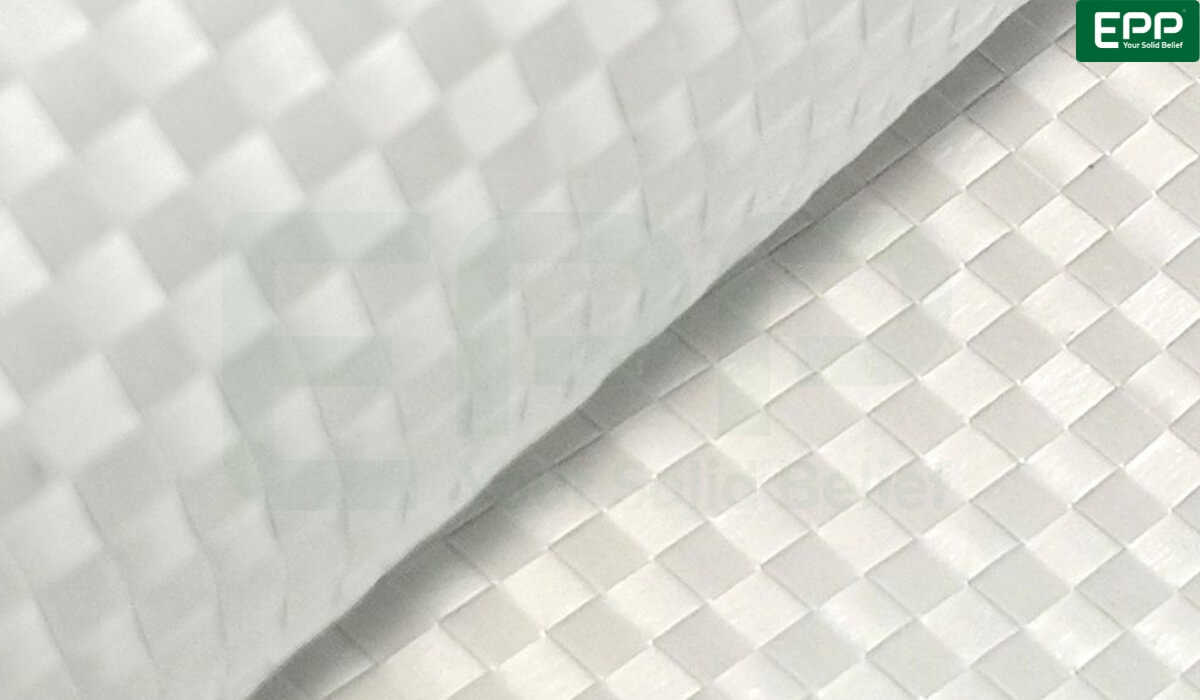
PP woven fabric for FIBC bags
Water-Resistant vs. Truly Waterproof
To select the appropriate big bags, logistics engineers must distinguish between two performance tiers:
- Water-Resistant (Coated/Laminated ): Designed to repel light rain splashes, surface dust, and ambient humidity during short transit windows. Water-resistant jumbo bags slow moisture penetration but cannot prevent water vapor transmission or withstand hydrostatic pressure along needle punctures.
- Waterproof jumbo bags/ Moisture-Impermeable: Engineered multi-layer barrier systems integrating specialized internal plastic liners, sealed spout mechanisms, and sift-proof seams. These systems achieve near-zero Moisture Vapor Transmission Rates, protecting dry solids against prolonged ocean freight humidity, heavy rainfall, and outdoor yard storage.
Top and bottom types plays an equally vital role in preventing moisture infiltration. Learn how specialized closure mechanics mitigate ingress in our spout top and discharge bottom guide.
Core Engineering Technologies for Waterproof Jumbo Bags
Transforming a porous woven structure into a heavy-duty moisture barrier requires integrating three core packaging technologies.
Laminated Woven PP Fabric
Lamination serves as the primary exterior defense against liquid splash and atmospheric humidity. During fabric preparation, a thin molten film of polypropylene combined with polyethylene (15 to 30 GSM) is extruded directly onto the woven PP substrate. This coating fills the inter-thread weave gaps and bonds securely to the base fabric.
Beyond moisture resistance, lamination increases fabric stiffness, prevents yarn slippage under dynamic loads, and enhances exterior print clarity. This technology is vital when sourcing high-purity FIBC bags for resins, where external ambient humidity must be excluded to prevent resin clumping prior to molding. While coating seals the body fabric, it does not seal the thousands of needle punctures created when sewing vertical seams or lifting loops.
Internal FIBC Liners
For products requiring complete liquid and gas impermeability, an internal plastic liner is the most critical component. The choice of bulk bag liner and polymer formulation dictates total barrier performance:
- Form-Fit (Shaped) Liners: Manufactured to mirror the exact internal contours of the waterproof jumbo bags, including the top fill spout and bottom discharge spout. Form-fit liners eliminate stress points, prevent trapped product during discharge, and maximize filling efficiency.
- Tubular / Gusseted Liners: Cylindrical PE films inserted loosely or cuffed over the bag top. They offer a cost-effective barrier for standard top-dumping or flat-bottom designs.
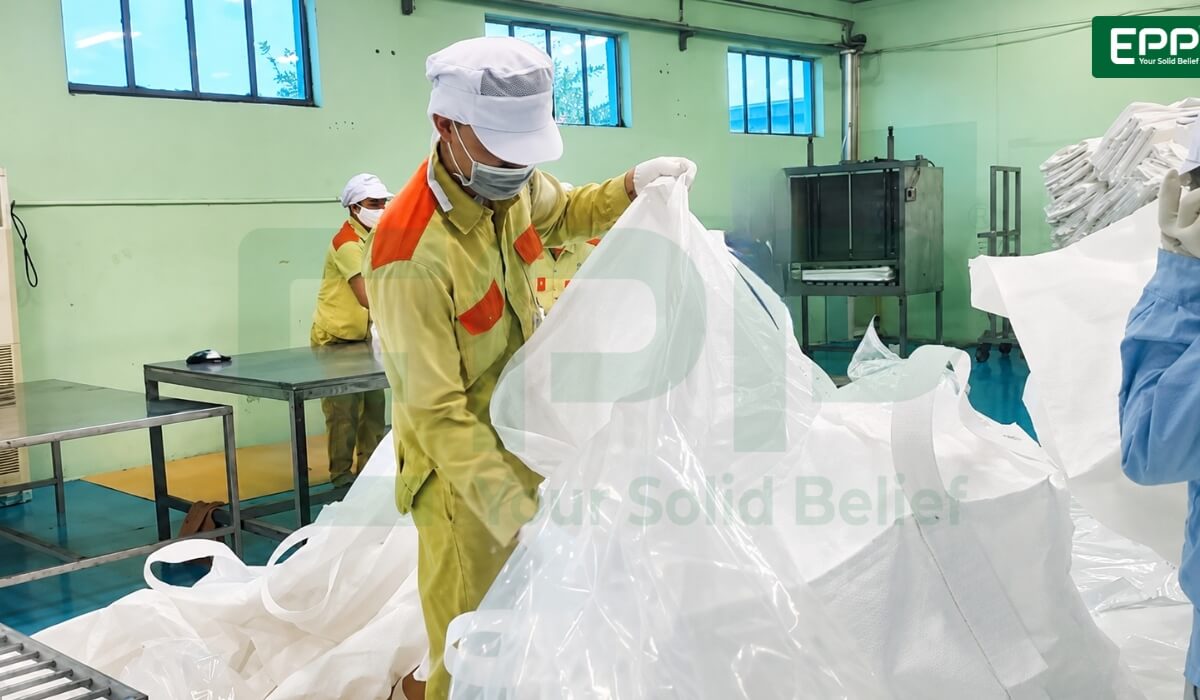
Inserting FIBC liners for jumbo bags at EPP Vietnam factory
Selecting the Right Waterproof Jumbo Bags
Matching your product’s physical properties with the correct structural components of bulk bags ensures complete cargo protection without over-engineering packaging costs.
Engineering Selection Matrix
| Barrier Level | Structural Components | Typical MVTR Rating (g/m2/24h) | Hydrostatic Resistance | Ideal Bulk Cargo Applications |
| Level 1: Splash Resistant | Single-wall Laminated PP Fabric (25GSM coating) | 15.0 – 25.0 | Low (Resists light rain) | Plastic pellets, coarse gravel, non-hygroscopic aggregates |
| Level 2: Moisture Proof | Laminated PP Fabric + LDPE liner | 1.0 – 3.0 | High (Resists heavy rain & humidity) | Cement, fertilizers, agricultural grains, animal feed |
| Level 3: Hermetic Barrier | Outer FIBC Shell + Aluminum Foil / EVOH Liner + Ultrasonic Seals | < 0.01 | Complete Ingress Protection | Fine powder, toxic chemicals, high-purity starches, specialty polymers |
Quality Standards & Electrostatic Safety
Selecting high-performance waterproof bags requires verifying compliance with international quality frameworks:
- Cleanroom Manufacturing: Food-grade and pharmaceutical empty bulk bags must be produced within BRCGS Packaging cleanroom facilities to ensure zero micro-contaminants or chemical migration.
- Electrostatic Safety: High-speed pneumatic filling of fine dry powders into plastic liners generates high static charges. Combining waterproof barrier liners with conductive threads (Type C) or antistatic dissipative thread (Type D) prevents static ignition in flammable environments. Review the operational differences in our technical breakdown on standard FIBC bags vs. antistatic bulk bags.
- ISO 21898 Compliance: Ensures structural load integrity, maintaining certified Safety Factor (SF) ratings even when heavy internal liners shift during transit.
Frequently Asked Questions (FAQs) about Waterproof Jumbo Bags
Are standard super sacks waterproof without a liner?
No. Standard super sacks are woven from polypropylene tapes that leave microscopic gaps between threads. To achieve true waterproofing, they must be engineered with an internal polyethylene (PE) or aluminum barrier liner combined with sift-proof seams.
What is the difference between coated jumbo bags and lined jumbo bags?
Coated (laminated) jumbo bags feature a thin plastic film applied directly to the woven fabric to repel light splash, surface rain, and dust. Lined jumbo bags feature a separate, thick internal plastic bag that provides complete protection against heavy liquid ingress, moisture vapor transmission, and oxygen oxidation.
Can waterproof bulk bags be stored outside in the rain?
Yes, but only if specified with a heavy-duty PE/Aluminum liner, UV-stabilized outer fabric, fully sealed top closure (duffle top or fill spout), and elevated off standing groundwater on pallets. Using a protective tarp over extended outdoor storage is still recommended.
How do I know if my product requires a Form-Fit Liner vs. a Standard Tubular Liner?
Form-fit liners are recommended for fine, flowable powders that require precise discharging via bottom spouts without bag deformation or trapped product. Standard tubular or gusseted liners work well for general granules, coarse aggregates, or top-dumping applications.
Selecting the correct waterproof jumbo bags specification protects material integrity, prevents costly cargo rejections, and optimizes global supply chain operations. Contact the senior packaging engineering team at EPP Vietnam today to review your product requirements, request sample testing, or receive a tailored quotation for custom-certified waterproof jumbo bags.
Website: epp.vn
Alibaba website: https://eppvietnam.trustpass.alibaba.com/
Email: [email protected] Hotline/ Whatsapps: +84 986 002 888