Global bulk procurement requires balancing material quality, transport logistics, and tariff compliance across international borders. For procurement teams sourcing industrial packaging, cross-border shipping introduces hidden risks—such as port congestion penalties, sudden import duty adjustments, and complex customs documentation.
The DDP Incoterm (Delivered Duty Paid) offers a streamlined solution. Under DDP terms, the seller assumes total operational and financial responsibility for delivering goods directly to the buyer’s warehouse, fully cleared through customs with all duties and taxes paid.
Understanding DDP Incoterm 2020 in Global Trade
DDP represents the highest level of seller obligation under the International Chamber of Commerce (ICC) rules. It creates a complete door-to-door service model where the seller manages every stage of the international supply chain.
1. What Is DDP Incoterm?
Under DDP (Delivered Duty Paid), the seller bears all risks and costs involved in bringing the goods to the named destination. This includes handling export clearance, main ocean or air carriage, import customs clearance, local taxes (including import VAT/GST), and final inland transport to the buyer’s facility.
DDP applies to any mode of transport, making it an effective framework for multimodal transport routes involving ocean shipping and land transportation for heavy industrial FIBC sacks.
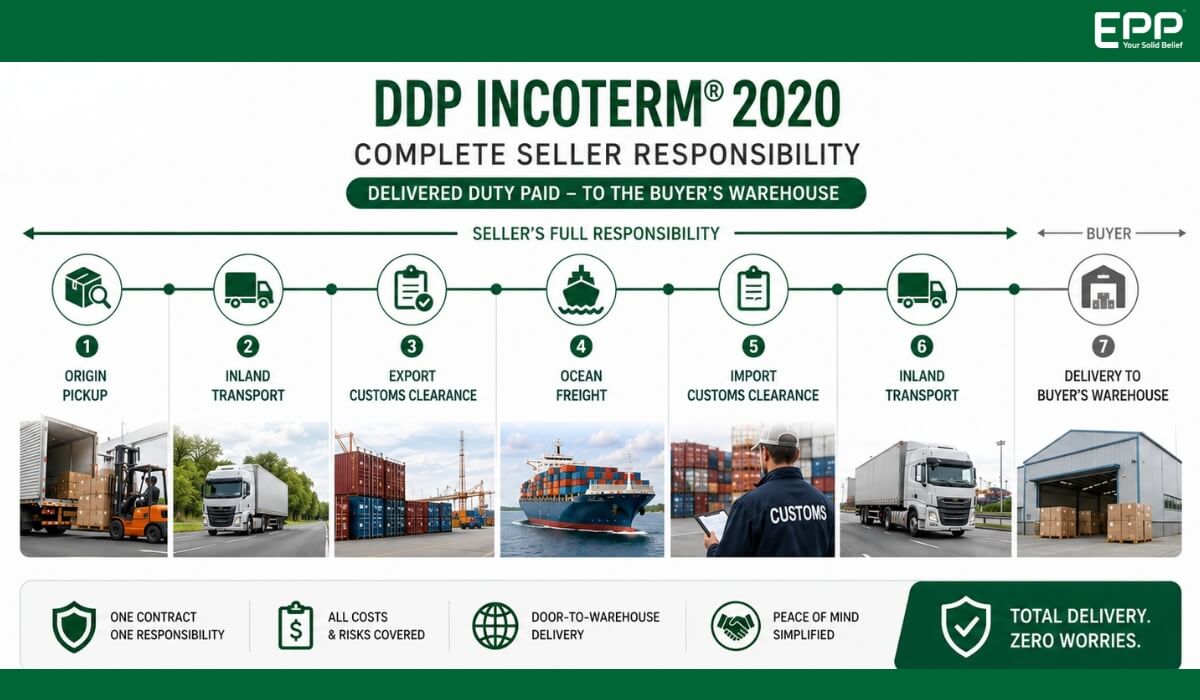
DDP Incoterm 2020 workflow
2. Risk Transfer and Control Points Under DDP 2020
- Risk Transfer Point: Risk transfers from the seller to the buyer only when the goods are placed at the disposal of the buyer at the named destination place, arrived on the delivering means of transport, and ready for unloading.
- Unloading Duty: Unless explicitly negotiated in the sales contract, the physical unloading of the cargo from the arriving truck at the destination warehouse remains the buyer’s responsibility.
3. Cost & Obligation Matrix: Seller vs. Buyer
| Cost & Duty Item | Seller | Buyer |
| Packaging & Marking | 100% Covered (Export-Grade Standards) | No Responsibility |
| Pre-Carriage & Export Clearance | 100% Covered | No Responsibility |
| Main Ocean / Air Freight | 100% Covered | No Responsibility |
| Cargo Insurance | Covered / Recommended | No Responsibility |
| Import Customs Clearance & Duties | 100% Covered (Key DDP Feature) | No Responsibility |
| Last-Mile Destination Delivery | 100% Covered to Door/Warehouse | No Responsibility |
| Unloading Cargo at Destination | No Responsibility (Unless contracted) | 100% Responsible |
DDP vs. Other Common Incoterms
Selecting the optimal trade term requires evaluating your internal logistics capabilities against the operational benefits offered by alternative Incoterms.
| Trade Term | Duty & Customs Clearance | Risk Transfer Point | Best Suited For |
| DDP (Delivered Duty Paid) | Seller handles both export & import clearance + duties. | Destination warehouse, ready for unloading. | Buyers seeking zero logistics overhead and guaranteed landed costs. |
| DAP (Delivered at Place) | Seller handles export; Buyer handles import clearance & duties. | Destination warehouse, ready for unloading. | Buyers with local customs clearance capabilities in the destination country. |
| CIF (Cost, Insurance & Freight) | Seller handles export; Buyer handles import clearance & duties. | Loaded on board the vessel at port of origin. | Buyers comfortable managing destination port handling and inland transport. |
| EXW (Ex Works) | Buyer handles all export, ocean transport, import clearance & duties. | Seller’s factory or warehouse floor. | Buyers with established global logistics networks wanting total shipping control. |
Compare all options across your global procurement strategy in our master guide to choosing the right Incoterm.
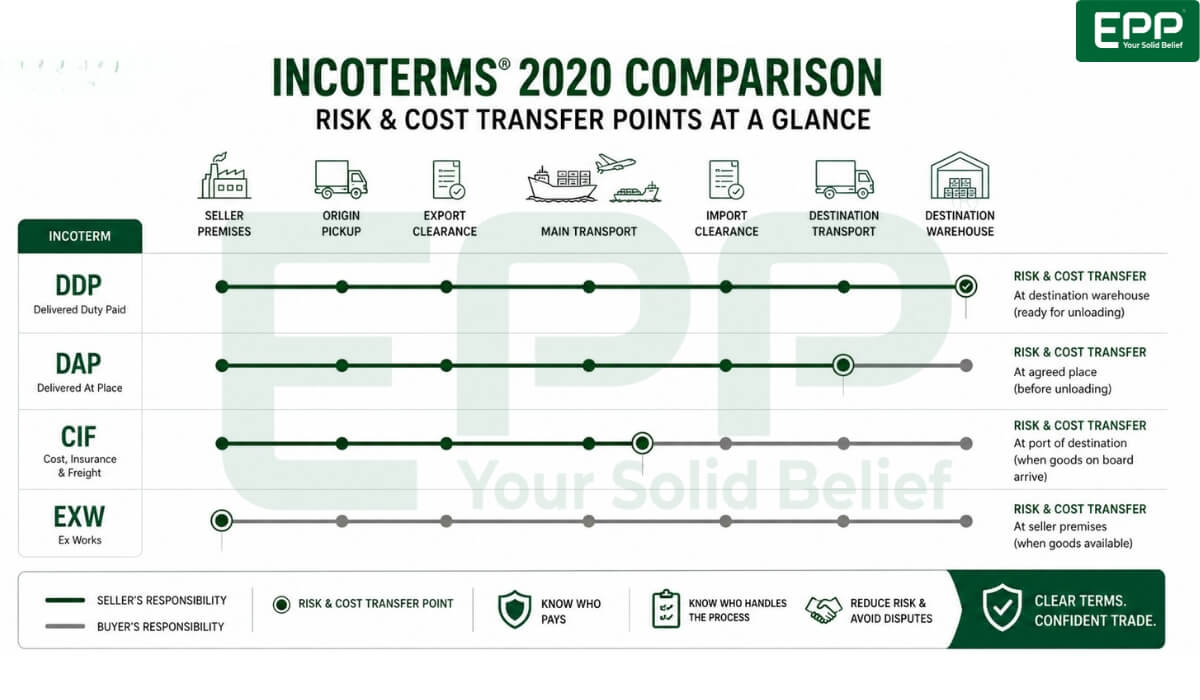
Risk and cost transfer point comparison across DDP, DAP, CIF, and EXW Incoterms
Benefits and Strategic Challenges of DDP Incoterm Procurement
Evaluating DDP from a strategic procurement perspective reveals distinct financial advantages alongside specific operational requirements.
Strategic Benefits for B2B Enterprise Buyers
- Guaranteed Landed Costs: DDP incoterm removes price volatility caused by destination port charges, unexpected storage fees, or currency fluctuations, providing 100% budget accuracy.
- Turnkey Supply Chain: Procurement teams avoid managing overseas freight forwarders, customs brokers, and inland trucking fleets.
- Elimination of Port Penalties: Because the seller manages import clearance, risks related to container demurrage or detention at the destination port fall on the supplier.
Operational Challenges & Mitigation Strategies
- Importer of Record (IOR) Bottlenecks: DDP requires the seller (or their designated agent) to act as the Importer of Record in the destination country. Operating as a Master Supply Chain Partner, EPP Vietnam resolves this by utilizing established global freight networks and licensed IOR partners across North America, Europe, Japan, and Australia to handle customs filings smoothly.
- Destination Quality Assurance: If sub-standard cargo arrives under DDP terms, returning goods across international borders creates heavy duty and freight costs. EPP Vietnam prevents this risk by applying strict manufacturing protocols—ensuring all partner facilities comply with ISO 9001:2015, BRCGS Grade A (food-grade purity), and UN Certified packaging standards for hazardous materials prior to export dispatch.
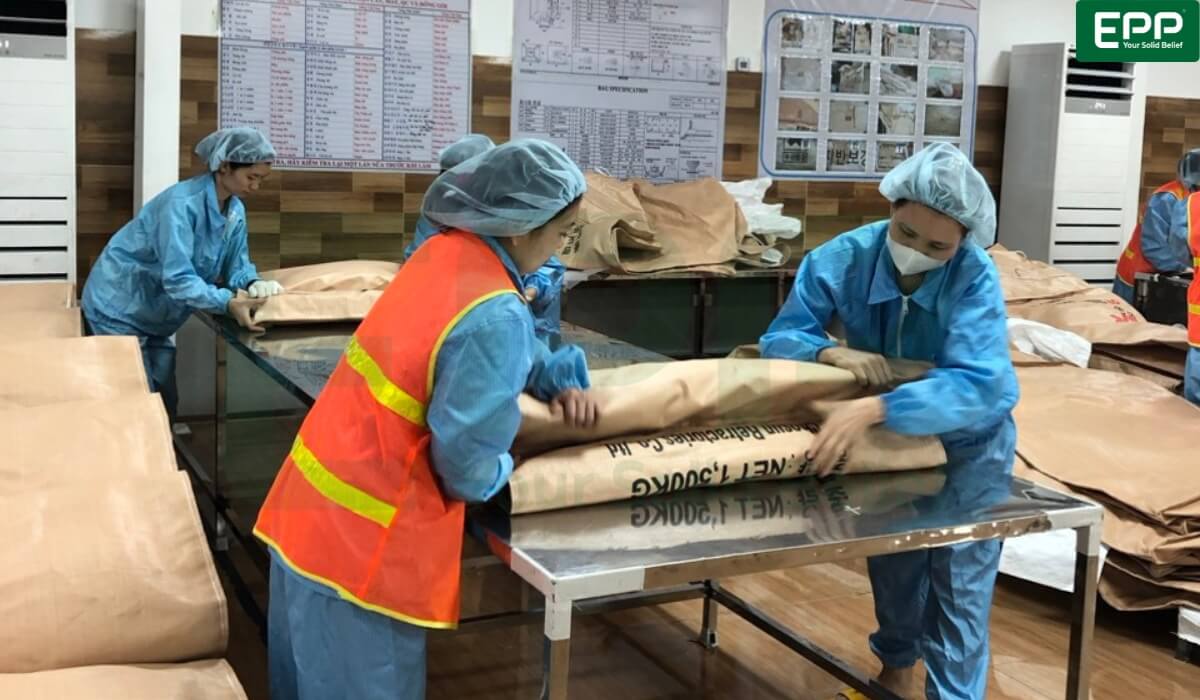
Quality control of FIBC bulk bags to prevent destination cargo rejections under DDP contracts
Step-by-Step DDP Incoterm Execution Process
Executing a DDP contract for industrial packaging requires careful coordination across multiple logistics stages.
Step 1: Technical Survey & Tariff Classification
Prior to shipment, the technical team verifies bag specifications, safe working loads (SWL), and safety factors (SF 5:1 / 6:1). The freight team confirms correct Harmonized System (HS) codes to ensure accurate tariff calculations at the destination port.
Step 2: Export Packaging and Container Optimization
Bags are compressed, baled, or palletized to fit High-Cube containers. Pallet loads are wrapped to maintain stability during ocean transport, preventing cargo shifting and physical damage.
Step 3: Main Carriage Booking and All-Risk Insurance
EPP Vietnam books container space with tier-one ocean carriers and secures comprehensive transit insurance coverage, protecting cargo value from origin to final destination.
Step 4: Two-Way Customs Clearance and Duty Payment
Export customs declarations are cleared at the origin port (e.g., Cat Lai or Hai Phong). Upon arrival at the destination port, designated customs brokers file entry documentation, handle agricultural/safety inspections, and settle all import duties and local taxes.
Step 5: Last-Mile Delivery & Proof of Delivery (POD)
The cleared container or truckload is dispatched via local drayage directly to the buyer’s warehouse gate. Upon arrival, the receiving team signs the Proof of Delivery (POD), completing the DDP cycle.
Modern Logistics Updates: Key Considerations for Buyers under DDP Incoterm
International logistics standards continue to evolve. Enterprise buyers managing DDP procurement must account for recent regulatory updates.
EU CBAM (Carbon Border Adjustment Mechanism) Integration
As carbon emission accounting becomes mandatory for imports entering the European Union, buyers must track embedded emissions across their supply chains. EPP Vietnam supports enterprise clients by providing verified Carbon Footprint Data for bulk packaging orders, ensuring compliance with EU sustainability standards.
EU CBAM carbon footprint reporting for bulk packaging exports
Digital Trade Documentation and e-Bills of Lading (e-BL)
The shift toward digital trade documents—including electronic Bills of Lading (e-BL) and digital certificates of origin—speeds up customs processing. Utilizing digital documentation reduces destination clearance times from days to hours, mitigating container detention risks.
1. What happens if cargo is delayed at destination customs due to inspections?
Under DDP, the seller assumes all risks and costs associated with destination customs clearance. If a container is held for routine customs examinations or documentation audits, any resulting port storage fees, demurrage, or inspection charges are absorbed by EPP Vietnam, insulating the buyer from unexpected logistics expenses.
2. Who is responsible if packaging is damaged during unloading at the buyer’s facility?
Under DDP Incoterm 2020 rules, seller liability ends when the vehicle arrives at the named destination place, ready for unloading. Physical unloading operations—and any risks incurred during unloading—are the responsibility of the buyer unless specialized contract clauses specify otherwise.
3. Can we switch an existing order from FOB or EXW to DDP mid-shipment?
Yes. As long as the container has not reached its destination import clearance cutoff, EPP Vietnam can restructure transit terms, arrange destination IOR representation, and convert the shipment to a single landed DDP price.
4. How does DDP protect buyers against sudden ocean freight rate hikes or surcharges?
When you contract under DDP Incoterm, the agreed unit price is fixed and landed. Any sudden fluctuations in ocean freight rates, peak season surcharges (PSS), or bunker adjustment factors (BAF) that occur during transit are borne entirely by the supplier, providing complete financial predictability for your procurement budget.
Sourcing industrial bulk packaging under DDP Incoterms gives enterprise buyers fixed landed costs, eliminates customs clearance delays, and simplifies global supply chain management.
EPP Vietnam delivers complete end-to-end supply chain execution. Contact our logistics specialists today to review your destination requirements, obtain a competitive DDP quotation, and secure high-performance FIBC sacks delivered directly to your warehouse gate.
Website: epp.vn
Alibaba website: https://eppvietnam.trustpass.alibaba.com/
Email: [email protected] Hotline/ Whatsapps: +84 986 002 888