In an era defined by global supply chain realignments, the rapid adoption of “China Plus One” sourcing strategies, and shifting trade policies, Vietnam’s logistics industry has emerged as a vital component of the economy, transforming the country into a premier logistics and industrial manufacturing powerhouse in Southeast Asia. Driven by continuous infrastructure modernization, expanded deep-water seaport networks, and an extensive portfolio of international trade agreements, the country offers international buyers a highly competitive and resilient operational footprint.
This analytical report examines the macro drivers transforming Vietnam’s freight and supply chain ecosystem, evaluates key regional logistics hubs, outlines actionable steps for procurement executives, and highlights why high-quality industrial packaging—such as bulk bag solutions—is essential for mitigating total landed cost during long-distance ocean shipping.

Vietnam’s expanding deep-water seaports and logistics infrastructure drive seamless international trade connectivity.
Status of Vietnam’s Logistics Industry
Vietnam’s logistics sector has emerged as a vital component of the national economy, showcasing an impressive annual growth rate of 14–16%. This significant expansion highlights the logistics market’s essential role in enhancing Vietnam’s export and import turnover. According to the Ministry of Industry and Trade, Vietnam ranks 43rd globally in the Logistics Performance Index (LPI), placing it among the top five ASEAN nations alongside Singapore, Malaysia, and Thailand.
A notable driver of this growth is the export of FIBC (Flexible Intermediate Bulk Containers) bags, which are increasingly in demand from major trading partners like the U.S., EU, and China. This demand contributed to a 20% surge in cargo volume at seaports compared to previous periods. Import-export activities reached $511 billion in the first eight months of 2024 (up 17%), with FIBC bulk bags playing a crucial role in this upward trend.
Agriseco Securities Corporation highlighted a remarkable 22% year-on-year profit increase for the logistics sector in Q3 2024 (~8,100 billion VND), pushing 9-month total profits to 24,400 billion VND (an 18% increase year-on-year). This robust financial performance underscores the logistics industry’s critical role in facilitating international trade and supporting Vietnam’s economic growth. To learn more about how trade treaties reduce tariff barriers, read our analysis on Vietnam’s free trade agreements.
Creating a Breakthrough in Vietnam’s Logistics Industry
To align the logistics sector with Vietnam’s economic potential from 2025 to 2035, the Ministry of Industry and Trade convened to advance the Draft Strategy for Developing Vietnam’s Logistics Services. As emphasized by Mr. Tran Thanh Hai, Deputy Director of the Import-Export Department, the national strategy targets four key economic milestones (Source: Decision No. 2229/QD-TTg dated October 9, 2025):
| Key Metric | Strategic Target (2025–2035) |
| GDP Contribution | Increase logistics added-value contribution to 5–7% of GDP |
| Industry Growth Rate | Maintain an average annual growth rate of 12–15% |
| Outsourcing & Cost Reduction | Achieve 70–80% outsourcing rate while dropping logistics costs to 12–15% of GDP |
| Global LPI Ranking | Elevate Vietnam’s global Logistics Performance Index rank into the Top 40 |
Achieving these milestones requires execution across six core operational pillars: establishing robust legal frameworks, aggressively expanding regional market access, training specialized human resources, driving technology and automated WMS innovation, accelerating industry collaboration, and building modern deep-water port infrastructure.
For deeper insights into Vietnam’s economic trajectory, consult our report on Vietnam’s economy as a rising power in Southeast Asia.

Vietnam’s multi-pillar logistics strategy elevates global competitiveness and supply chain resilience.
Key Macro Drivers Reshaping Vietnam’s Logistics Landscape
The structural evolution of Vietnam’s logistics sector is driven by a combination of strong foreign direct investment (FDI), expanding trade turnover, and active government policy support.
- Massive Industrial FDI Inflows: Multinational manufacturing leaders across electronics, textiles, automotive, and heavy industries continue to shift primary production lines into Vietnam to hedge against single-country dependency.
- Expanding Free Trade Agreement (FTA) Network: Vietnam’s participation in major trade pacts—including CPTPP, EVFTA, and RCEP—provides preferential tariff access to major global consumer markets while simplifying customs clearance procedures.
- Regulatory Focus on Logistics Efficiency: National master plans prioritize reducing total logistics costs as a percentage of GDP toward international benchmarks through streamlined customs digitization, bonded warehouse networks, and multimodal transit routes.
What Are the Major Logistics Hubs in Vietnam?
Vietnam’s industrial packaging and logistics footprint is divided across three key regional hubs:
- Northern Economic Zone (Hai Phong, Ha Noi, Bac Ninh, Quang Ninh): Anchored by the Lach Huyen deep-water seaport, serving electronics, machinery, and industrial exports.
- Southern Economic Zone (Ho Chi Minh City, Vung Tau, Binh Duong, Dong Nai): The country’s primary commercial hub, powered by the Cai Mep – Thi Vai deep-water complex and Cat Lai port for bulk commodities, chemicals, and plastic packaging exports.
- Central Economic Zone (Da Nang, Quy Nhon, Dung Quat): A specialized corridor for agricultural products, timber, minerals, and heavy industrial materials.
Remaining Problems That May Affect the Logistics Industry
While growth prospects remain strong, global procurement managers must navigate four major headwinds currently impacting Vietnam’s supply chain:
Geopolitical Instability: Cited by 82.4% of logistics companies as their top challenge. Global conflicts, trade tensions, port closures in conflict zones, and exchange rate volatility increase operating costs and prolong transit times.
Slowing Global Demand & Policy Shifts: Highlighted by 58.8% of businesses, modest global GDP growth directly limits export volume gains. Furthermore, leadership transitions in major trading partner economies continue to create trade policy uncertainties.
Environmental Compliance: Strict international environmental regulations, including EU CBAM and mandatory ESG reporting, require exporters to rapidly adopt green supply chains and recyclable materials.
Actionable Execution Steps for Procurement Managers
To navigate logistics complexities and protect landed margins, procurement directors should follow a structured management protocol:
- Audit Total Landed Cost (TLC): Factor in factory pricing (FOB), ocean freight surcharges, marine insurance, terminal handling charges (THC), and destination customs duties.
- Optimize Container CBM Density: Coordinate with suppliers to design product and packaging dimensions that maximize container space utilization in 20ft, 40ft, and 40ft HC sea containers.
- Select Direct Ocean Routes: Utilize ocean carriers calling directly at Lach Huyen or Cai Mep to bypass transshipment delays to US and EU ports. Learn more about transit steps in our guide on shipping from Vietnam to the US.
- Enforce Quality Certifications: Mandate that suppliers hold ISO 9001:2015, BRCGS (for cleanroom food/pharma packaging), and official UN Packaging certificates for dangerous goods.
- Mandate Full Origin Traceability: Require complete bill-of-materials (BOM) and valid Certificates of Origin (C/O) to secure preferential FTA duty rates.

End-to-end logistics management workflow detailing Total Landed Cost (TLC) optimization and quality compliance for sourcing from Vietnam.
Frequently Asked Questions About Vietnam Logistics
How does Vietnam’s logistics infrastructure compare to other Asian hubs?
Vietnam ranks 43rd globally in the Logistics Performance Index (LPI), placing it among the top five ASEAN nations alongside Singapore, Malaysia, and Thailand. Its deep-water seaports (Lạch Huyện and Cái Mép) accommodate ultra-large container vessels for direct shipping to Western markets.
Is Vietnam logistics infrastructure improving?
Yes. Driven by government strategies targeting a 12–15% annual growth rate and infrastructure investments in deep-water ports, expressways, and airport logistics hubs, Vietnam is steadily lowering logistics costs and improving transit times.
Why is high-quality Plastic Packaging essential for ocean freight from Vietnam?
Maritime transit across international sea lanes exposes cargo to 20 to 35 days of marine humidity, temperature shifts, static electricity, and crane handling stress. Using substandard packaging risks bag tears, product contamination, and costly claims.
Partnering with an experienced supplier for certified jumbo sack bag solutions—built with 5:1 / 6:1 Safe Working Load (SWL) safety ratios, anti-static Type C/D protection, moisture barriers, and cleanroom BRCGS compliance—ensures maximum cargo protection and zero-loss delivery to global destination ports.
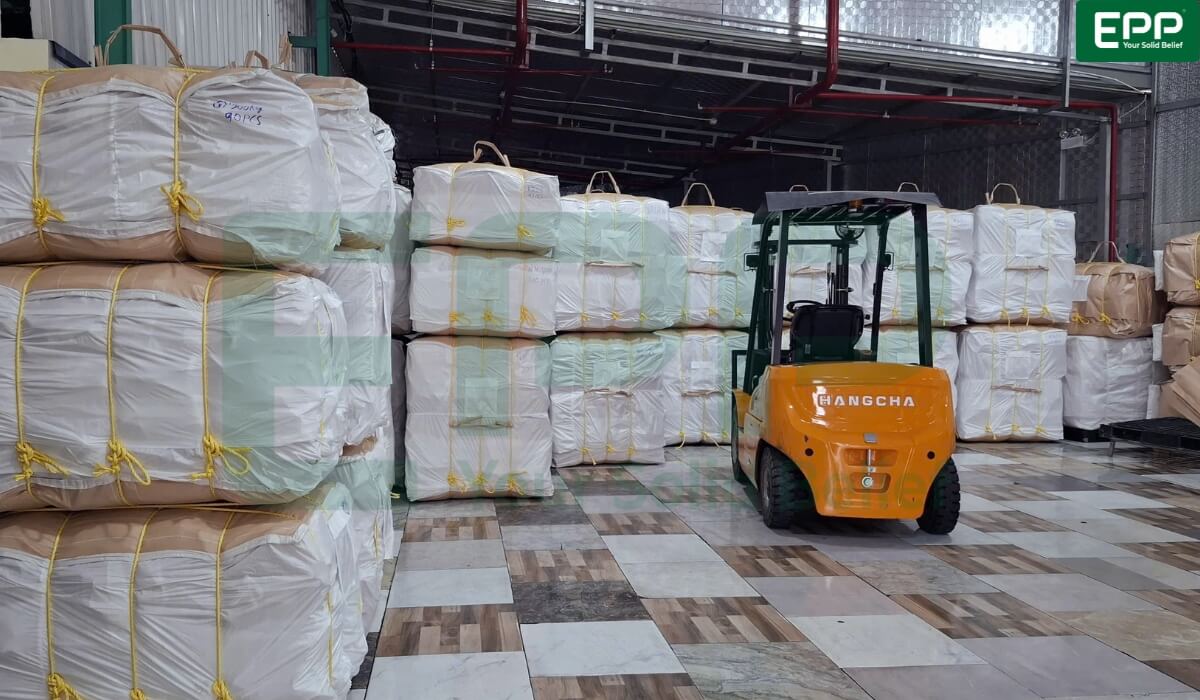
Modern FIBC jumbo bags stored in an industrial warehouse facility ready for global export.
Partnering for Global Supply Chain Resilience
Vietnam’s logistics industry is undergoing an unprecedented evolution, driven by robust export growth, strategic deep-water seaport developments, and ambitious national infrastructure targets. While this rapid expansion positions the country as a premier regional supply chain hub, international buyers must navigate ongoing global trade headwinds, shifting environmental compliance standards, and long-distance maritime risks. Optimizing every link in the supply chain—from ocean transit routes down to heavy-duty, certified industrial packaging—is essential to lowering total landed costs, preventing cargo loss, and securing seamless customs clearance across international borders.
Ready to elevate your ocean freight safety and optimize your bulk packaging performance? Partner with EPP Vietnam, the leading FIBC bulk bag supplier with over 20 years of manufacturing and export excellence. Contact our packaging engineers today to request custom technical specifications, physical sample testing, and factory-direct pricing tailored to your global supply chain needs.
Website: epp.vn
Alibaba website: https://eppvietnam.trustpass.alibaba.com/
Email: [email protected] Hotline/ Whatsapps: +84 986 002 888