As global supply chains navigate ongoing geopolitical shifts, rising trade tariffs, and the imperative for multi-country sourcing strategies (“China+1”), Vietnam has emerged as one of the world’s most strategic manufacturing and export hubs. Driven by aggressive economic integration over the past two decades, Vietnam now boasts an expansive network of 18 active and planned bilateral and multilateral Vietnam’s Free Trade Agreements (FTAs).
This comprehensive guide breaks down Vietnam’s active trade agreements, compares regional tariff advantages against competing Asian manufacturing hubs, and outlines actionable strategies—including Rules of Origin (ROO) compliance and Certificate of Origin (C/O) documentation—to maximize tariff savings for your supply chain.
What is Free Trade Agreements?
Vietnam’s Free Trade Agreements (FTAs) represent a comprehensive network of bilateral and multilateral treaties engineered to eliminate tariff barriers, facilitate customs clearance, and establish transparent regulatory frameworks between Vietnam and major economies worldwide.
Over the past two decades, Vietnam has transformed from an agrarian export economy into one of the most open and dynamic manufacturing hubs in Asia-Pacific. Operating 18 active and planned FTAs, the country offers preferential trade access to markets representing nearly 90% of global GDP. For international procurement directors, supply chain executives, and global enterprise buyers, Vietnam’s FTA landscape is more than just macro-economic policy—it is a direct lever for cost optimization.
By sourcing industrial commodities, textiles, electronics, and bulk packaging from Vietnam, foreign buyers can reduce landed import duties from standard Most-Favored-Nation (MFN) rates of 6.5%–25% down to 0%. As multinational corporations execute China+1 strategies to insulate their supply chains against geopolitical friction and punitive tariffs, leveraging Vietnam’s economy in Southeast Asia provides a competitive advantage in global trade.

Vietnam free trade agreements global export network map
List of Vietnam’s Free Trade Agreements Until 2026
Vietnam’s strategic trade policy encompasses both targeted bilateral economic partnerships and massive regional economic agreements. The tables below outline Vietnam’s active FTA framework, detailing partner jurisdictions, effective dates, and strategic market focus.
Bilateral Vietnam’s Free Trade Agreements
| Partner | Agreement Name | Signed Date | Effective Date | Notes |
|---|---|---|---|---|
| Chile | Vietnam-Chile Free Trade Agreement | 12 Nov 2011 | 4 Feb 2014 | Enhances trade in agricultural products |
| Cuba | Vietnam–Cuba Free Trade Agreement | 9 Nov 2018 | 1 Apr 2020 | Strengthens historical ties, trade in goods |
| Japan | Vietnam–Japan Economic Partnership Agreement (VJEPA) | 25 Dec 2008 | 1 Oct 2009 | Includes investment and services |
| South Korea | Vietnam–Korea Free Trade Agreement (VKFTA) | 5 May 2015 | 20 Dec 2015 | Boosts electronics and automotive trade |
| United Kingdom | United Kingdom–Vietnam Free Trade Agreement (UKVFTA) | 29 Dec 2020 | 1 May 2021 | Post-Brexit trade enhancement |
| United States | US–Vietnam Bilateral Trade Agreement (BTA) | 14 Jul 2000 | 10 Dec 2001 | Comprehensive trade, often considered an FTA |
| Israel | Vietnam-Israel Free Trade Agreement | 2023 | 2024 | Recent, enhances tech and agricultural trade |
| European Union | European Union–Vietnam Free Trade Agreement (EVFTA) | 30 Jun 2019 | 1 Aug 2020 | Significant for high-tech exports |
| Eurasian Economic Union | Vietnam-EAEU Free Trade Agreement | 2015 | 2016 | With Russia, Belarus, etc., trade in energy |
| European Free Trade Association (EFTA) | Vietnam-EFTA Free Trade Agreement | 27 Apr 2024 | Assumed 2025 | With Switzerland, Iceland, etc., if in effect |
The inclusion of the US-Vietnam BTA as an FTA is based on its function, despite being officially a Bilateral Trade Agreement, as it reduces tariffs and enhances trade, fitting the FTA definition.
Multilateral Vietnam’s Free Trade Agreements
| Agreement Name | Partners Included | Signed Date | Effective Date | Notes |
|---|---|---|---|---|
| AFTA (ASEAN Free Trade Area) | Brunei, Cambodia, Indonesia, Laos, Malaysia, Philippines, Singapore, Thailand | 1992 | 1993 | Core ASEAN trade liberalization |
| ACFTA (ASEAN–China Free Trade Agreement) | China, and all ASEAN members | 2004 | 2010 | Significant for manufacturing exports |
| AKFTA (ASEAN–Korea Free Trade Agreement) | South Korea, and all ASEAN members | 2006 | 2007 | Enhances electronics trade |
| AANZFTA (ASEAN–Australia–New Zealand Free Trade Agreement) | Australia, New Zealand, and all ASEAN members | 2009 | 2010 | Boosts agricultural and service exports |
| RCEP (Regional Comprehensive Economic Partnership) | Australia, China, Japan, South Korea, New Zealand, and ASEAN | 2020 | 2022 | Largest trade bloc, covers vast markets |
| CPTPP (Comprehensive and Progressive Agreement for Trans-Pacific Partnership) | Australia, Brunei, Canada, Chile, Japan, Malaysia, Mexico, New Zealand, Peru, Singapore | 2018 | 2019 for Vietnam | Includes advanced economies, high-tech trade |
Tariff reduction schedules across primary agreements like the EVFTA and CPTPP have reached full maturity. Over 98% of industrial goods exported from Vietnam into the European Union, United Kingdom, Canada, and Australia now qualify for 0% preferential import duties, provided products fulfill specific Rules of Origin criteria.
Strategic Sourcing Advantages from Vietnam vs. Regional Competitors
Understanding how Vietnam’s Free Trade Agreements footprint compares against alternative Asian manufacturing destinations reveals significant tariff and operational advantages:
| Sourcing Location | Active Primary FTAs | Import Tariff to EU (Industrial Packaging) | Import Tariff to US / Canada | Supply Chain & Tariff Risk Level |
| Vietnam | EVFTA, CPTPP, RCEP, UKVFTA, VKFTA | 0% (with Form EUR.1) | 0% (Canada via CPTPP) / MFN (US) | Low (Stable FDI climate, multi-FTA coverage) |
| China | RCEP, ACFTA | 6.5% – 8.0% (MFN Rate) | Up to 25%+ (Section 301 Tariffs) | High (Geopolitical trade tensions, anti-dumping duties) |
| India | India-UAE CEPA, EFTA (signed) | 6.5% – 8.0% (MFN Rate) | Standard MFN Rates | Moderate (Higher protective import tariffs on raw inputs) |
| Thailand | RCEP, AFTA | 6.5% (No active EU FTA) | Standard MFN Rates (No CPTPP access) | Moderate (Lacks direct trade deals with EU/North America) |
| Indonesia | RCEP, AFTA (EU CEPA pending) | 6.5% (MFN Rate) | Standard MFN Rates | Moderate (Negotiations ongoing; no active EU FTA) |
While China retains vast manufacturing capacity, rising labor costs and trade tensions have increased landed costs for global buyers. Non-FTA countries like India, Thailand, and Indonesia face standard MFN import tariffs ranging from 6.5% to 8% when shipping manufactured goods to European and North American ports.
Vietnam stands out by combining lower operational overhead with duty-free access across major Western and Eastern consumer markets. Procurement officers who execute sourcing from Vietnam as a strategic move secure immediate landed-cost reductions while establishing resilient, duty-optimized supply networks.

Worldwide logistics and freight networks for strategic sourcing from Vietnam
How to Leverage Vietnam’s Free Trade Agreements for FIBCS?
HS Code Classification & Tariff Schedules
For industrial packaging buyers moving bulk dry goods understanding the Harmonized System (HS) code classification is essential for auditing import duties. Flexible Intermediate Bulk Containers (commonly known as Jumbo bags, super sacks, or big bags) fall under HS Code 6305.32: Flexible intermediate bulk containers, of man-made textile materials.
- Standard MFN Tariff Rate (Non-FTA countries): 6.5% to 8.4% duty applied to FOB shipment values.
- EVFTA Preferential Rate (Vietnam to EU): 0% (using C/O Form EUR.1 or REX declaration).
- UKVFTA Preferential Rate (Vietnam to UK): 0% (using C/O Form EUR.1 / UK declaration).
- CPTPP Preferential Rate (Vietnam to Canada/Australia): 0% (using CPTPP Origin Certificate).
Sourcing certified fibc bulk bags from established Vietnamese producers allows enterprise buyers to eliminate import duties entirely, saving tens of thousands of dollars on high-volume bulk packaging orders.
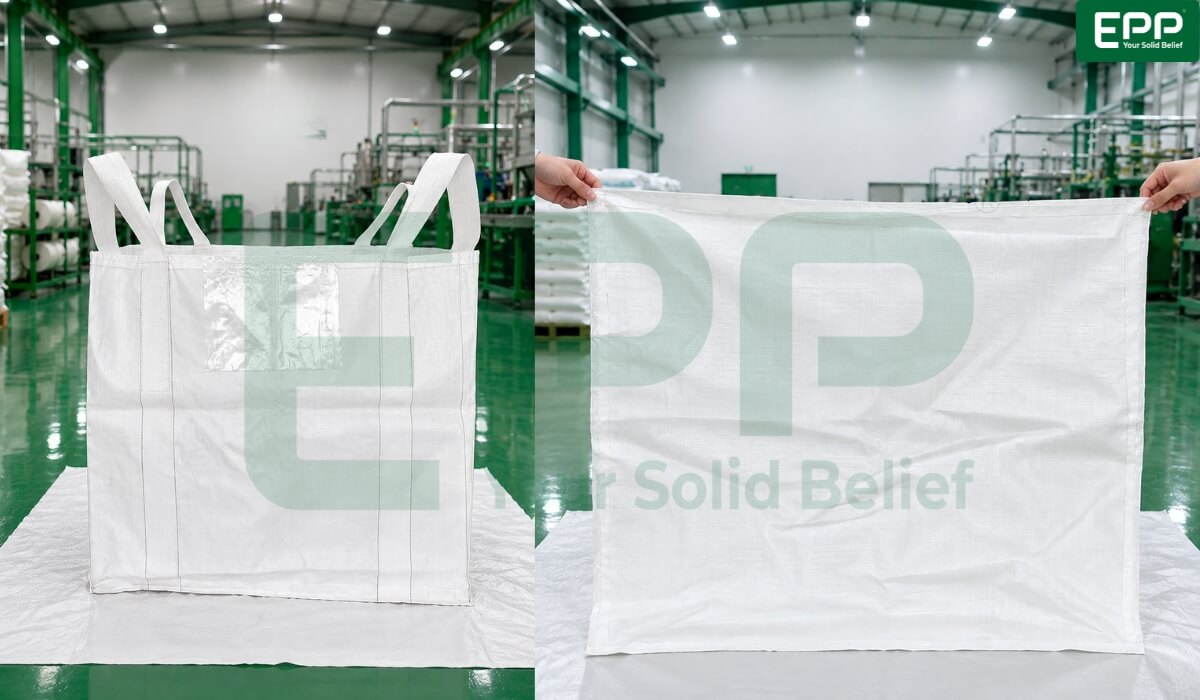
Certified FIBC Jumbo bag ready for export under Vietnam FTAs
Navigating Rules of Origin
To claim 0% preferential tariffs under agreements like the EVFTA or CPTPP, the imported goods must satisfy specific Rules of Origin (ROO). For woven polypropylene packaging under HS 6305.32, the product must undergo substantial transformation within Vietnam.
Working with an experienced manufacturer that maintains full traceability from resin extrusion to sewing ensures smooth customs approval. Navigating customs procedures for importing goods from Vietnam requires partnering with suppliers that provide pre-verified Certificate of Origin paperwork alongside commercial invoices and bills of lading.
Step-by-Step Practical Action Plan for Foreign Importers
To capture maximum value from Vietnam’s Free Trade Agreements, foreign procurement teams should execute a structured sourcing strategy:
Audit Your Current Tariff Burden
Identify the specific HS codes for all raw materials, finished components, and packaging materials in your inventory. Compare your current landed tariff rates against Vietnam’s preferential FTA tariff schedules under EVFTA, CPTPP, UKVFTA, or RCEP.
Partner with Verified Vietnamese Manufacturers
Select manufacturing partners that maintain audited supply chain traceability. Ensure your supplier has a proven track record of issuing C/O Form EUR.1, Form CPTPP, or Form RCEP documentation approved by Vietnam’s Ministry of Industry and Trade (MOIT).

Certificate of Origin Form EUR.1 for Vietnam packaging exports under EVFTA
Request Sample Testing and Customs Paperwork Pre-Validation
Before finalizing high-volume contracts, request production samples along with draft C/O documentation and technical test reports. Have your local customs broker pre-validate the origin documentation to ensure frictionless customs clearance upon shipment arrival.
Conclusion & Procurement Recommendations
Vietnam’s strategic execution of 18 bilateral and multilateral Vietnam’s Free Trade Agreements establishes the nation as a vital link in global commerce. By offering 0% duty market access across Europe, the Americas, and the Asia-Pacific, Vietnam provides a clear landed-cost advantage over competing manufacturing hubs.
For enterprise buyers seeking reliable, high-performance industrial packaging, EPP Vietnam offers the perfect combination of world-class quality and duty-free export capability. Contact EPP Vietnam’s technical sales specialists today to audit your packaging requirements, request certified product samples, and discover how our EVFTA-compliant packaging solutions can lower your supply chain costs.
Website: epp.vn
Alibaba website: https://eppvietnam.trustpass.alibaba.com/
Email: [email protected] Hotline/ Whatsapps: +84 986 002 888