As trade friction and penalizing trade remedies continue to disrupt traditional manufacturing hubs, sourcing from Vietnam has emerged as a cornerstone strategy for international buyers, importers, and procurement directors seeking stability, regulatory compliance, and cost predictability.
This comprehensive guide explores how sourcing from Vietnam acts as a powerful hedge against tariff volatility, detail the real cost factors behind global procurement, and demonstrate how partnering with EPP Vietnam—a leading FIBC supplier in Vietnam—enables international businesses to optimize their industrial packaging supply chains with complete transparency.
Why Are International Buyers Sourcing from Vietnam?
The global manufacturing landscape is undergoing a structural realignment. Decision-makers are no longer focusing exclusively on unit price; instead, they prioritize supply chain resilience, tariff diversification, and risk mitigation. Sourcing from Vietnam allows international buyers to balance risk across multiple geographic locations while maintaining proximity to key Asian raw material supply networks.

Sourcing from Vietnam provides global procurement teams with a tariff-optimized and resilient supply chain footprint.
Vietnam as a China Plus One Sourcing Strategy
The implementation of “China Plus One” strategies has accelerated rapidly among global enterprises. Rather than completely dismantling established manufacturing hubs, companies choose sourcing from Vietnam to complement existing supply chains. This approach prevents single-country dependency, mitigates sudden regulatory disruptions, and provides procurement teams with operational flexibility without compromising production volume or lead times.
Vietnam’s Manufacturing and Export Ecosystem
Vietnam has cultivated mature industrial clusters across high-value sectors, including textiles, electronics, furniture, and industrial packaging. According to data reported by VOV, Vietnam’s total import-export turnover reached a historic record of US$930.05 billion in 2025, representing an 18.2% year-on-year increase and cementing the country’s position as a primary global manufacturing base. The nation’s expanding raw material processing infrastructure—such as local domestic polypropylene (PP) resin conversion—ensures seamless support for heavy-duty industrial packaging supplier Vietnam operations.
Trade Agreements and Market Access
A fundamental driver behind sourcing from Vietnam is the country’s extensive network of Free Trade Agreements (FTAs). Vietnam participates in major multilateral pacts, including the Comprehensive and Progressive Agreement for Trans-Pacific Partnership (CPTPP), the EU-Vietnam Free Trade Agreement (EVFTA), and the Regional Comprehensive Economic Partnership (RCEP). These agreements offer global importers preferential tariff rates and streamlined customs procedures. To understand how these treaties lower trade barriers, explore our detailed analysis of Vietnam’s free trade agreements.
Strategic Advantages of Sourcing from Vietnam
When evaluating sourcing from Vietnam, procurement teams often ask whether shifting orders automatically shields them from punitive import duties. Navigating international trade policy requires a clear understanding of HS codes, trade measures, and origin compliance.
Vietnam Sourcing Does Not Automatically Mean Zero Tariffs
It is critical to recognize that sourcing from Vietnam is a strategy for duty optimization and risk diversification, not an automatic tariff waiver. Import duties depend on exact HS classifications, product-specific trade remedies, and the importing country’s current tariff schedules (such as U.S. Section 301 rules or anti-dumping duties). Evaluating duty impact requires thorough analysis of specific Harmonized System codes rather than assuming broad exemptions.
Why Country of Origin and Compliance Matter?
To legally access preferential duty treatment when sourcing from Vietnam, products must strictly satisfy international trade rules. Customs authorities, particularly U.S. Customs and Border Protection (CBP) and EU authorities, rigorously monitor trade compliance to prevent illegal transshipment.
- Substantial Transformation: Products must undergo significant, documented processing within Vietnam. For instance, converting imported primary PP resin into woven fabric and sewing finished FIBC bulk bags in a domestic factory constitutes genuine local value addition.
- Origin Documentation & Traceability: Importers must maintain complete compliance documentation, including Certificates of Origin (C/O Form B, Form EUR.1, or Form ICO), bill of materials (BOM), and factory production logs to pass official audits.
Tariff Volatility vs. Supply-Chain Diversification
While unilateral tariff rates can fluctuate based on executive trade decisions, maintaining an active supplier base in Vietnam creates vital strategic agility. By spreading production across multiple jurisdictions, global companies hedge against sudden policy shifts, maintaining predictable landed cost models even during broader trade disputes.
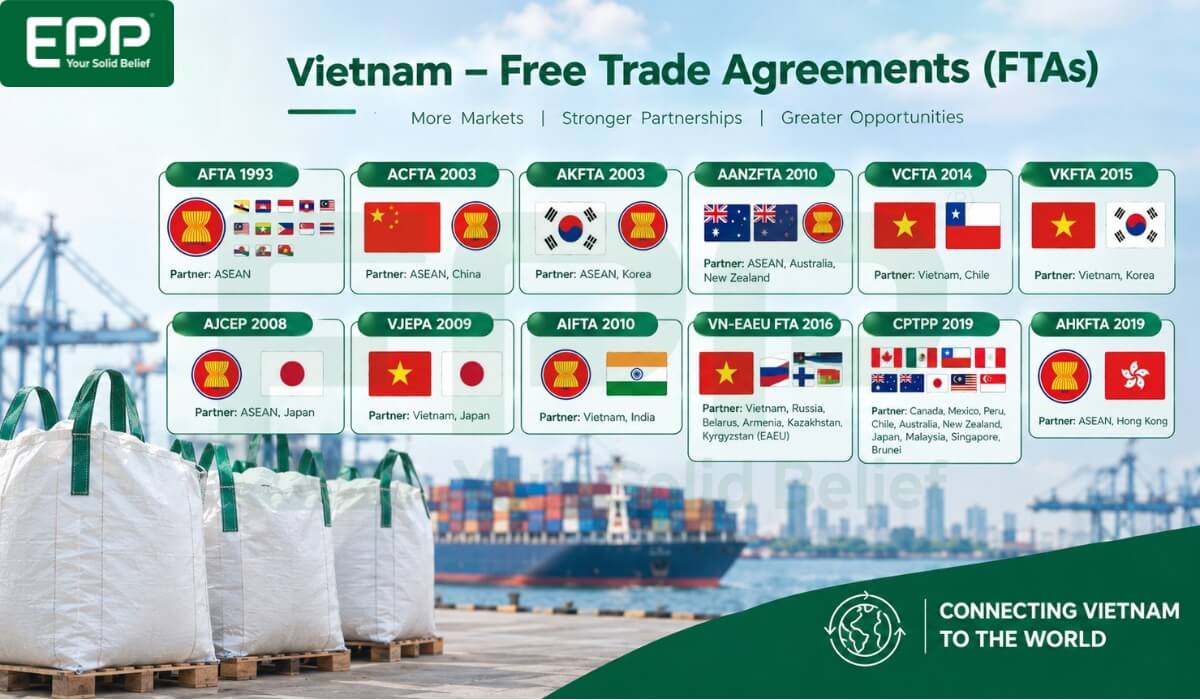
Vietnam’s extensive FTA network offers distinct tariff advantages for international procurement managers.
What Is the Real Cost of Sourcing from Vietnam?
A common mistake in international procurement is evaluating suppliers based solely on Ex-Works (EXW) or Free on Board (FOB) quotes. Successful sourcing from Vietnam requires analyzing the total landed cost to build an accurate commercial business case.
Product Price Is Only One Part of Landed Cost
The complete landed cost calculation for importing manufactured goods includes multiple interconnected expenses:
Total Landed Cost = Factory Price + Ocean Freight & Insurance + Import Duties
+ Customs Clearance & Handling + Inland Logistics + Financing Costs
Accounting for each component prevents budget overruns and establishes a clear cost baseline when transitioning order volumes to new overseas vendors.
Vietnam Logistics and Ocean Freight Infrastructure
Vietnam’s geography along primary maritime shipping lanes offers direct sea access to North American, European, and Asian markets. Deep-water port systems accommodate large container vessels, enabling direct ocean services that shorten transit times to major destination ports.
To streamline maritime logistics, partnering with reliable freight experts is crucial. Procurement directors should review the top Vietnam freight forwarders to optimize container routing, carrier selection, and port handling.
Shipping Routes and Transit Planning
Transit timelines directly influence safety stock calculations and inventory holding costs. Direct container routes from Vietnam to North American ports provide predictable delivery schedules:
- Vietnam to U.S. West Coast (Los Angeles / Long Beach): ~18 to 22 days.
- Vietnam to U.S. East Coast (New York / Savannah): ~28 to 35 days.
For a detailed review of customs clearance steps, port options, and shipping documentation, consult our specialized guide on shipping from Vietnam to the US.
Key Actionable Steps for Procurement Managers Sourcing from Vietnam
For global procurement managers sourcing general goods—ranging from apparel and electronics to industrial commodities and packaging—following a standardized framework ensures operational continuity and trade compliance.
- Audit HTS Classifications and Import Duty Schedules: Identify the precise 8-digit or 10-digit Harmonized Tariff Schedule (HTS) code for your goods to calculate baseline duty rates, applicable trade remedies, and eligible FTA tariff margins.
- Standardize Technical Product Specifications: Develop rigorous Product Specification Sheets (PSS) covering material grades, engineering tolerances, packaging standards, and target regulatory compliance before requesting quotations.
- Perform Multi-Tier Supplier Vetting: Validate vendor credibility through physical or third-party factory audits. Verify legal business registrations, production capacities, in-house machinery, subcontracting risks, and labor compliance.
- Request and Benchmark Pre-Production Samples: Subject custom physical prototypes to independent laboratory testing (e.g., tensile strength, chemical composition, electrical safety, or drop impact tests) prior to commercial contract signing.
- Verify Rules of Origin and Traceability: Require suppliers to demonstrate local value addition (substantial transformation) and ensure full access to Certificates of Origin (C/O) and raw material bill-of-materials (BOM) for customs clearance.
- Calculate Total Landed Cost (TLC): Conduct comprehensive financial modeling factoring in FOB unit price, international ocean freight, marine insurance, terminal handling charges (THC), import duties, customs brokerage, and destination inland transport.
- Execute Phased Purchase Orders: Begin with initial trial container orders to test production lead times, quality consistency, and ocean freight logistics before shifting strategic purchasing volume.
Why EPP Vietnam Is Your Premier Partner for FIBC Bulk Bags?
When sourcing from Vietnam for industrial bulk packaging, choosing a partner with deep technical expertise and export experience is essential. EPP Vietnam serves as a premier FIBC supplier in Vietnam, delivering tailored packaging solutions to international buyers across the globe.
20+ Years of Manufacturing Excellence and Export Expertise
With over two decades of industry leadership, EPP Vietnam bridges the gap between complex buyer requirements and high-quality manufacturing execution. Our technical domain expertise ensures that every Vietnam PP woven bag export meets exact engineering specifications, strict safety ratios, and international compliance standards.
Comprehensive Packaging Portfolio
EPP Vietnam provides a complete range of industrial packaging engineered for bulk material handling across agriculture, chemicals, mining, construction, and food processing:
- Jumbo Bags: Type A, B, C, D, Standard U-Panel, 4-Panel, Circular, Baffle (Q-Bags), Venting bags, and Cross-Corner loop bags.
- Specialized Cleanroom & Hazard Bags: Food-Grade BRCGS certified bags, UN-certified dangerous goods packaging, and IEC compliant Type C/D anti-sta,tic bulk bags.
Full Customs Compliance and Documented Origin Traceability
EPP Vietnam offers complete support for international trade compliance. We provide full origin documentation—including valid C/O certificates, raw material origin records, and technical test certificates—ensuring smooth customs clearance and optimized duty treatment for global buyers.

Export packaging compliance requires aligning product properties, packaging materials, transport modes, and destination regulations.
Frequently Asked Questions (FAQs) About Sourcing from Vietnam
Is sourcing from Vietnam cheaper than sourcing from China?
Sourcing from Vietnam offers highly competitive labor costs and competitive factory pricing. However, total landed cost depends on specific raw material inputs, product technical specifications, ocean freight rates, and destination import tariffs. When factoring in preferential tariff treatment under trade agreements, sourcing from Vietnam frequently results in a lower total landed cost for international buyers.
Is Vietnam a good alternative to China?
Yes. Vietnam is a primary destination for companies implementing a “China Plus One” strategy. It offers political stability, a skilled labor force, modern deep-water ports, and extensive free trade agreements. Rather than replacing existing supply bases entirely, sourcing from Vietnam complements global supply networks by spreading concentration risk.
How can businesses mitigate risks when sourcing from Vietnam?
Businesses can mitigate sourcing risks by conducting thorough supplier background checks, performing physical or third-party factory audits, requiring pre-shipment quality inspections, establishing clear Incoterms (e.g., FOB or DDP), and verifying all origin documentation to ensure customs compliance.
What products can I source from Vietnam?
Vietnam is a major global manufacturing hub for industrial packaging (FIBC bulk bags, PP woven sacks), textiles, footwear, consumer electronics, furniture, wood products, rubber components, and agricultural commodities.

Secure Your Packaging Supply Chain with EPP Vietnam
Navigating global tariff volatility requires proactive strategic planning, reliable supply partners, and uncompromising quality standards. Sourcing from Vietnam empowers procurement leaders to reduce supplier concentration risks while maintaining clear landed cost advantages and complete trade compliance.
As a leading FIBC supplier in Vietnam with over 20 years of export excellence, EPP Vietnam is equipped to support your organization in optimizing its bulk packaging supply chain. Contact our engineering and export team today to review your technical specifications, order custom samples, or receive a competitive landed cost quotation.
Website: epp.vn
Alibaba website: https://eppvietnam.trustpass.alibaba.com/
Email: [email protected] Hotline/ Whatsapps: +84 986 002 888