Flexible Intermediate Bulk Containers (FIBCs), often referred to as bulk bags, are critical for the safe and efficient transport and storage of non-dangerous solid materials like powders, granules, and pastes. To ensure FIBCs meet modern safety, performance, and sustainability standards, the International Organization for Standardization (ISO) has released ISO 21898:2024, an updated standard replacing ISO 21898:2004. This comprehensive revision introduces key changes to reflect advancements in technology, industry needs, and environmental considerations.
In this article, we explore the background and key content of revised ISO 21898, offering insights for manufacturers, suppliers, and end users seeking to optimize operations and ensure compliance.
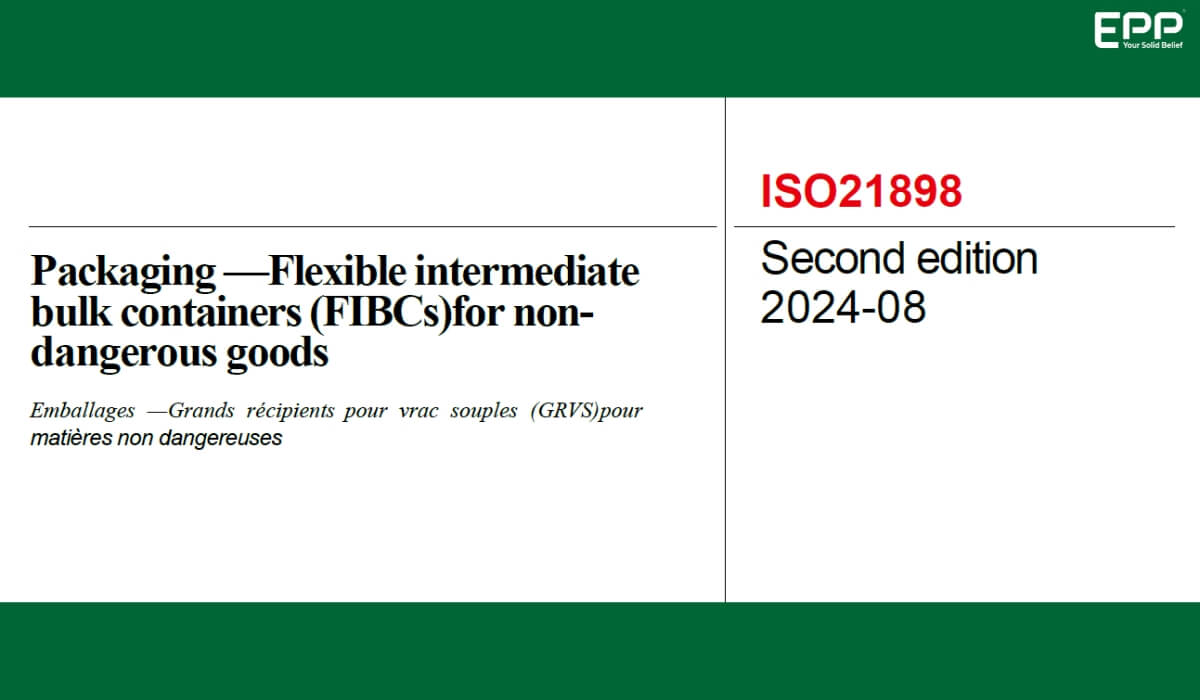
ISO 21898:2024 introduces updated dynamic testing requirements for non-dangerous goods packaging.
What is ISO 21898?
ISO 21898:2024 is the primary international standard that specifies requirements for materials, design, construction, type testing, and marking of flexible intermediate bulk containers intended to contain non-dangerous solid materials. These materials cover agricultural products (grains, seeds), construction minerals (sand, cement), chemical granules, and food ingredients (flour, sugar). The standard applies to bags filled by gravity or pressure and lifted from above using integral or detachable lifting devices.
Beyond manufacturing criteria, the ISO 21898 standard provides guidance on safe selection, handling, storage, and recycling. By establishing harmonized performance metrics across global markets, it helps buyers minimize product loss, prevent workplace injuries, and maintain seamless cross-border compliance.
For buyers looking to align their packaging with international market guidelines, explore our overview on standards for fibc bags in the international market.
ISO 21898:2004 vs ISO 21898:2024 — What Changed?
While ISO 21898:2004 established a reliable baseline for two decades, advancements in woven polypropylene fabric technology, automated handling, and environmental regulations necessitated a major update. The 2024 revision incorporates 20 years of field feedback, introducing five major structural enhancements:
1. Integration of Recyclable and Recycled Materials
ISO 21898:2024 officially permits the use of Recycled Mono-Materials (RM) consisting of 95% or more of the same polymer across all FIBC components.
- No Percentage Cap: There is no restriction on the percentage of recycled materials used, provided FIBCs made from recycled plastics fulfill the exact same test criteria as those made from virgin materials.
- Inner Liners: Liners manufactured from recycled polymers must also satisfy the identical performance standards required for virgin liners.
2. Stricter Seam Construction and Stitching Rules
To prevent fine powder leakage and seam failure, the updated standard establishes stricter seam construction rules. Stitched seams must feature locked-off threads or minimum 20 mm thread tails. Welding, gluing, or heat-sealing methods must maintain clean bonding surfaces to ensure structural integrity under pressure.
3. Incorporation of Electrostatic Standards
ISO 21898:2024 explicitly incorporates IEC 61340-4-4. FIBCs intended for use in hazardous explosive atmospheres where dusts, gases, or solvent vapors could ignite must satisfy the test methods and classification specified in IEC 61340-4-4 (Type B, C, or D).
4. Enhanced UV Stabilization and Weathering Standards
ISO 21898:2024 raises requirements for UV stabilization to extend bag longevity during outdoor yard staging, significantly reducing degradation risks in tropical climates.
- Test Cycle: At least 300 hours of UV/condensation exposure using UVB-313 lamps.
- Pass Criterion: Load-bearing fabrics must retain $\ge 50\%$ of their original tensile strength and elongation.
To review facility accreditations matching these new requirements, read our guide on certifications for high quality bulk bag manufacturers.
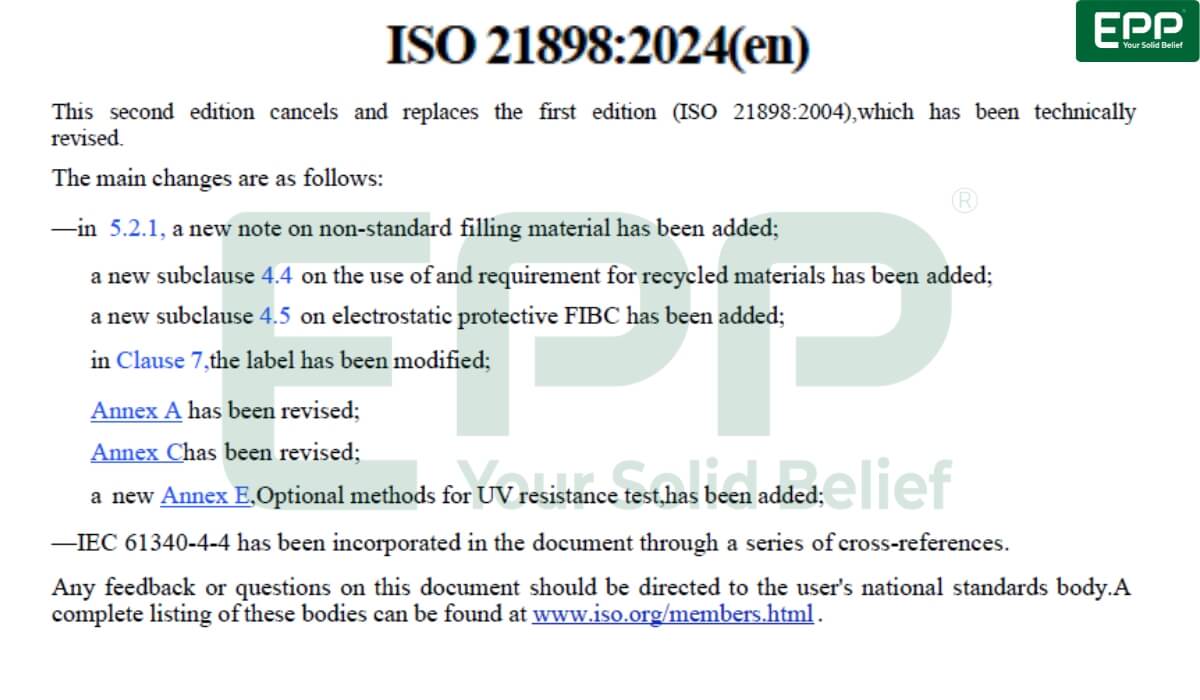
Summary of key updates in ISO 21898:2024, including new subclauses for recycled materials and electrostatic safety.
Comparing Standards: ISO 21898:2024 vs. AS 3668-2019
Procurement managers operating across the Asia-Pacific region often evaluate ISO 21898:2024 against Australia’s AS 3668-2019 standard:
| Feature / Criteria | ISO 21898:2024 | AS 3668-2019 |
| Geographic Recognition and Scope | Global standard (ISO/CEN harmonized) for non-dangerous goods bulk packaging. | Regional standard strictly enforcing compliance within Australia and New Zealand. |
| Use of Recycled Materials | Permitted: Allows Recycled Mono-Materials (>= 95% same polymer) with no percentage caps. | Strictly restricted: Primarily mandates virgin polypropylene resins for load-bearing components. |
| Electrostatic Protection Integration | Direct integration of IEC 61340-4-4 for Type B, C, and D FIBC requirements. | Refers separately to AS/NZS regional electrostatic standards. |
| Seam Finishing and Thread Tails | Mandatory >= 20 mm thread tail or locked-off/back-sewn stitching. | Standard industrial lock-stitching without explicit minimum tail length criteria. |
For food-grade applications, mechanical compliance must be paired with cleanroom hygiene. Learn how food packaging safety shields cargo in our article on BRCGS for food packaging.
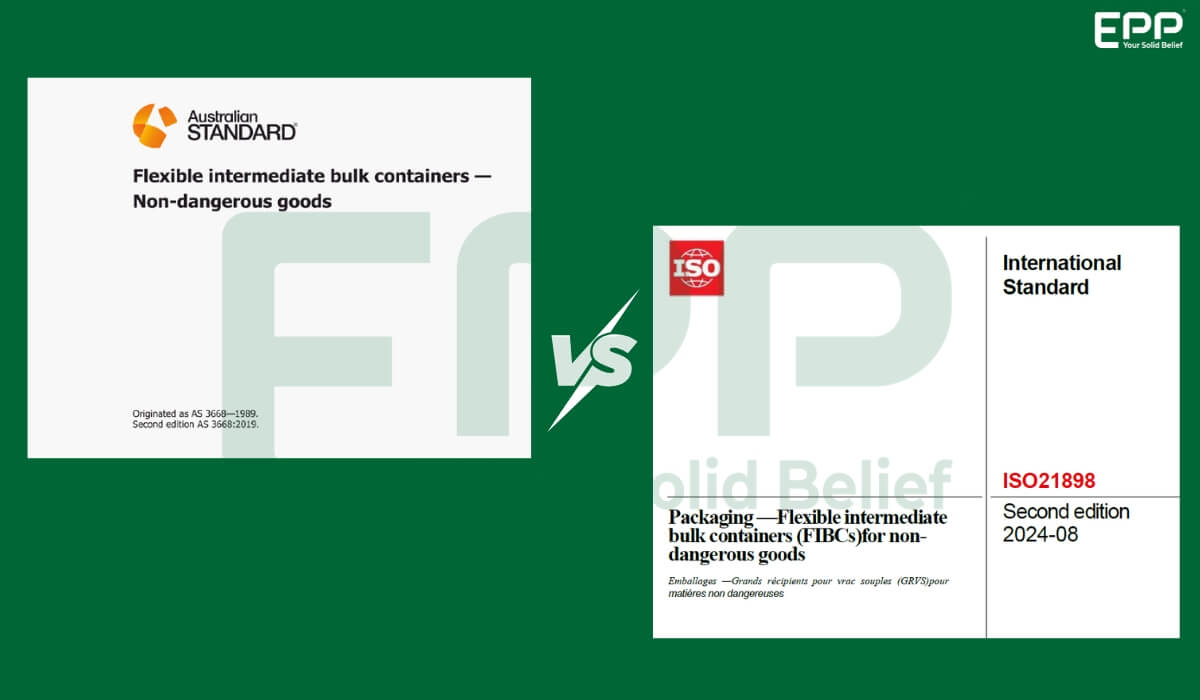
ISO 21898:2024 vs Australia’s AS 3668-2019 standard
How Buyers Should Verify ISO 21898:2024 Compliance?
To ensure complete compliance when purchasing bulk bags, procurement officers should verify four essential areas:
Mandated Labeling Format
Every FIBC must feature a permanently attached, visible label containing:
- Manufacturer name, address, and unique reference number.
- Safe Working Load (SWL in kg) and Safety Factor (SF 5:1, 6:1, or 8:1).
- Stacking symbol showing maximum permitted stacking (1+n bags).
- Approved laboratory name, test number, and issue date.
- Exact reference text: ISO 21898:2024.
- Class of FIBC (“single-trip”, “standard-duty reusable”, or “heavy-duty reusable”).
- Date of manufacture (month and year).
Reviewing Statement of Conformity Documentation
Validate that the supplier’s certificate includes test report references, the exact material used during testing (standard granules vs. specific product), and confirm the document is within its 3-year validity window.
To source compliant, fully tested bulk containers across various custom specifications, browse our export catalog for fibc super sack.

Frequently Asked Questions (FAQs) About ISO 21898:2024
Does ISO 21898:2024 apply to dangerous goods?
No. ISO 21898:2024 strictly covers non-dangerous solid materials in powder, granular, or paste form. Hazardous goods packaging is governed by separate UN Dangerous Goods regulations.
What are the UV testing requirements under ISO 21898:2024?
Under Annex A, load-bearing fabrics must undergo at least 300 hours of UV/condensation cycling (UVB-313 lamps at 0.71 W/m2/nm) and retain at least 50% of their original tensile strength and elongation at rupture.
Can recycled polypropylene be used under ISO 21898:2024?
Yes. Subclause 4.4 permits recycled mono-materials (>= 95% same polymer) without percentage limits, provided the finished FIBC meets all standard type-testing requirements.
How does ISO 21898:2024 handle electrostatic protection?
Subclause 4.5 references IEC 61340-4-4. FIBCs designed for explosive atmospheres must pass IEC 61340-4-4 breakdown voltage and resistance testing.

EPP Vietnam engineers custom Big bags for severe industrial environments
Streamline Your ISO 21898:2024 Sourcing with EPP Vietnam
The ISO 21898:2024 standard provides an updated framework for non-dangerous goods bulk packaging. By enforcing stricter seam standards, formalizing recycled material rules, and standardizing 3-year certificate validities, ISO 21898:2024 helps global buyers minimize transport hazards.
EPP Vietnam simplifies international procurement by delivering fully certified, audit-ready bulk packaging solutions. Contact our technical sales team today for custom engineering consultations, sample requests, or instant FOB/CIF freight quotes:
Website: epp.vn
Alibaba website: https://eppvietnam.trustpass.alibaba.com/
Email: [email protected] Hotline/ Whatsapps: +84 986 002 888