
Global enterprise procurement requires balancing operational speed, cost efficiency, and risk mitigation. Flexible Intermediate Bulk Containers (FIBCs), or bulk bags, serve as the primary transport vessel for dry bulk solids worldwide. However, managing bulk packaging across international borders involves complex engineering and strict regulatory frameworks.
This guide breaks down the critical compliance standards for FIBC bags every procurement team must know—from structural load thresholds and explosion hazards to food hygiene certifications—providing a practical roadmap for auditing suppliers and safeguarding your bulk material logistics.
Why Do Standards for FIBC Bags Matter for B2B Buyers?
Selecting industrial bulk packaging is a critical operational decision directly affecting product safety, regulatory compliance, and bottom-line profitability.
For procurement managers and supply chain directors, adhering to international standards for FIBC bags is not merely a technical formality; it is a primary safeguard against package failure, international customs seizures, expensive product loss, and severe workplace safety incidents.
Partnering with accredited suppliers who comply with recognized global standards ensures that your packaging maintains structural integrity throughout ocean freight transit, automated warehouse stacking, and high-speed loading operations. Working with vetted vendors supported by verified certifications for high quality bulk bag manufacturers gives enterprise buyers the confidence that their global supply chains remain secure and fully compliant.

Standards for FIBC bags in the international market
General Performance Standards for FIBC bags
Mechanical performance standards form the baseline for structural engineering in bulk packaging. These standards ensure that an FIBC can safely withstand static loads, mechanical lifting forces, and the physical stresses encountered during long-distance transportation.
ISO 21898: The Mechanical Baseline
The benchmark international standard governing non-dangerous goods bulk bags is ISO 21898. This standard defines essential structural parameters, including:
- Safe Working Load (SWL): Specifies the maximum payload weight an FIBC is rated to carry safely, typically ranging from 500 kg to 2,000 kg (1,100 lbs to 4,400 lbs).
- Safety Factor (SF): Defines the structural safety margin of the bag under test conditions.
- SF 5:1 (Single-Trip Bags): Engineered for a single fill-and-discharge cycle. The bag must withstand a top-lift load of five times its rated SWL before structural failure during laboratory testing.
- SF 6:1 (Multi-Trip / Heavy-Duty Bags): Engineered for repeated use or rugged transport environments, requiring a six-fold load threshold.
Staying current with technical updates—such as recent ISO 21898: 2024 standard updates—is vital for enterprise buyers to ensure their procurement technical specifications align with modern mechanical safety requirements.
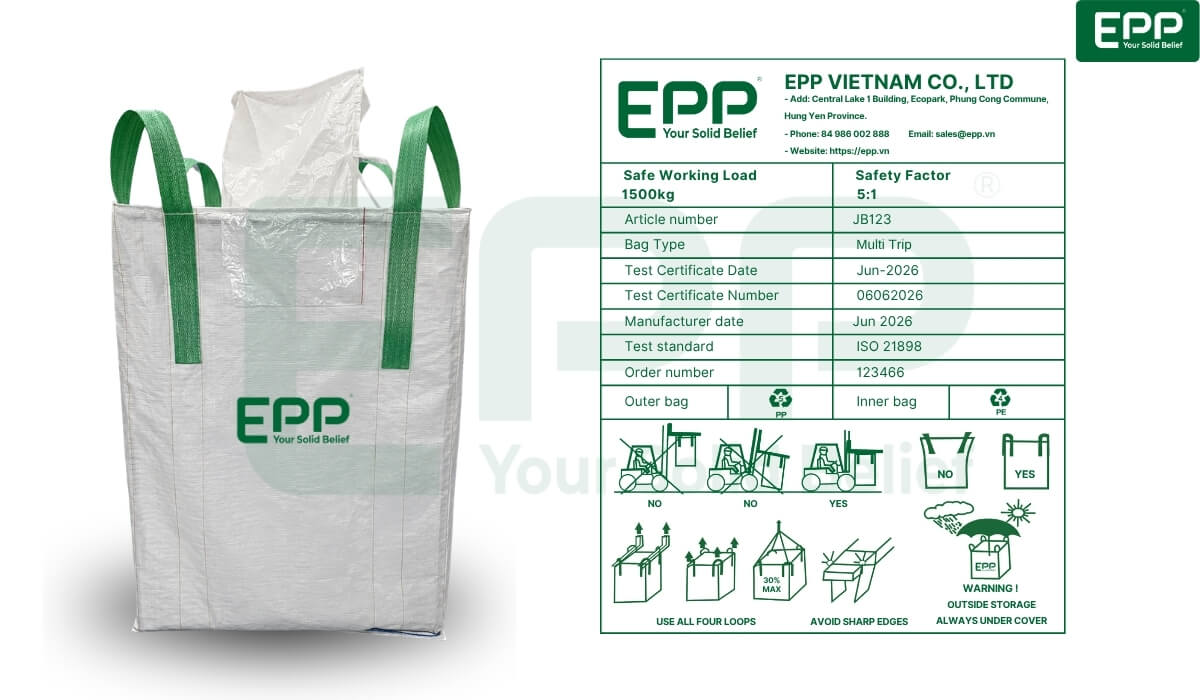
Bulk bag label from EPP Vietnam under ISO 21898 standard
Mechanical Rigor and Stress Testing
Before an ISO 21898 certificate is granted by an accredited laboratory (such as Labordata), sample super sacks must pass rigorous mechanical stress evaluations:
- Cyclic Top-Lift Test: The bag is filled to its rated SWL and subjected to repeated cyclic lifting actions via its corner or cross-corner lifting loops to simulate crane and forklift handling.
- Stacking (Compression) Test: Simulates long-term warehouse storage conditions where filled bags are stacked 2 to 4 high, verifying that the lower units resist sidewall bulging and tilting.
- Drop and Topple Test: Filled big bags are dropped from specified heights to ensure seams and spout closures remain intact under sudden kinetic impact.
Hazardous Materials & Electrostatic Safety
When transporting volatile chemicals, flammable powders, or combustible dusts, packaging failure can lead to environmental contamination or facility explosions. Specialized international standards regulate these high-risk applications.
UN Certification for Dangerous Goods
The United Nations (UN) regulates the transport of dangerous goods across international borders. FIBCs intended for hazardous materials must carry an official UN code marking and undergo specialized testing based on the material’s Packing Group assignment:
| Packing Group | Hazard Level | UN FIBC Testing Requirements |
| Packing Group I | High Danger | Not permitted in standard FIBCs |
| Packing Group II | Medium Danger | Requires rigorous drop, stack, tear, and top-lift testing |
| Packing Group III | Low Danger | Standard hazardous testing protocols apply |
Official UN markings (such as 13H1, 13H2, 13H3, or 13H4) indicate the woven fabric construction, lamination, and liner configuration, proving compliance with global maritimeand air transport codes.
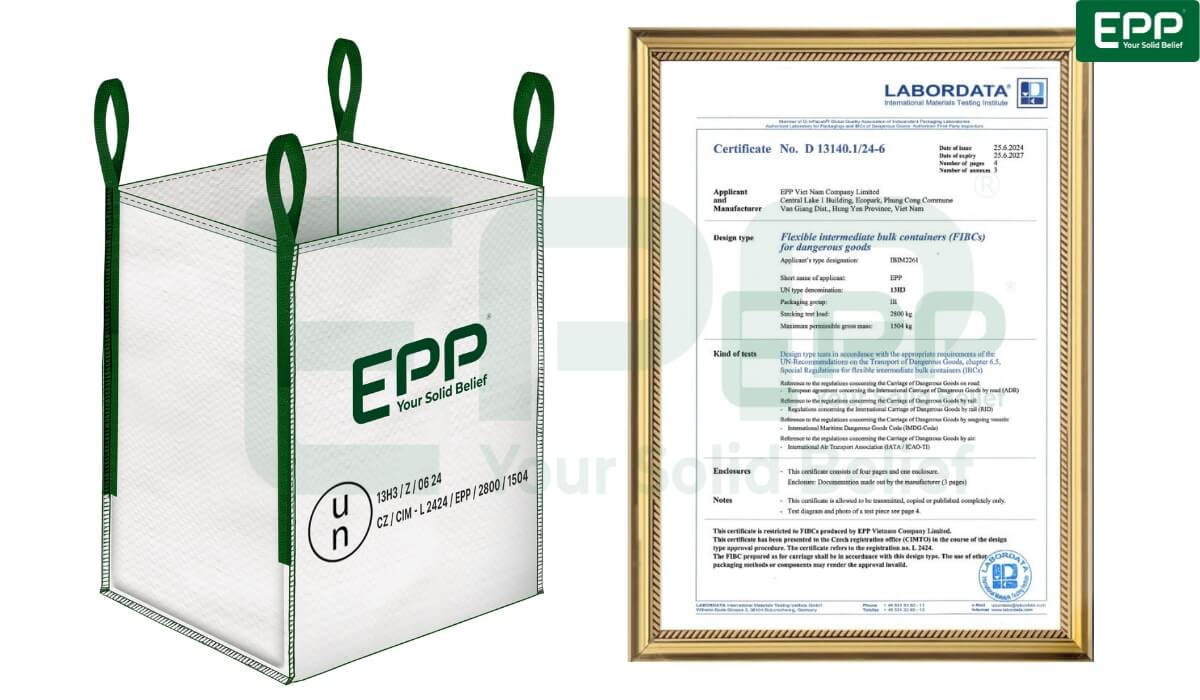
UN big bag and UN certificates from EPP Vietnam
Electrostatic Safety: IEC 61340-4-4 Standards
High-speed pneumatic filling or emptying of dry powders generates substantial static electricity. In environments containing flammable gases or combustible dusts, an electrostatic spark can cause a catastrophic explosion.
The International Electrotechnical Commission standard IEC 61340-4-4 categorizes bulk bags into four distinct electrostatic safety classes:
- Type A: Standard fabric with no electrostatic protection. Used exclusively for non-flammable materials in non-hazardous environments.
- Type B: Fabric designed with breakdown voltage control (< 6 kV) to prevent energetic propagating brush discharges.
- Type C (Groundable): Constructed with a grid of interconnected conductive threads. Must be connected to a verified ground point during filling and emptying.
- Type D (Crohmiq / Dissipative): Manufactured with specialized static-dissipative threads that safely discharge static energy into the atmosphere via corona discharge without requiring a ground connection.
Reviewing the technical requirements of the IEC 61340-4-4 helps safety officers match the appropriate bag type to their facility’s specific explosion hazard zones.
Food and Pharmaceutical Standards for FIBC Bags
Packaging used for food ingredients, agricultural grains, or active pharmaceutical ingredients (APIs) requires high standards of hygiene and chemical purity to prevent batch contamination and preserve consumer health.
Cleanroom Production and BRCGS Certification
Food-grade FIBCs cannot be produced on standard industrial assembly lines. They require dedicated cleanroom facilities certified under international food safety frameworks, such as BRCGS Packaging Materials (Global Standard for Packaging Materials), ISO 22000, or FSSC 22000.
Cleanroom manufacturing protocols include:
- Environmental Controls: HEPA air filtration, positive air pressure, and automated pest control systems to prevent airborne particulate contamination.
- Optical & Ultrasonic Cutting: Utilizing heated or ultrasonic cutters instead of traditional blades to seal fabric edges and eliminate loose polypropylene threads.
- Foreign Object Inspection: Light-table inspection, metal detection, and vacuum cleaning of every individual bag before final packaging.
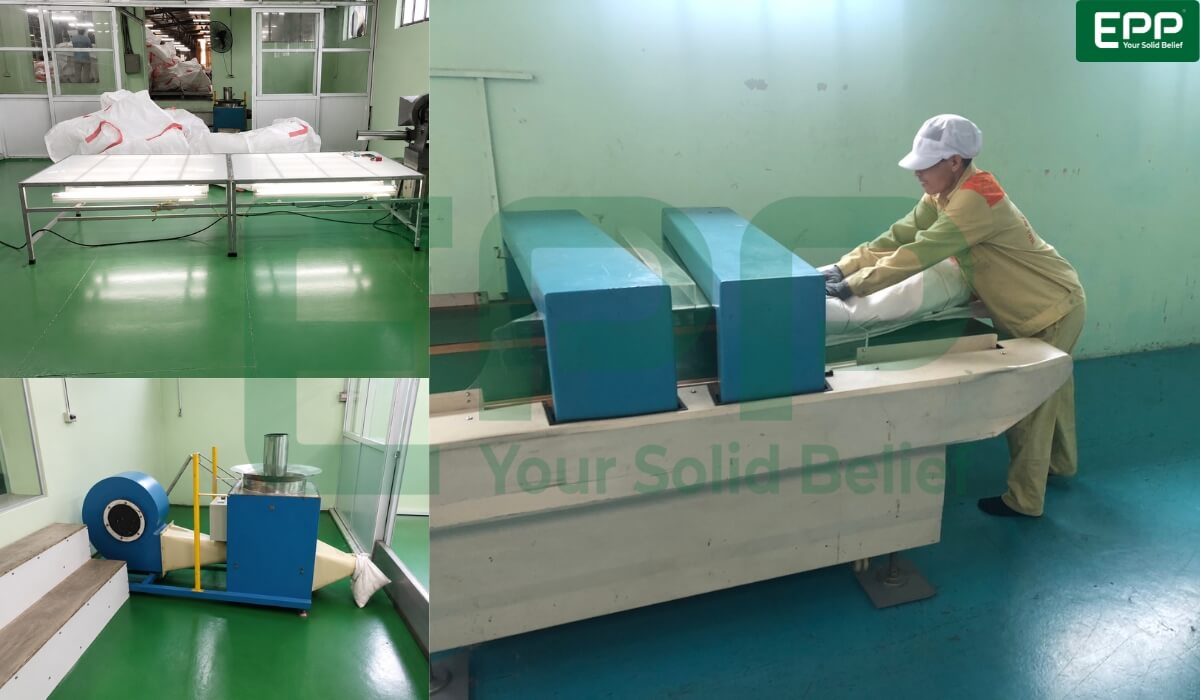
Light-table inspection, metal detection, and vacuum cleaning in EPP vietnam
Chemical Migration Compliance
All materials—including 100% virgin polypropylene resin, color masterbatches, sewing threads, and PE inner liners—must comply with direct food-contact regulations set by the US Food and Drug Administration (FDA) and EU Regulation (EC) No 10/2011.
B2B Buyer’s Checklist: How to Verify Manufacturer Certificates
Securing compliant FIBC packaging requires active supplier verification. Procurement teams should implement a systematic certificate audit process before finalizing purchasing contracts:
Step 1: Request Third-Party Test Reports
Demand full, unedited test certificates issued by recognized, independent testing laboratories (e.g., Labordata, Pira, or IIP) rather than self-issued manufacturer declarations.
Step 2: Cross-Check SWL and Safety Factor Parameters
Verify that the certificate explicitly lists the requested Safe Working Load (e.g., 1,000 kg) and Safety Factor (5:1 or 6:1) matching your specific technical purchase order.
Step 3: Validate BRCGS / ISO Directory Listings
Check the supplier’s BRCGS or ISO certificates against the official issuing body’s online directory to ensure the accreditation remains current and active.
Step 4: Audit UN Marking Validity
For hazardous goods, verify that the UN certificate accurately matches the specific dimensions, fabric weight, and inner liner specifications of the exact bag model being ordered.
Step 5: Verify Sourcing Platforms
Source high-volume orders through verified, experienced export manufacturing networks. Evaluating reliable procurement channels on where to buy bulka bags ensures your supplier possesses the production capacity, engineering oversight, and international quality certifications needed for seamless global supply chain operations.

FIBC bags from EPP Vietnam that meet international standards for bulk bags
Conclusion
Understanding and enforcing global standards for FIBC bags is an essential risk-management strategy for modern enterprise buyers. From baseline mechanical strength (ISO 21898) and explosion prevention (IEC 61340-4-4) to food-grade hygiene (BRCGS), strict adherence to international packaging benchmarks protects your workforce, safeguards your product quality, and preserves your corporate reputation across the global trade network.
🌐 Website: https://epp.vn – https://eppvietnam.trustpass.alibaba.com
📲 +84 986 002 888 – [email protected]