
In high-volume material processing, plant managers often ask a critical operational question: how are industrial super sacks lifted safely without exposing workforce personnel to risks or damaging valuable bulk inventory? Lifting Flexible Intermediate Bulk Containers (FIBCs) carrying 1000kg- 2000kg of dense powders or aggregates requires strict mechanical alignment between the bag’s loop structure and your plant’s material handling equipment.
1. Understanding FIBC Load Dynamics and Loop Configurations
Answering how are industrial super sacks lifted requires treating the FIBC as a engineered, high-tensile woven polypropylene system rather than a standard static container. When a bulk bag is loaded to capacity, gravitational force exerts massive downward stress that transfers directly through the side fabric into the corner lifting straps.
If lifting forces are pulled inward at acute angles rather than remaining perfectly vertical (a 90-degree angle relative to the top plane), lateral vector forces multiply exponentially. This concentrated side-tension stresses top seams, frequently resulting in premature strap detachment or seam tearing during transit.
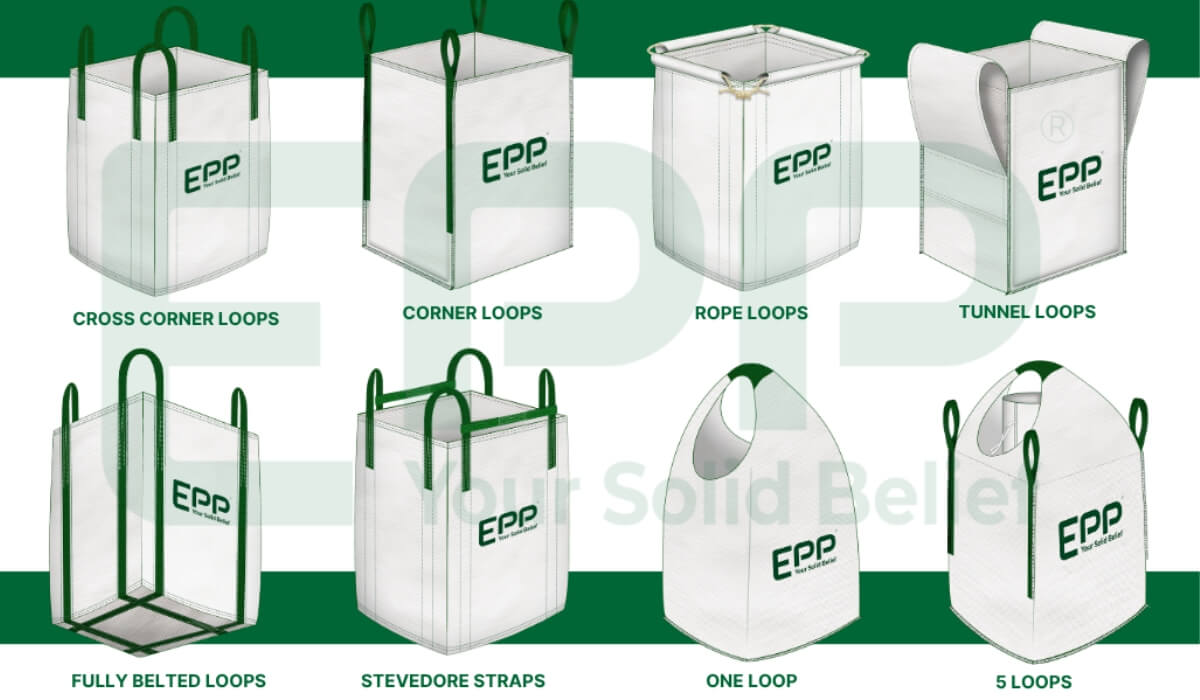
Common FIBC Lift Loop Engineering Designs
Executing effective super sack handling depends on matching your mechanical machinery to the specific loop style engineered into the bag body:
- Cross Corner Loops: Sewn across adjacent corners of circular fabric bodies, engineered to stand open naturally for rapid, single-operator forklift tine entry.
- Corner Loops: Stitched directly into the vertical side seams of 4-panel or U-panel bags, offering high tensile resistance for heavy vertical lift profiles.
- Tunnel Loops (Sleeve Loops): Continuous fabric side channels integrated along top margins, enabling instant forklift fork entry without requiring manual strap adjustment.
- Fully Belted Loops: Webbing reinforcement straps that extend continuously down the entire side fabric and cross beneath the bag base, delivering maximum structural integrity for extreme load capacities.
- Stevedore Straps: Secondary webbing straps connected across main corner loops, allowing single-point hook attachment for a super sack crane or shipboard hoisting system.
- One Loop (Single Loop): Formed by extending the main body fabric into a single, wide top lifting aperture, optimized for high-speed automated crane loading lines.
To establish comprehensive site protocols, consult EPP Vietnam’s detailed guide on FIBC Safe Handling Guidelines to train handling personnel effectively.
2. Core Mechanical Equipment for Lifting industrial super sacks
Plant operators rely on three primary equipment categories to perform a bulk bag lift, depending on whether materials are being moved horizontally across warehouse floors or raised vertically over discharge hoppers.
2.1 Forklifts and Dedicated Lifting Attachments
Forklifts are the workhorses of warehouse bulk transport, providing the fastest mobile option for how to move 1 ton bags between receiving docks and storage racks. However, using standard bare tines introduces significant shear risk if the steel edges are sharp or burred.
When using bare fork tines, operators must ensure fork edges have a rounded radius of at least 5mm or apply protective rubber sleeves. Without these safeguards, raw steel edges act like blades against woven polypropylene straps under high tension.
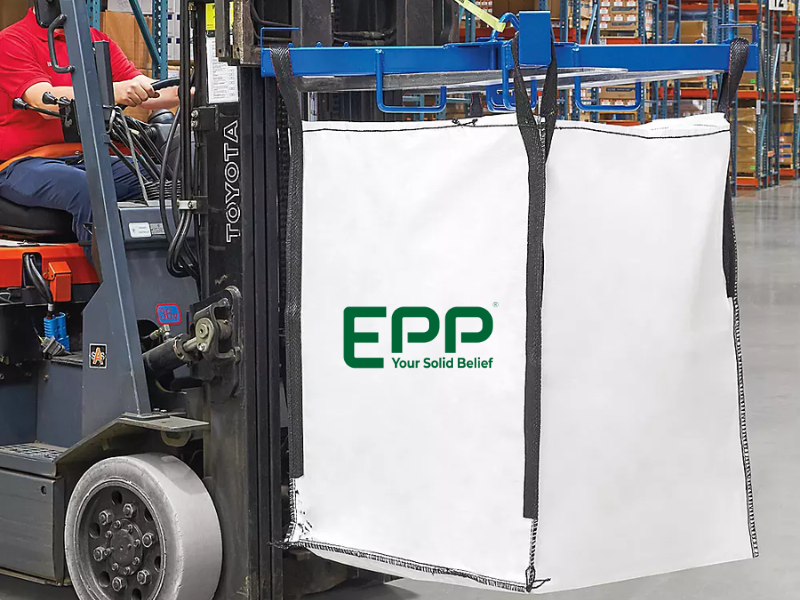
Forklift Super Sack Lift Operations
Using a dedicated forklift bulk bag lifter (spreader beam) eliminates tine wear completely. These heavy-duty steel attachments slide directly onto standard forklift tines and feature four wide-angle safety hooks.
By suspending the bag loops from fixed outer points, a specialized super sack lifter keeps all four loops vertical, preventing the bag from crowding the forklift mast or sliding during sudden stops.
For operations integrating specialized transport vehicles, review our technical overview of Means of Transporting FIBC Bags to streamline logistics workflows.
2.2 Overhead Crane Systems and Super Sack Hoist Units
In multi-level processing facilities, chemical plants, and batching plants, vertical lifting above reactors or mixing hoppers requires overhead rigging. An overhead super sack hoist or gantry crane offers precise positioning without occupying floor space.
Overhead lifting hardware must comply with ASME B30.20 standards for below-the-hook lifting devices. Rigid H-frame lifting beams equipped with labyrinth safety hooks ensure straps cannot slip off during suspended movement.
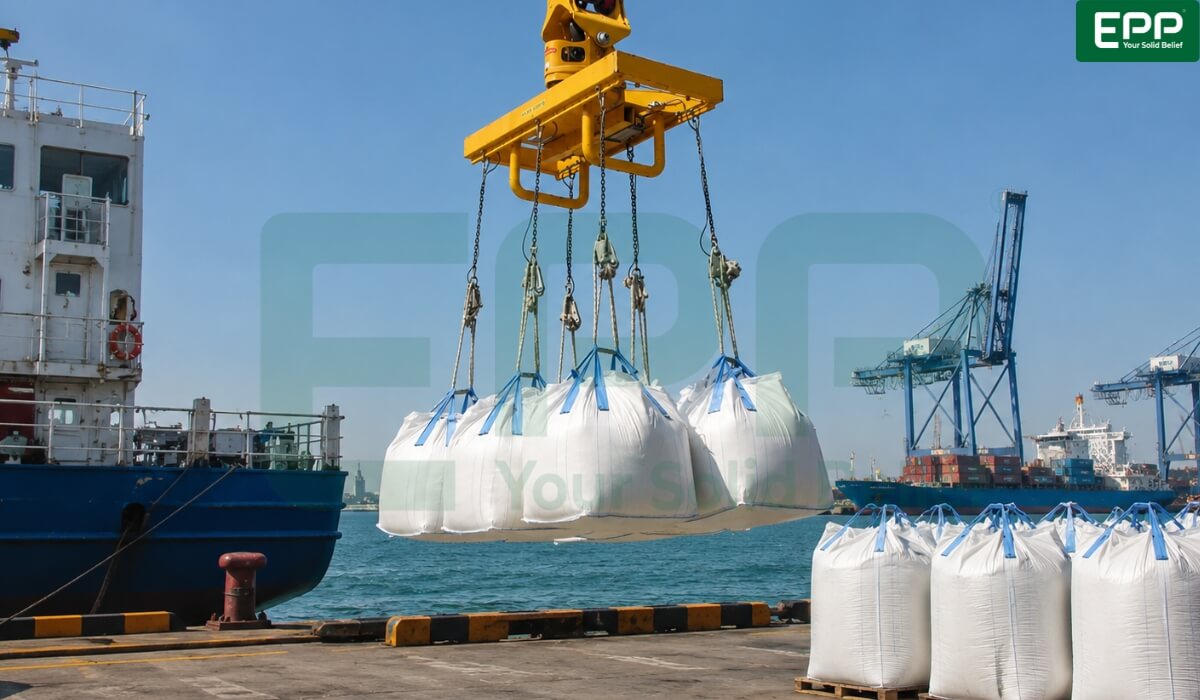
Overhead Super Sack Spreader Beam
2.3 Fixed Lifting Frame and Unloader Racks
When bulk bags must remain suspended over discharge chutes for extended periods, relying on active forklifts or cranes ties up expensive machinery and creates safety hazards. Stationary unloader frames solve this operational bottleneck.
- Stationary Super Sack Rack: Heavy structural steel frames fitted with top-tier hook mounts, designed to hold static loads up to 2000 kg securely during manual discharge.
- Integrated Unloader Stations: Complete discharge frameworks equipped with built-in pneumatic hoists, dust-tight access doors, and massage paddles to encourage material flow.
2.4 Comparison of Industrial Super Sack Lifters
Choosing the correct equipment requires matching mobility needs, ceiling clearance, and load capacities across hardware types:
| Equipment Category | Primary Mechanism | Standard Capacity | Optimal Operational Environment |
| Bare Forklift Tines | Direct insertion through 4 corner loops. | Limited by Forklift SWL. | Low-frequency, short-distance palletized transit. |
| Fork-Mounted Spreader Beam | Slide-on pockets with 4 safety hooks. | 1,000 kg- 2,500 kg | High-frequency truck unloading and dock transport. |
| Overhead Super Sack Crane | Motorized hoist with rigid H-frame. | 1,000 kg – 5,000 kg | Multi-story chemical and food processing plants. |
| Stationary Super Sack Rack | Fixed structural frame with hook mounts. | Static 2,000 kg rating. | Dedicated filling, storage, and discharge lines. |
Poor warehouse practices during storage can compromise structural integrity before a lift even occurs; learn how to safeguard your inventory by reading about Stacking Bulk Bags.
3. How to Safely Move Industrial Super Sacks?
Handling heavy, high-density materials like sand, minerals, or crushed aggregates requires strict operational discipline. Below is the standardized procedure detailing how to move a bulk bag of gravel or heavy construction solids safely without risking seam failures.
- Pre-Lift Fabric Inspection: Check loop stitching for fraying, UV degradation, or tears. Verify that the FIBC label certifies a minimum 5:1 Safety Factor (for single-trip use) or 6:1 Safety Factor (for multi-trip reusable applications) under ISO 21898 standards.
- Rigging and Centering: Position the 1 ton bag lifter directly above the bag’s center of gravity. Secure all four loops into safety latches. Never attempt to lift a four-loop super sack using only two loops unless it features specialized tunnel sleeves.
- The Stability Clearance Test: Raise the load 2 to 4 inches off the floor. Verify that tension is distributed evenly across all four straps and that the bag hangs level.
- Low-Clearance Transport: Tilt the forklift mast backward slightly to settle the load against the carriage. Keep the bottom of the bag low (6 to 12 inches off the ground) during movement to maintain a low center of gravity.
- Zero-Personnel Zone Rule: Enforce a strict exclusion zone. Never allow personnel to walk, work, or stand beneath a suspended bulk bag under any circumstances.
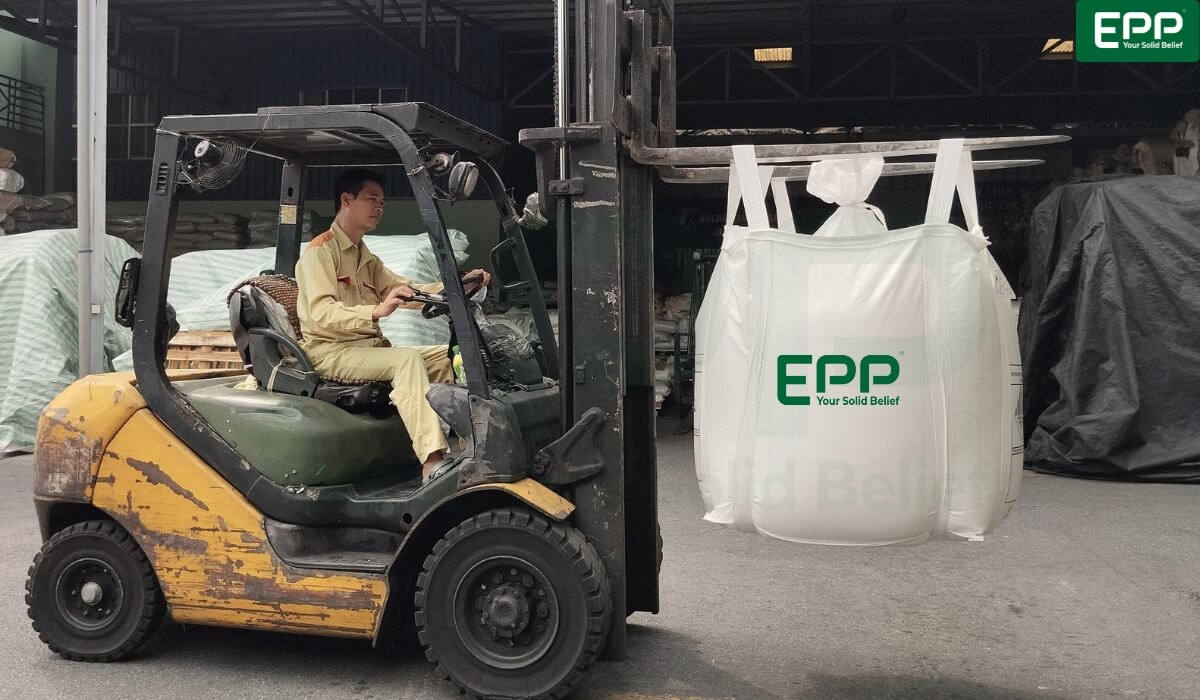
Safely Move a Bulk Bag at EPP VIETNAM factory
As a premier global supply chain partner, EPP Vietnam coordinates precision manufacturing across certified international facilities to deliver high-performance Vietnam Jumbo Bag Solutions tailored to your facility’s mechanical lifters.
4. Frequently Asked Questions (FAQ) about lifting industrial super sacks
4.1 Can you lift a super sack using standard forklift tines without attachments?
Yes, provided the fork tines feature smooth, deburred edges (minimum 5 mm radius) or protective rubber sleeves, and all four loops hang vertically without twisting. Using a dedicated forklift bulk bag lifter is strongly recommended to eliminate strap wear and prevent load tipping.
4.2 What is the difference between a 5:1 and 6:1 Safety Factor in bulk bag lifting?
A 5:1 Safety Factor rating indicates single-trip construction, meaning the bag is engineered to withstand an ultimate break test of 5 times its Safe Working Load (SWL). A 6:1 Safety Factor rating designates multi-trip, reusable construction featuring heavy-duty loop webbing and reinforced seam stitching.
4.3 How do you safely move a 1-ton bag of gravel over uneven ground?
Use a heavy-duty or rough-terrain forklift equipped with a 4-point ton bag lifter. Keep the bag suspended low (6 to 12 inches above the surface), tilt the forklift mast backward, and travel at low speeds to eliminate dynamic shock loading caused by bumps.
5. Partner with EPP Vietnam for High-Performance Packaging Solutions
Lifting industrial super sacks safely requires high-tensile loop stitching, precise material engineering, and reliable manufacturing. EPP Vietnam serves as your expert supply chain sourcing partner, coordinating high-volume FIBC production in state-of-the-art facilities certified to ISO 9001:2015, ISO 22000, and BRCGS standards.
Contact our technical packaging engineers today to consult on loop geometry, custom spout configurations, and bulk bag designs matched to your facility’s machinery!
Website: epp.vn
Alibaba website: https://eppvietnam.trustpass.alibaba.com/
Email: [email protected] Hotline/ Whatsapps: +84 986 002 888