
In global industrial logistics and bulk material handling, Flexible Intermediate Bulk Containers (FIBCs)—commonly known as jumbo bags, bulk bags, or super sacks—are the primary packaging solution for transporting powders, granules, and agricultural commodities. However, handling heavy payloads ranging from 500 kg to over 2,000 kg carries inherent operational risks.
Adhering to standardized FIBC Safe Handling Guidelines is essential to prevent catastrophic loop failure, material loss, and severe workplace injuries. As a leading manufacturer and exporter of woven poly products in Vietnam, EPP Vietnam designs export-grade bulk packaging compliant with strict international standards, including ISO 21898, BRCGS, and UN Dangerous Goods regulations, as well as the industry-standard safety recommendations published in the official FIBCA Safe Handling Guidelines.

Adhering to recognized FIBC safe handling guidelines prevents accidents, protects personnel, and eliminates material loss.
Why FIBC Safe Handling Guidelines Matter?
Adopting a rigorous safety protocol based on recognized industry standards, such as the FIBCA Handling Guidelines, provides critical operational benefits for commercial facilities and logistics centers:
- Protecting Warehouse Personnel: A fully loaded FIBC carries immense potential energy. Following proper lifting and rigging protocols eliminates the risk of big bags tipping or dropping onto personnel.
- Eliminating Material Degradation and Financial Loss: Poor handling techniques, such as dragging jumbo bags or using sharp forklift tines, cause fabric tears that ruin sensitive raw materials.
- Maintaining Equipment Integrity: Proper weight distribution prevents damage to forklift masts, overhead cranes, and filling/discharging hoppers.
- Ensuring Regulatory Compliance: Adhering to established safety factors (SF 5:1 for single-trip bags or SF 6:1 for multi-trip bags) ensures compliance with international transport regulations.
Before selecting packaging for your supply chain, evaluate potential operational risks by reviewing the critical risks of using low-quality PP bulk bags.
Summary of Essential Do’s and Don’ts for FIBC Handling
The following core rules summarize essential operational practices aligned with global industry guidelines:
| Operational Category | Recommended Best Practice (DO) | Dangerous Action (DON’T) |
| Lifting & Rigging | Lift vertically using all provided loops; ensure forklift tines have rounded edges (R ≥ 5 mm). | NEVER tilt forklift tines forward or pull bulk bags by a single loop unless specifically designed for single-point lifting. |
| Personnel Safety | Establish clear safety zones; keep bystanders clear during active overhead lifting operations. | NEVER allow personnel to stand or position hands/feet beneath a suspended bulk bag. |
| Storage & Stacking | Use pyramid stacking or wall-supported methods; store bags indoors away from direct UV exposure. | NEVER stack bags that show signs of instability or exceed maximum recommended stacking height limits. |
| Static Control | Ground Type C bags securely (resistance to ground < 10⁸ Ω) before filling or discharging combustible powders. | NEVER disconnect grounding clamps while flammable material or fine dust is actively flowing. |
How to Inspect FIBC Bags Before Use
Conducting a thorough pre-operation inspection is the first line of defense against structural failure during filling or transport.
Pre-Operation Inspection Checklist
Before attaching an FIBC to filling rigs or forklift tines, inspectors must verify:
- Fabric & Seam Integrity: Inspect the woven Polypropylene (PP) body for cuts, UV bleaching, fraying, or chemical contamination.
- Lifting Loop Condition: Check loop attachment points for broken stitching, severe abrasion, or heat degradation.
- Closure and Spout Tie Security: Ensure discharge spouts and bottom ties are securely fastened and undamaged.
- Label and Rating Verification: Confirm that the bag’s Safe Working Load (SWL) and Safety Factor (SF) match the intended payload weight.
Zero Tolerance Rule: If a bulk bag displays any visible fabric tear, seam damage, or loop degradation, remove it from service immediately.

Core Operational Guidelines for Bulk Bags: Lifting, Filling, and Discharging
Executing smooth handling procedures requires standardized protocols across every stage of the bag’s lifecycle.
1. Lifting Protocols for Forklifts and Cranes
- Forklift Tine Preparation: Ensure forklift tines are smooth and free of sharp burrs. Fork edges should be rounded to a minimum radius of 5 mm to prevent cutting loop webbing.
- Loop Position: Keep lifting loops completely vertical during elevation. Never gather loops together onto a central hook unless using an approved spreader bar or a purpose-built single-point loop system.
- Transport Motion: Drive smoothly with the bulk bag held low to the ground (20–30 cm above the surface) and the forklift mast tilted slightly backward.
2. Filling Guidelines
- Support the base of the super sack on a pallet or warehouse floor during filling to relieve tension on the lifting loops.
- Adjust the fill spout to maintain steady downward flow while utilizing dust extraction equipment for fine powders. Learn more in our guide about efficient techniques for filling super sacks .
3. Discharging Protocols
- Position the FIBC over the receiving hopper using an overhead hoist or forklift with a safety latch.
- Access the discharge spout from the side using specialized safety reach tools or remote untying mechanisms to keep personnel hands clear from beneath the suspended load. For a step-by-step operational breakdown, consult our guide on safe discharging protocols for industrial bulk bags.
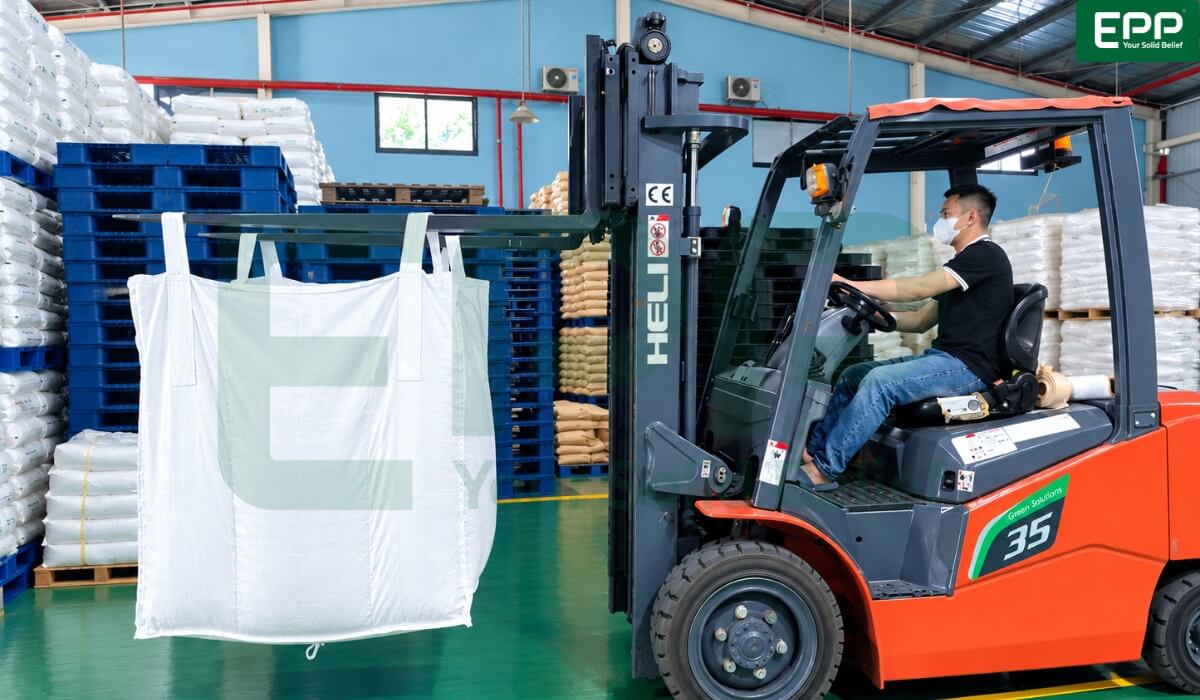
Safe forklift handling of an FIBC bulk bag following FIBCA operational guidelines.
Storage, Stacking, and Export Transport Guidelines
Stacking Methods in Warehouses
- Pyramid Stacking: Stack bags so that each upper bag rests securely on four lower bags, forming a stable pyramid structure.
- Supported Stacking: Place bags against two rigid, load-bearing facility walls to prevent tipping.
- Environmental Controls: Store PP bulk bags inside clean, dry facilities. Prolonged exposure to sunlight (UV radiation) degrades polypropylene strands over time, weakening the bag’s load capacity.
Export Container Loading
When preparing bulk shipments for trans-Pacific routes, maximizing container fill rates while securing cargo against sea motion is vital.
Commercial buyers can explore EPP Vietnam’s full portfolio of high-tensile packaging on our dedicated page for certified export-grade FIBC jumbo bags.
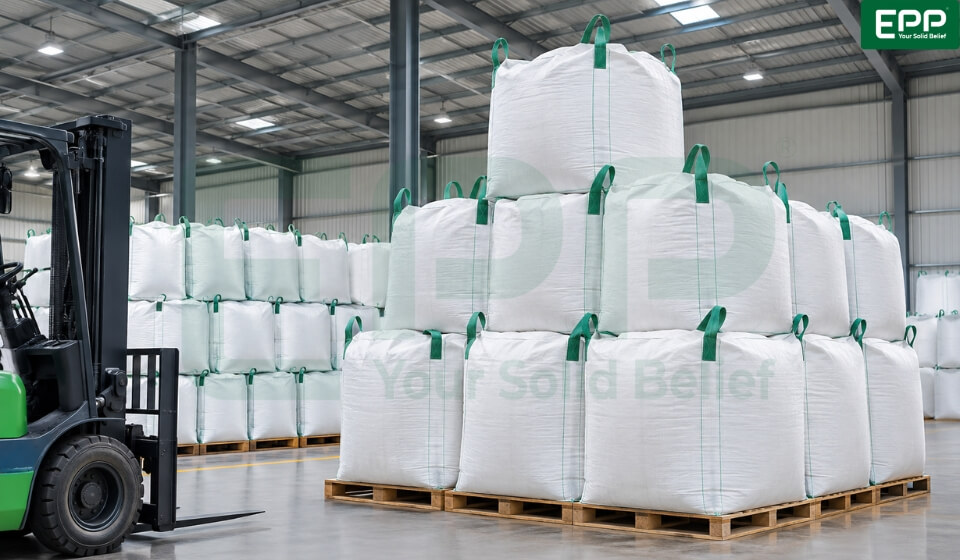
Pyramid stacking compliant with international safety standards for bulk bags ensures structural stability inside storage facilities.
Static Electricity Safety Management
When handling dry combustible powders or operating in explosive gas/dust environments, static electricity buildup creates severe ignition hazards. FIBCs are categorized into four electrostatic types:
- Type A: Standard non-antistatic bags. Used only for non-combustible materials in non-hazardous environments.
- Type B: Low-breakdown voltage fabric (< 6 kV). Prevents high-energy propagating brush discharges; safe for dry combustible powders without flammable solvents nearby.
- Type C (Groundable FIBC): Interwoven with conductive carbon/silver threads. Must be grounded to an electrical earth connection (resistance < 10⁸ Ω) during filling and discharging.
- Type D (Antistatic): Uses special dissipative threads that safely disperse static charges into the surrounding air without requiring grounding cables.

FAQs for FIBC Safe Handling Guidelines
How do you inspect a bulk bag before lifting?
Perform a visual inspection of the PP woven fabric, lifting loops, stitching lines, and discharge spouts. Ensure there are no visible tears, UV damage, or broken threads, and verify that the payload does not exceed the bag’s rated Safe Working Load (SWL).
Can a damaged FIBC be reused?
No. Damaged bulk bags should never be reused. Furthermore, standard single-trip FIBCs rated with a 5:1 Safety Factor are designed for one-time use only. Only multi-trip FIBCs certified with a 6:1 Safety Factor (compliant with ISO 21898) can be reused, provided they pass a professional safety inspection and cleaning process.
What are the most important FIBC safe handling guidelines?
The golden rules of FIBC safe handling are: always keep lifting loops vertical, use rounded forklift tines, never drag bags across floor surfaces, ensure Type C bags are grounded during static-sensitive transfers, and never allow personnel beneath a suspended load.
How often should I inspect FIBCs?
Regular inspections should be conducted before use, especially if the FIBCs have been stored for an extended period. Periodic performance testing is also recommended.
Conclusion
Implementing standardized FIBC Safe Handling Guidelines across your warehouse and supply chain operations protects valuable personnel, preserves cargo integrity, and lowers operational overhead. Proper inspection, correct lifting mechanics, and compliant static management form the foundation of a safe industrial facility.
Looking for high-performance, export-certified bulk packaging for your global supply chain? Contact EPP Vietnam today to consult with our packaging specialists and receive factory-direct quotes!
Website: epp.vn
Alibaba website: https://eppvietnam.trustpass.alibaba.com/
Email: [email protected] Hotline/ Whatsapps: +84 986 002 888