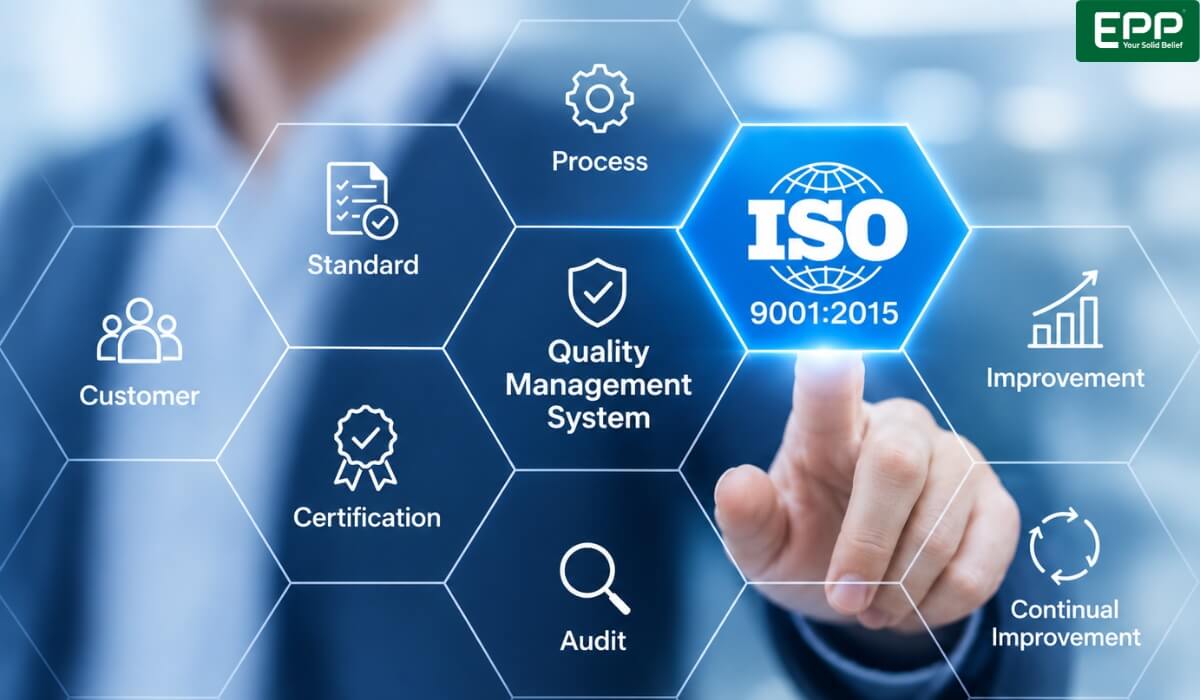
In international bulk packaging procurement, choosing an ISO 9001:2015 certified manufacturer is essential to eliminate fabric tears, seam failures, and costly supply chain delays. As a leading FIBC supplier in Vietnam, EPP Vietnam embeds certified Quality Management Systems (QMS) into every production stage to guarantee zero-defect bulk bags and full batch consistency for global buyers.
What Is ISO 9001 and How Does It Apply to FIBC Suppliers?
An ISO 9001 certification is an internationally recognized quality management standard governed by the International Organization for Standardization. The ISO 9001:2015 revision incorporates a risk-based thinking methodology alongside the Plan-Do-Check-Act (PDCA) cycle, forcing packaging suppliers to proactively identify and mitigate supply chain bottlenecks before product defects occur.
Verified ISO quality and environmental management certificates ensuring compliance across global bulk packaging supply chains.
When applied to heavy-duty industrial bulk bags, ISO 9001:2015 dictates standardized operational controls across every production step. This structured Quality Management System requires continuous auditing of raw material quality, extrusion machine calibration, weaving tension, stitching density, and packaging inspection. For international procurement teams, choosing a supplier backed by a verified ISO 9001:2015 accreditation removes quality variance and guarantees that the 100th shipping container performs with the exact tensile strength as the first sample.
Why ISO 9001 Matters When Buying FIBC Jumbo Bags?
Stringent Raw Material Standardization and Resin Purity Quality bulk bags begin with virgin resin formulation. An ISO 9001:2015 certified manufacturer enforces strict incoming material inspection protocols. Every batch of 100 percent virgin polypropylene (PP) resin, high-density polyethylene (HDPE), UV stabilizers, and color masterbatches is tested for Melt Flow Index (MFI) and polymer purity prior to extrusion. This prevents the inclusion of cheap, unverified recycled fillers that compromise fabric tenacity and accelerate UV degradation.
Process-Driven Extrusion and Weaving Controls During thermal tape extrusion, maintaining exact yarn denier and tensile breaking strength is vital. Under ISO 9001:2015 guidelines, automated sensors continuously monitor tape thickness, elongation ratios, and denier values. During circular weaving, loom tension settings are controlled to produce precise fabric weights (gsm) without structural thin spots, ensuring high burst resistance under heavy dynamic loads.
Full Lot Traceability from Resin to Destination Port One of the most critical requirements of ISO 9001:2015 is end-to-end product traceability. Every production lot is assigned a unique tracking serial number recorded on the bag’s sewn-in safety label and outer bale packaging. If an issue arises in the field, quality engineers can instantly trace the product back to the specific resin lot, machine operator, weaving loom, and quality inspection shift.
Minimization of Human Error and Defect Rates By implementing Standard Operating Procedures (SOPs) across cleanroom sewing, over-lock stitching, and liner insertion, an ISO 9001:2015 facility systematically reduces human error. Automated thermal cutting prevents fabric fraying, while specialized needle configurations maintain consistent seam strength.
Evaluating international quality benchmarks is essential when establishing global supply agreements. To review the fundamental compliance benchmarks governing global packaging exports, read our comprehensive overview on international market standards for FIBC bulk bags.

ISO 9001:2015 protocols require strict Melt Flow Index (MFI) testing of virgin PP resin to ensure high fabric tenacity.
How ISO 9001:2015 Serves as the Foundation for Multi-Certification Frameworks?
While an ISO 9001:2015 certification establishes a baseline for general quality management, global bulk packaging requires compliance with specialized technical standards. Within a modern manufacturing ecosystem, ISO 9001:2015 acts as the structural foundation that supports additional international certifications.
Integration with ISO 21898 Performance Standards
An ISO 9001:2015 certified QMS ensures that mechanical design specifications strictly align with performance mandates. Every bag design undergoes top-lift cyclic testing, seam tensile break tests, and drop tests to verify Safe Working Loads (SWL) from 500 kg to 2,000 kg with 5:1 or 6:1 Safety Factors. To explore the latest technical revisions governing non-dangerous goods packaging, review our analysis of ISO 21898 key updates for FIBC bulk bags.

ISO 9001:2015 certified FIBC bulk bag manufactured by EPP Vietnam, engineered to meet strict ISO 21898 mechanical performance standards.
Seamless Synergy with Hygiene and Food Safety Systems
For agricultural, pharmaceutical, and food-grade applications, quality management must extend into cleanroom hygiene. The standardized document control and risk management mechanisms of ISO 9001:2015 seamlessly integrate into BRCGS Packaging Materials and ISO 22000 standards. To see how preventive hazard controls protect sensitive cargo from biological and chemical contamination, explore our guide on applying 7 HACCP principles to bulk bag manufacturing.
Compliance for Hazardous and Anti-Static Environments
For industrial clients handling combustible dusts or dangerous chemicals, an ISO 9001:2015 framework guarantees strict adherence to UN Dangerous Goods packaging regulations and IEC 61340-4-4 electrostatic safety requirements for Type C conductive and Type D dissipative bulk bags.
How to Verify an ISO 9001-Certified FIBC Supplier
In the global marketplace, intermediary brokers or uncertified factories sometimes display outdated or fraudulent quality seals. To safeguard your procurement budget, international buyers should follow a 4-step verification protocol:
- Check the Scope of Certification: Ensure the certificate explicitly covers “Design, Manufacture, and Conversion of Polypropylene Woven Fabrics and FIBC Bulk Bags.” A certificate limited solely to “Trading” or “Administrative Services” does not cover factory floor quality control.
- Verify Accredited Issuing Bodies: Authentic certificates are issued by internationally recognized registrar bodies accredited by IAF members (such as SGS, TÜV Rheinland, Bureau Veritas, or Intertek).
- Validate Certificate Registration Numbers: Access the official online portal of the issuing Registrar Body and input the unique certificate registration number to verify active status and expiration dates.
- Request Factory Audit Summary Reports and COAs: Ask the supplier for their latest third-party audit summary report and sample Certificate of Analysis (COA) documentation from recent export shipments.
Frequently Asked Questions (FAQ)
What is the difference between ISO 9001:2015 and ISO 21898?
ISO 9001:2015 is a management framework standard that governs overall factory quality control processes, documentation, and continuous improvement. ISO 21898 is a technical product standard that defines specific mechanical performance tests (such as cyclic top-lift and seam tensile tests) required for non-dangerous FIBC bulk bags.
Does an ISO 9001:2015 certificate guarantee that a bulk bag is food-grade?
No. An ISO 9001:2015 certificate verifies that the manufacturer follows standardized quality management procedures, but it does not mandate sterile cleanroom conditions. Food-grade packaging requires specialized certifications such as BRCGS Packaging Materials, ISO 22000, or HACCP cleanroom protocols.
Does ISO 9001 certify individual FIBC bags?
No. ISO 9001 certifies the manufacturer’s overall Quality Management System (QMS), verifying that the factory follows standardized operating procedures, quality controls, and material testing across production. Individual bag designs are tested and rated under technical product standards such as ISO 21898 or UN Regulations.
Can an ISO-certified supplier still deliver non-conforming bags?
While ISO 9001:2015 drastically minimizes defect rates through standardized processes and quality checks, no system eliminates physical risk entirely. However, an ISO 9001-certified supplier maintains complete lot traceability, allowing rapid root-cause analysis, batch isolation, and immediate claim resolution if a non-conformance occurs.

Partner with EPP Vietnam for Certified Bulk Packaging Excellence
Achieving supply chain resilience requires a packaging partner that prioritizes quality assurance, technical precision, and transparent commercial practices. EPP Vietnam combines extensive manufacturing scale, independent cost engineering, and an audited ISO 9001:2015 Quality Management System to deliver zero-defect bulk packaging globally.
Contact our technical sales team today to request product samples, technical data sheets, or verified audit reports:
Website: epp.vn | eppvietnam.trustpass.alibaba.com
Phone / WhatsApp: +84 986 002 888
Email: [email protected]