For over a decade, Vietnam has stood out as one of the global economy’s most dynamic export performers—a growth trajectory built on open trade policies, a strategic geographic position, and steady industrial expansion. However, as the 150-day implementation window for the 2026 US tariff framework takes effect, Southeast Asia’s manufacturing hub faces a shifting trade landscape.
Rather than focusing solely on near-term cost pressures, the central question for international buyers and procurement leaders is how Vietnam’s manufacturing sector will adapt to maintain its long-term trade resilience.
Macroeconomic Consequences for Vietnam
The implementation of a blanket 15% tariff by the United States marks a seismic shift in global trade dynamics. For Vietnam, the primary concern is the potential erosion of its competitive edge. Historically, Vietnam’s GDP growth has been inextricably linked to its trade surplus with the US. A sudden 15% price hike on imported goods essentially acts as a tax on the Vietnamese miracle.
However, the macroeconomic conditions of 2026 present mitigating factors:
- Currency Index Realignments: Shifts in the US Dollar Index have created relative exchange rate stability for Southeast Asian currencies, helping offset portion of the landed cost increase for overseas buyers.
- Asset Stabilization: Strong domestic balance sheets and asset valuations across Vietnam’s financial and banking sectors provide structural stability during periods of international trade friction.
- Energy Cost Adjustments: Fluctuations in global energy markets—including periods where oil prices pull back below critical resistance levels—help reduce resin and freight surcharges across manufacturing supply chains. To understand general import/export frameworks, review our summary on Vietnam’s tariff structure for import and export.
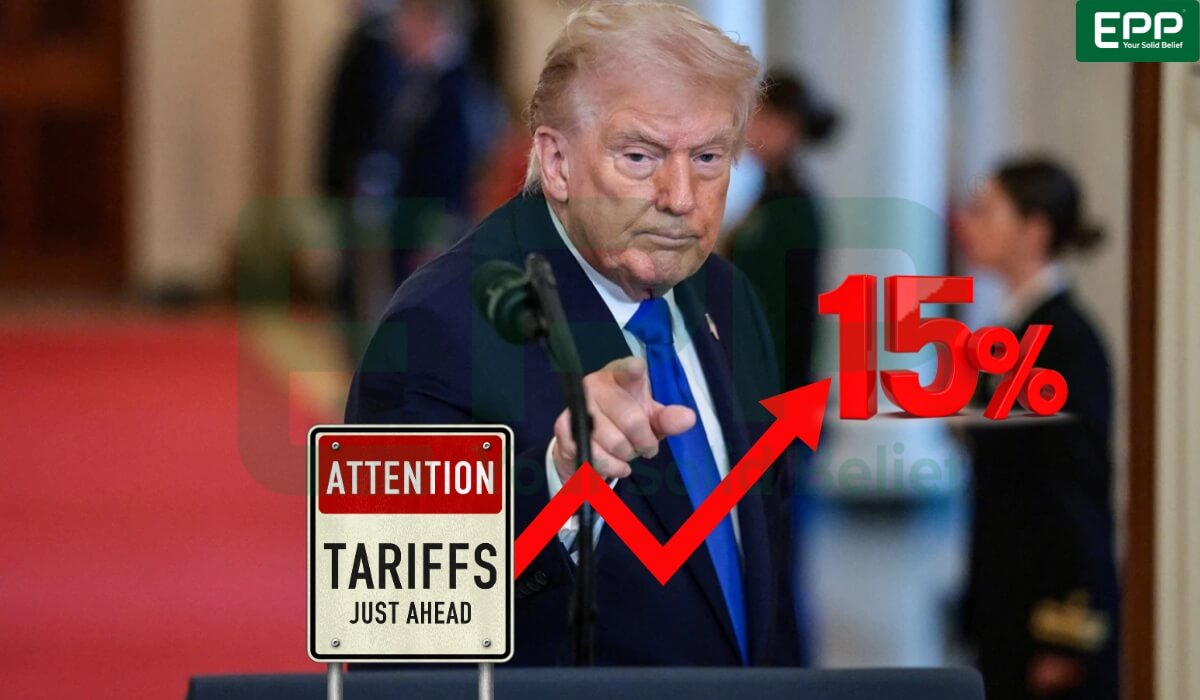
Implementation of updated US tariff frameworks presents shifting trade dynamics and cost adjustments for Vietnamese export supply chains.
Winners and Losers from 2026 US Tariff
Protectionism rarely affects everyone equally. In the 2026 landscape, we are seeing a clear divergence between industries that are “too essential to fail” and those that are “easily replaceable.”
The Losers
Low-value-added manufacturing sectors are feeling the heat. Small-scale textile firms and basic plastic assembly lines, where the margin for error is less than 5%, are struggling to absorb the 15% cost increase. For these businesses, the US market—once a land of endless opportunity—is becoming a high-risk zone.
The Winners
High-tech manufacturing and specialized industrial sectors are proving surprisingly resilient. For example, in the industrial packaging and logistics sector, bulk bag wholesale suppliers are finding that their products are more essential than ever. As global supply chains become more fragmented and regionalized, the demand for high-quality Flexible Intermediate Bulk Containers (FIBCs) has remained steady.
When a US-based manufacturer imports raw chemicals or minerals, the cost of the “bulk bag” is a fraction of the total shipment value. Consequently, these suppliers can often pass through the tariff costs more easily than a t-shirt manufacturer could. Companies that have invested in “smart packaging” and sustainable materials are finding that US buyers are willing to pay the tariff-inclusive price for the sake of quality and reliability. Partnering with a reliable supplier like EPP Vietnam for FIBC bulk bags ensures that global buyers receive certified, high-grade packaging capable of withstanding strict international regulatory standards.
Government Response for 2026 US Tariff
The Vietnamese government’s response to the 2026 trade shock has been decisive, encapsulated in the “Innovation 2.0” framework. This isn’t just about building more factories; it’s about changing what happens inside those factories.
Innovation 2.0, driven by the Prime Minister’s recent directives, focuses on three core pillars:
- Digital Transformation: Integrating AI and automation into the production line to slash operational costs. If a factory can improve its efficiency by 15%, it effectively “cancels out” the US tariff.
- The Green Pivot: Vietnam is aggressively aligning with global ESG standards. By producing goods that meet the strictest environmental criteria, Vietnamese exporters can differentiate themselves from cheaper, “dirtier” competitors, justifying a higher price point that accommodates tariff costs.
- Domestic Value Chains: Moving away from the “assembly only” model. The government is incentivizing the production of raw materials within Vietnam, reducing the need for costly imports from third-party nations and strengthening the “Rule of Origin” documentation required for US trade.
For a deeper dive into how policy agreements are structured to safeguard trade, you can read our detailed analysis inside the 2025 US-Vietnam tariff deal.
Geopolitical and Trade Strategy Responses to 2026 US Tariff
Vietnam has long mastered the art of “Bamboo Diplomacy”—standing firm but remaining flexible. In response to the 2026 US tariff, Hanoi is doubling down on its “Plus One” status, but with a twist.
Vietnam is no longer just the alternative to China; it is positioning itself as the hub of a “Multiplex Trade Network.” By leveraging the Comprehensive and Progressive Agreement for Trans-Pacific Partnership (CPTPP) and the EVFTA with Europe, Vietnam is actively redirecting trade flows. If the 15% tariff makes a specific product line unviable for the US market, the infrastructure is already in place to pivot that volume toward the European or Japanese markets.
Furthermore, Vietnam is engaging in proactive trade dialogues. Rather than retaliating with its own tariffs—which would only hurt domestic consumers—Vietnam is positioning itself as a “Secure Trade Partner,” offering US companies deeper transparency in supply chain mapping to ensure that goods are not being “laundered” from other sanctioned jurisdictions. To understand why these underlying advantages preserve market momentum, see our article on why Vietnam’s 20% tariff.

General Secretary To Lam meeting US President Donald Trump during bilateral trade diplomacy talks
Strategic Recommendations for Vietnamese Exporters
Having observed the first wave of the 2026 US tariff implementation, the path forward for exporters requires a mix of tactical agility and long-term vision.
1. Diversify or Die: Reliance on a single market is now a liability. Exporters must aim for a “30/30/30” split—30% US, 30% EU/Japan, and 30% ASEAN/Domestic. This balance ensures that a policy shift in Washington doesn’t result in a total collapse of the order book.
2. Invest in Specialized Segments: Follow the lead of successful bulk bag wholesale suppliers by specializing. Don’t just sell a commodity; sell a solution. Whether it’s food-grade certification, anti-static properties, or recycled content, specialization creates “pricing power” that can withstand 15% (or higher) tariff barriers.
3. Master the Paperwork: In 2026, the “War of Trade” is often won in the accounting office. Ensuring flawless documentation of “substantial transformation” within Vietnam is critical. Exporters should undergo voluntary audits to ensure their supply chains are “Clean and Clear” for US Customs and Border Protection (CBP).
4. Financial Hedging: With the dollar’s volatility and gold’s high valuation, exporters should use forward contracts to lock in exchange rates and maintain a portion of their reserves in “hard assets.” This provides the liquidity needed to survive shipping delays or sudden inventory backups at US ports.
Conclusion
The 2026 US tariff is undoubtedly a challenge, but they are not the end of the Vietnam Export Miracle. Instead, they represent a “Great Filter.” Companies that rely solely on cheap labor and high-volume US exports will struggle. However, for those who embrace Innovation 2.0, specialize their offerings, and diversify their reach, this era of protectionism will merely be a catalyst for a more mature, technologically advanced Vietnamese economy.
The miracle isn’t over; it’s just getting its second wind. As the world watches Vietnam navigate these turbulent waters, the nation is proving once again that its greatest export isn’t just goods—it’s resilience.
Website: epp.vn
Alibaba website: https://eppvietnam.trustpass.alibaba.com/
Email: [email protected] Hotline/ Whatsapps: +84 986 002 888