
In modern industrial processing—from high-grade pharmaceutical powders and fine chemical reagents to infant formula starch—bulk material handling is fraught with operational challenges. Unloading fine powders from standard FIBCs often triggers an uncontrolled release, generating dense dust clouds, risking worker contamination, creating dust explosion hazards, and causing significant product loss.
To eliminate these risks, global plant managers and packaging engineers are upgrading their discharge systems to Iris Closure FIBCs. As a leading FIBC supplier in Vietnam with decades of international export experience, EPP Vietnam delivers custom bulk packaging solutions designed to overcome the most demanding material handling obstacles. Understanding how an Iris Closure FIBC operates allows procurement officers and operations directors to optimize unloading efficiency, protect cleanroom environments, and stop material loss at the discharge point.
What is an Iris Closure FIBC and How Does It Work?
An Iris Closure FIBC (also referred to in the industry as a bonnet closure or petal closure hybrid) is a specialized bulk bag bottom design engineered specifically for controlled, dust-free discharge. Named after its resemblance to the diaphragm mechanism of an optical camera iris, this design uses a twisting, choked-sleeve mechanism to regulate material flow.
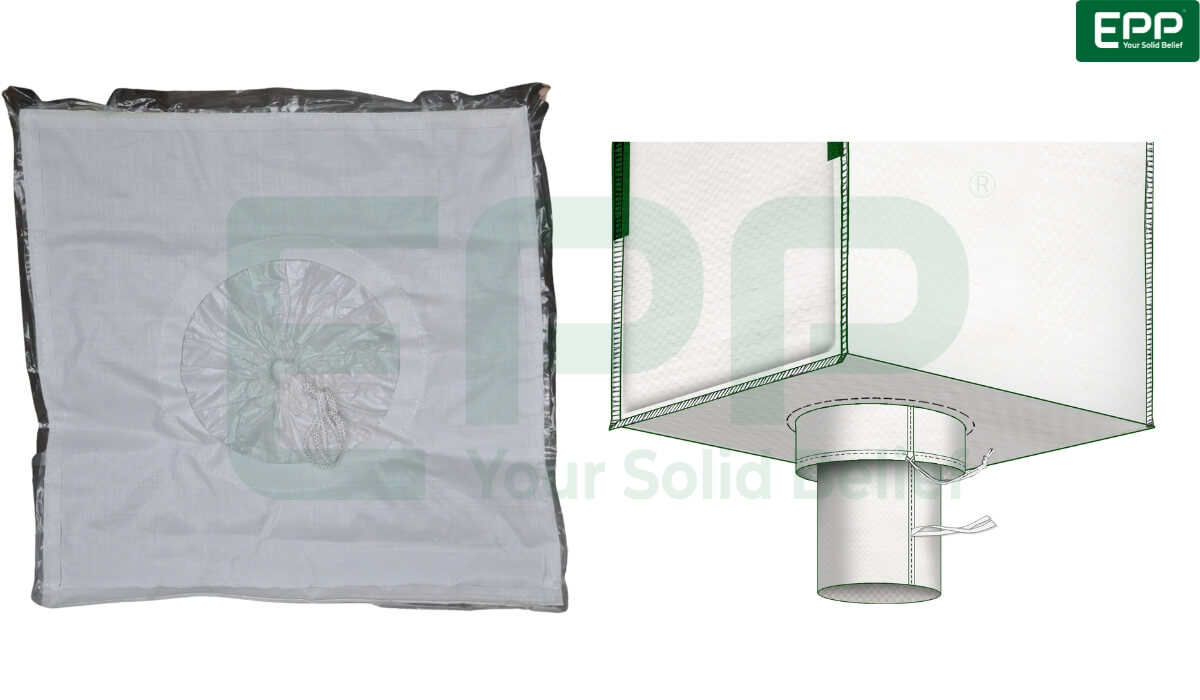
High-precision Iris Closure FIBCs supplied by EPP Vietnam provide a tight dual-barrier seal that eliminates dust emission and product loss during discharge.
Anatomy of an FIBC Discharge Spout with Iris Closure
A high-performance iris valve bulk bag features a dual-layer bottom construction:
- Internal Discharge Sleeve: An elongated fabric tube made from virgin polypropylene (PP) or flexible polyethylene film that connects directly to the receiving hopper or discharge line.
- External Protective Iris Bonnet: A reinforced outer fabric collar or series of woven flaps fitted with a heavy-duty drawstring (manufactured from high-tensile polyester or nylon braid). This collar encases the inner discharge sleeve, holding it tightly against the bag’s base during transit and storage.
The Mechanics of Dust-Free Discharge
The operational secret of an Iris Closure FIBC lies in its 360-degree radial choking mechanism.
When preparing for discharge, the operator does not simply untie a cord to drop the bag’s contents all at once. Instead, the inner discharge sleeve is extended inside the outer iris bonnet and connected to the receiving equipment’s inlet pipe. The operator then gradually loosens the drawstring, allowing the fabric sleeve to untwist smoothly. As the sleeve untwists, material flows evenly into the hopper.
If the operator needs to halt or throttle the flow, they pull the drawstring to re-twist and choke the inner sleeve, stopping material discharge instantly without creating a dust cloud.
Iris Closure vs. Standard FIBC Discharging Systems
Understanding the differences between various FIBC bottom closure types helps procurement teams select the most cost-effective packaging for their specific materials.
| Discharging Feature | Standard Discharge Spout | Petal / Star Closure | Iris Closure FIBC |
| Dust Containment Level | Moderate (High risk of dust puffs upon untying) | Good (Protects spout from external abrasion) | Maximum (Airtight 360° labyrinth seal) |
| Bulk Bag Discharge Control | Low (Once untied, full volume discharges continuously) | Limited (Designed primarily for spout protection) | Superior (Precise throttling & mid-stream stop) |
| Spout Abrasion Protection | Low (Spout rests directly on pallet floor) | High (Bottom flaps shield the spout) | Superior (Enclosed within protective collar) |
| Ideal Material Application | Coarse granules, plastic pellets, aggregates | Free-flowing grains, medium powders | Fine powders, toxic/hazardous chemicals, ultra-fine food ingredients |
When evaluating iris closure vs petal closure, remember that a standard petal closure primarily serves as a protective cover to keep the discharge spout clean during transit. In contrast, a true FIBC iris discharge spout provides active bulk bag discharge control, enabling fine flow adjustment and mid-discharge shut-off.
How Iris Closure FIBCs Stop Dust and Product Loss Step-by-Step?
Preventing bulk bag spillage prevention and controlling dust requires a standardized unloading procedure. Here is how an Iris Closure FIBC achieves zero-emission unloading:
Step 1: Pre-Discharge Sealed Connection
Before opening the discharge spout, the operator pulls the inner sleeve through the iris bonnet and clamps it securely around the receiving hopper’s inlet pipe. Because the inner sleeve remains choked by the tightened iris drawstring, no powder escapes during this setup stage.
Step 2: Controlled Discharge and Flow Regulation
Once the seal is established, the operator slowly releases the iris drawstring. The operator can fine-tune the opening diameter to match the processing rate of downstream mixers, feeders, or conveyers. This controlled discharge jumbo bag feature prevents downstream hoppers from overflowing.
Step 3: Mid-Stream Shut-Off
If a downstream hopper reaches capacity or a weighing batch is metered, the operator simply pulls the drawstring to re-choke the inner sleeve. This immediately cuts off product flow without de-coupling the bag from the receiving station.
Step 4: Eliminating Final Dust Puffs with Specialized Liners
When the bag empties, residual fine particles often collapse suddenly, causing a “dust puff” to blow back into the room. The Iris Closure FIBC prevents this by keeping the sleeve connected to the dust-collection hood until the iris collar is fully choked shut.
For facilities handling combustible bulk materials, preventing dust plumes is only half the battle; eliminating static charges is equally critical. To ensure complete operational safety, plant engineers frequently combine choked discharge spouts with conductive and anti-static FIBC liner systems that dissipate electrostatic build-up during rapid material flow.

Connecting the Iris closure sleeve to receiving equipment prior to release ensures 100% dust containment during high-volume unloading.
Which Materials and Applications Benefit from Iris Closure FIBCs?
An Iris Closure FIBC is the industry standard for handling materials where dust creation poses financial, environmental, or health risks:
- Fine Food Ingredients & Additives: Starch, flour, powdered sugar, cocoa powder, whey protein, and spices.
- Pharmaceutical Intermediates: Fine active pharmaceutical ingredients (APIs), excipients, and tablet bindings.
- Toxic or High-Value Chemicals: Carbon black, pigments, battery cathode powders, catalysts, and pesticide powders.
- Fine Mineral Powders: Hydrated lime, calcium carbonate, silica flour, and gypsum powder.
While specialized iris closures excel at containing volatile micronized powders, heavy construction and mining operations handling coarse aggregates, sand, or gravel often rely on heavy-duty jumbo builders bags designed for high tensile load capacity and rugged site conditions.
When dealing with sticky, cohesive, or poorly flowing powders, choosing the right bottom spout mechanism is just one piece of the puzzle. Enterprise buyers often pair iris closures with steeply sloped conical bulk bag bases to direct sluggish materials naturally toward the discharge outlet without requiring mechanical agitation. Furthermore, if your fine powders are also susceptible to environmental moisture or oxygen exposure, incorporating protective internal film liners inside your super sacks provides an essential secondary barrier to keep the product dry and free-flowing throughout storage.
How to Specify the Right Iris Closure FIBC
When ordering dust containment bulk bags from a global supplier, specifying precise technical criteria ensures seamless compatibility with your plant’s unloading equipment:
- Spout Diameter and Length: Match the inner discharge sleeve diameter (typically 35 cm to 50 cm) and length to your receiving hopper’s clamping system.
- Drawstring Material & Hardware: Ensure drawstrings are made from high-tensile braided cord with heavy-duty cord locks that will not slip under heavy material pressure.
- Fabric Weight & Cleanroom Quality: Select appropriate fabric weights (GSM) certified to ISO 9001 and ISO 21898 standards. For food and pharmaceutical applications, ensure bags are produced in certified cleanroom facilities to prevent thread contamination.
- Custom Engineering: Partner with an experienced iris closure bulk bag supplier that offers tailored sleeve geometries and reinforced tie-points to withstand repeated choke-and-release cycles.

EPP Vietnam supplies certified cleanroom FIBCs manufactured to strict ISO 9001 and ISO 21898 standards for global food and chemical industries.
Frequently Asked Questions (FAQs)
Can an Iris closure FIBC stop material flow mid-discharge?
Yes. Thanks to the heavy-duty radial drawstring encircling the inner sleeve, operators can pull and lock the cord at any point during discharge to halt material flow completely and resume it later.
Do Iris Closure FIBCs eliminate dust completely?
When paired with a sealed receiving hopper clamp, an Iris Closure FIBC creates a closed-loop system that virtually eliminates ambient dust emissions, keeping work areas clean and compliant with EHS standards.
Can Iris Closure FIBCs be used for fine powders?
Absolutey. An FIBC for fine powders with an iris closure is specifically designed to handle micronized powders, preventing fine particle seepage, dust clouds, and product loss during unloading.
Conclusion
Upgrading to an Iris Closure FIBC is an investment in plant safety, operational efficiency, and product loss prevention. By providing a 360-degree choked seal, this advanced bottom closure transforms volatile powder discharge into a controlled, clean, and safe operation.
As a premier global FIBC supplier in Vietnam, EPP Vietnam delivers custom controlled discharge jumbo bags engineered to your exact operational specifications. Contact EPP Vietnam today to consult with our technical packaging specialists and request a tailored quotation for export-grade bulk packaging solutions!
Website: epp.vn
Alibaba website: https://eppvietnam.trustpass.alibaba.com/
Email: [email protected] Hotline/ Whatsapps: +84 986 002 888