
Big bags dimensions are crucial for various industries, especially in logistics, construction, and agriculture. Understanding these dimensions helps businesses choose the right bags for their specific needs, ensuring efficient storage and transportation of materials.
As a leading FIBC and industrial packaging supplier in Vietnam, EPP Vietnam delivers custom-engineered bulk bag solutions tailored to strict international export standards. This technical guide breaks down standard bulk bag sizes, critical dimension factors, volume calculations, and container loading strategies.
What Is the Standard Jumbo Bag Size?
In the FIBC industry, there is no single universal standard for big bags dimensions because bags are manufactured to match the bulk density of the material being packed. However, when buyers ask, “What is the standard jumbo bag size?”, the most widely adopted international base size (length x width) is 90 x 90 cm (35 x 35 inches) or 95 x 95 cm (37.5 x 37.5 inches), with adjustable heights ranging from 90 cm up to 200 cm.
When evaluating fibc bag dimensions, and various bulka bags size options, it is important to distinguish between three distinct measurement states:
- Flat Dimensions: The laid-flat width and length of the woven polypropylene fabric prior to filling.
- Internal Filled Dimensions: The usable inner volume accommodating the packed product.
- External Inflated Dimensions: The total footprint of the bag after filling, accounting for the natural outward bulging (+10% to +15% expansion) caused by material pressure.

Standard FIBC big bags dimensions are measured by base length, width, and body height before product filling.
Standard Bulk Bag Sizes Matrix by Load Capacity (500kg – 2 Tons)
Selecting the right super sack bag sizes or big bags sizes requires balancing the target Safe Working Load (SWL) with the product’s bulk density (kg/m3). Whether you are evaluating a general bulk bag size, specific bulk bags size ranges, or a compact builder bag size, the table below maps capacity ratings to standard base dimensions, heights, and volume capacities:
| Load Capacity (SWL) | Base Dimensions (L x W) | Body Height Range | Estimated Volume (m3) | Industry Benchmarks & Keywords |
| 500 kg | 85 x 85 cm / 90 x 90 cm | 70 – 90 cm | 0.50 – 0.75 m3 |
500 kg jumbo bag dimensions (Dense powders, heavy metals) |
| 1 Ton / 1 Tonne | 90 x 90 cm / 95 x 95 cm | 110 – 140 cm | 1.00 – 1.25 m3 |
1 ton jumbo bag dimensions, 1 tonne bulk bag dimensions
|
| 1.5 Ton | 95 x 95 cm / 100 x 100 cm | 140 – 170 cm | 1.30 – 1.60 m3 |
1.5 ton jumbo bag dimensions (Fertilizers, animal feed) |
| 2 Ton | 100 x 100 cm / 105 x 105 cm | 180 – 200 cm | 1.80 – 2.00 m3 |
2 ton jumbo bag dimensions (Biomass, low-density grains) |
To calculate exact payload limits based on fabric GSM and loop strength, explore our technical breakdown on super sack carrying capacity.

Bulk bags sizes vary based on material density, ranging from compact 500 kg sacks to heavy-duty 2 ton jumbo bags.
Critical Technical Factors Affecting FIBC Bag Dimensions
Four primary mechanical and physical parameters determine the ideal super sack dimensions and overall size of bulk bag for industrial applications:
- Material Bulk Density (kg/m3): Heavy products (such as metal concentrates at 1,500 kg/m3) require compact bag dimensions to avoid exceeding forklift capacities. Conversely, light products (like powders at 400 kg/m3) need taller, high-volume bags.
- The Bulging Effect & Baffle Bags (Q-Bags): Standard circular or 4-panel bulk bags expand outward into a cylinder when filled. Installing internal fabric baffles prevents bulging, maintaining a square profile that saves up to 20% in storage space.
- Top & Bottom Spout Allowances: Filling spouts (typically 35 – 50 cm long) and discharge spouts must be factored into total vertical machine clearances during loading and discharging.
- Lifting Loop Clearance: Standard corner lifting loops add 25 – 30 cm of vertical height above the bag body, which must be accounted for in warehouse ceiling and crane heights.
For a detailed formula on converting dimensions into exact volumetric capacity, read our breakdown on bulk bag cubic metre volume calculation.

How to Choose the Right Bulk Bag Size for Your Material?
When comparing different bulk bag sizes, procurement managers must evaluate whether a standard 1 ton bag dimensions or a specialized 1 tonne bag dimensions specification fits their filling stations. Follow this step-by-step engineering calculation to choose the right 1 ton jumbo bag size:
- Identify the Product Bulk Density: Obtain the bulk density in kg/m3 or lbs/ft3.
- Calculate Required Volume: Divide the target batch weight (e.g., 1,000 kg) by the bulk density (e.g., 800 kg/m3) to find the required volume (1.25 m3).
- Select Base Footprint: Match the base size to your pallet system (90 x 90 cm for standard ISO/EUR pallets).
- Determine Body Height: Calculate required height = Target Volume / Base Area, adding 5 – 10% for bag expansion allowance.
If your facility handles specialized hazardous chemicals, review our technical breakdown on industrial FIBC specifications.
How Big Bags Dimensions Impact Shipping Container Loading
Matching your target 1 ton bulk bag dimensions or 1 ton big bag size to international shipping container interior dimensions eliminates wasted space and prevents load shifting during ocean transit:
- 20ft Dry Container (Interior: 5.90m L x 2.35m W x 2.39m H): Holds 20 standard bags with typical dimensions of 1 tonne bag (90 x 90 cm or 95 x 95 cm) stacked 1-high, or 40 bags double-stacked if bag height is 110 cm or less.
- 40ft High Cube Container (Interior: 12.03m L x 2.35m W x 2.69m H): Accommodates 40 to 44 bags double-stacked, depending on whether baffle construction is used to mitigate side bulge.
To view our full range of export-ready container bags, explore the EPP Vietnam full FIBC bags catalog.
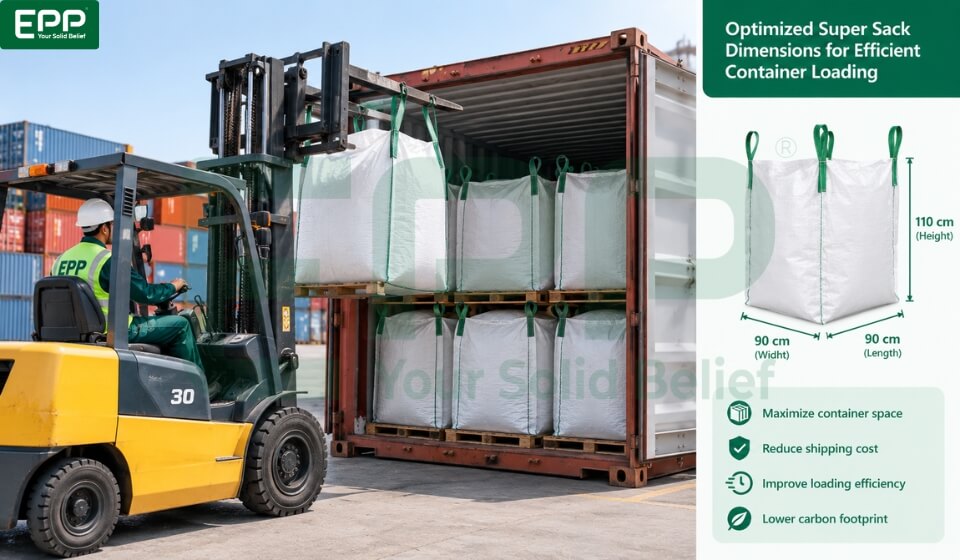
EPP Vietnam custom-engineers big bags dimensions to fit client-specific automation filling equipment and export container profiles.
International Quality & Safety Standards for FIBC Dimensions
Dimensional stability directly dictates operational safety during stacking and transport:
- Height-to-Base Ratio: Under ISO 21898 safety standards, the total filled height of a bulk bag should not exceed 2 times its shortest base dimension (Height:Base ratio less than or equal to 2:1) to maintain a stable center of gravity and prevent tipping.
- Pallet Fit: Filled bags should sit flush within standard European (1200 x 1000 mm) or American (48 x 40 inches) pallets to avoid side overhang tears caused by forklift tines.
- Safety Factor Ratings: Bag dimensions and fabric weights are rated for SWL under SF 5:1 (single-trip) or SF 6:1 (multi-trip) safety standards.
Frequently Asked Questions About Big Bags Dimensions
What is the most common 1 ton bag dimensions?
The most common 1 ton bag dimensions are 90 x 90 x 110 cm or 95 x 95 x 120 cm. The exact height varies between 100 cm and 140 cm based on the bulk density of the packed material.
Can EPP Vietnam customize big bags dimensions for unique machinery?
Yes. As a leading FIBC supplier in Vietnam, EPP Vietnam custom-engineers big bags dimensions, loop styles, spouts, and internal baffles to fit client-specific automated filling lines, rack systems, and container configurations.
Do Bigger Bulk Bags Always Carry More Weight?
No. Bag dimensions determine volumetric capacity (m3), not safe weight capacity (SWL). A large 2 m3 bag carrying low-density sawdust may weigh only 600 kg, while a smaller 0.6 m3 bag filled with dense metal powder can safely weigh 1,500 kg. Weight limits are determined by fabric GSM, weave tensile strength, and loop reinforcement.
Conclusion
Selecting the right big bags dimensions is vital for safeguarding material integrity, ensuring site safety, and maximizing shipping container efficiency. By matching bag volume to bulk density, accounting for the bulging effect, and adhering to ISO safety ratios, procurement leaders can significantly optimize their packaging supply chain.
Contact EPP Vietnam today to consult with our packaging engineers and receive custom-dimensioned FIBC quotes for your bulk export needs!
Website: epp.vn
Alibaba website: https://eppvietnam.trustpass.alibaba.com/
Email: [email protected] Hotline/ Whatsapps: +84 986 002 888