
FIBC bags price transparency has become a critical requirement for global supply chain managers navigating the industrial landscape of 2026. As the world shifts its manufacturing focus toward Southeast Asia, Vietnam has emerged as the premier destination for high-quality, high-tenacity bulk packaging. For those asking about the current market rates, it is essential to understand that the price of a Flexible Intermediate Bulk Container (FIBC) is not merely a reflection of its size, but a complex calculation of polymer resin indices, manufacturing precision, and safety certifications.
As a leading Vietnam supplier for FIBCs, we have seen the industry evolve from basic agricultural sacks to highly engineered containers for the pharmaceutical and chemical sectors. Here is the definitive breakdown of the current pricing environment in the Vietnamese market.
Market Overview of FIBC Bags in Vietnam

The Vietnamese FIBC market is currently experiencing a period of robust growth and technological maturity. Unlike other regional players, Vietnam has invested heavily in vertical integration. Most top-tier factories in regions like Phu Tho, Dong Nai, Long An, and Hung Yen now house their own extrusion, weaving, and clean-room assembly lines.
This maturity has stabilized the FIBC bags price by reducing reliance on imported fabric. Furthermore, Vietnam’s strategic participation in the EVFTA (EU-Vietnam Free Trade Agreement) and CPTPP has made “Made in Vietnam” bulk bags significantly more attractive to Western markets, as the lack of import duties often offsets the shipping costs, providing a lower total landed cost compared to other Asian counterparts.
Factors Influencing the Current FIBC Bags Price
Before looking at the raw numbers, one must account for the variables that cause the FIBC bags price to shift. In the current situation, these factors include:
- Polypropylene (PP) Resin Volatility: Roughly 60% of the bag’s cost is tied to the global price of PP resin. Fluctuations in oil and gas markets directly impact the base fabric cost.
- Safety Factor (SF): A super sack with a 5:1 SF (Single-trip) is fundamentally cheaper than a 6:1 SF (Multi-trip) jumbo bag, as the latter requires higher GSM (grams per square meter) fabric and reinforced webbing.
- Additive Inclusion: The percentage of UV stabilizers and anti-static agents added during the extrusion process changes the price per unit.
- Labor & Complexity: A standard open-top bag is fast to produce, while a baffled Q-bag with sifting-proof seams requires significantly more manual labor and specialized sewing machines.
The Current Range of FIBC Bags price in Vietnam
To help procurement officers budget effectively, we have compiled the current average price ranges for various bulk bag types. Note that these are FOB (Free On Board) prices based on standard 1000kg capacities and Full Container Load (FCL) orders.
Vietnam FIBC Bags Price List (2026 Estimates)
| FIBC Type | Technical Description | Price Range (USD/Unit) |
|---|---|---|
| Type A FIBC (Normal) | Basic polypropylene, no static protection. Used for inert materials like sand. | $3.00 – $5.00 |
| Type B FIBC (Antistatic) | Breakdown voltage < 6kV; prevents brush discharges. | $7.00 – $11.00 |
| Type C FIBC (Conductive) | Grounded bags; essential for explosive environments. | $8.00 – $12.00 |
| Type D FIBC (Dissipative) | Crohmiq or similar; no grounding required. Premium safety. | $10.00 – $13.00 |
| Specialty Bulk Bags | Baffled (Q-Bags), 5-loop designs, or custom food-grade. | $7.00 – $10.00 |
Prices are subject to variation based on specific dimensions, loop configurations, and current resin indices.
Vietnam vs. Global FIBC Bags Price
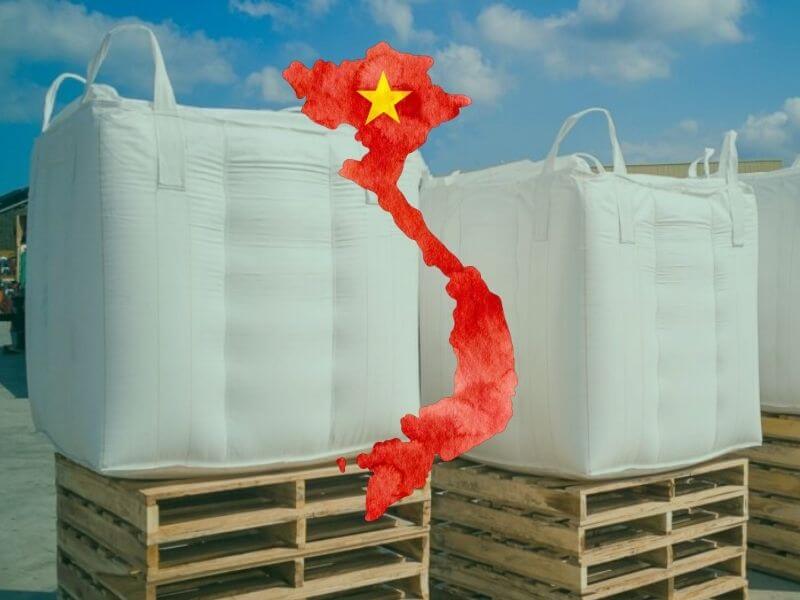
When comparing the FIBC bags price in Vietnam to the global average, a clear competitive pattern emerges. While China remains a high-volume competitor, rising labor costs and trade tariffs have pushed their prices upward. India remains a strong player in the agricultural sector, but Vietnam holds the “quality-to-price” title for technical and food-grade bags.
The “Vietnam Advantage” lies in lower electricity costs for manufacturing and a highly skilled workforce that can handle complex sewing for baffled bags and specialized liners. This allows Vietnamese suppliers to offer Type C and Type D bags at rates that are often 5% lower than European or North American manufacturers, even after accounting for ocean freight.
Vietnam’s strategic logistics network and proximity to major shipping lanes reduce the “time-to-market” cost, which is often a hidden expense in global procurement. Unlike other regions where bureaucratic hurdles can stall exports, Vietnam’s streamlined customs processes and favorable trade agreements mean that the final landed cost remains stable even when global shipping markets are volatile.
By sourcing from Vietnam, buyers are essentially bypassing the high overheads of Western manufacturing while tapping into an ecosystem designed for high-precision, low-cost export excellence.
Quality and Price Balance: The Supplier’s Advice

As a supplier, my advice to buyers is simple: never sacrifice the FIBC bags price for structural integrity. A “cheap” bag that costs $1.00 less but uses 20% Calcium Carbonate filler is a ticking time bomb in your warehouse. Excessive fillers compromise the molecular bonds of the polypropylene, leading to “stress cracking” and a significantly lower UV resistance—factors that are invisible until the bag fails under load.
In Vietnam, we pride ourselves on transparency. A premium quality FIBC should use 100% virgin resin, have clearly defined GSM weights, and come with a certified Top-Lift test report. The “suitable” bag is the one where the price matches the risk level of your cargo. If you are shipping high-value chemicals, a $12.00 Type C bag is the most economical insurance policy you can buy. Beyond the resin, pay close attention to the stitching quality; a suitable bulk bag uses high-denier sewing thread and consistent stitch density to ensure that the Safe Working Load is a reality, not just a number on a label.

True value in the FIBC market is found when you minimize the “Cost of Failure,” which includes product loss, clean-up expenses, and damage to your brand’s reputation. Buying smart means investing in a bag that facilitates a seamless supply chain from the factory floor to the end-user’s facility.
Conclusion
The current FIBC bags price range in Vietnam reflects a market that is mature, competitive, and technologically advanced. By understanding the tiers—from the budget-friendly $3.00 Type A jumbo bag to the specialized $12.00 Type D dissipative container—you can strategically align your packaging budget with your operational needs.
Vietnam is no longer just an alternative sourcing destination; it is the primary hub for those who refuse to compromise on safety while seeking the most competitive global rates.
