
Baffle bags, often referred to in the industry as Q-Bags, are the premium solution for exporters who are tired of losing money to inefficient shipping and unstable warehouse stacks. If you have ever filled a standard jumbo bag with 1 ton of material, you know exactly what happens: the bag “bellies” out, turning from a neat square into a bulging cylinder. This might not seem like a big deal on the factory floor, but once you try to fit those rounded bags into a square shipping container, you realize you are paying to ship a lot of empty air.
At EPP Vietnam, we’ve seen how switching to baffle bags can transform a company’s logistics. In this guide, we will break down why these specially engineered FIBCs are becoming the gold standard for global trade in 2026.
What are baffle bags?
To understand a baffle bag, you have to look at what’s inside. While a standard FIBC is just a large woven sack, a baffle bag contains four internal fabric panels (baffles) sewn across the corners.
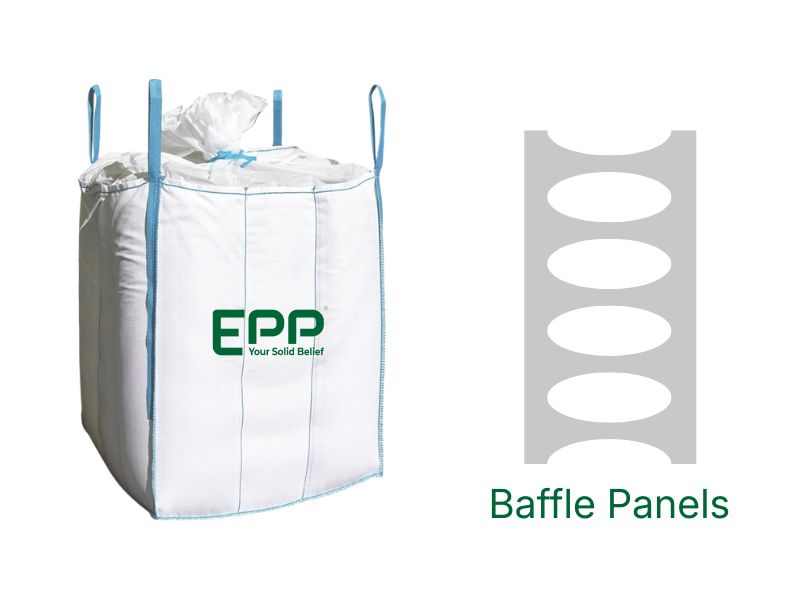
These baffles are not solid walls; they have holes (apertures) that allow the material to flow freely into the corners during filling. Their only job is to act as internal “tensioners.” They pull the sides of the bag inward, preventing the fabric from stretching outward into a circle. The result? A bag that stays as a perfect cube—even when it’s holding 1,500 kg of heavy minerals or fine flour.
Maximize Shipping Space and Reduce Freight Costs
The number one reason our customers at EPP Vietnam switch to baffle bags is the bottom line. In recent years, ocean freight rates remain volatile, and every cubic centimeter of container space is valuable.
When a standard bag bulges, it creates “dead space” in the corners of your pallets and between the bags in a container. You usually end up with gaps that are too small for another bag but too large to ignore.

-
The Math: A standard bag typically utilizes about 75–80% of a container’s footprint.
-
The Q-Bag Advantage: Because baffle bags stay square, they fit together like Lego bricks. This allows you to increase your loading capacity by 16% to 25%.
If you previously fit 20 standard bags in a 20ft container, you might now fit 24 or 25 baffle bags. Over a year of high-volume exporting, that is a massive reduction in the number of containers you need to book, directly lowering your carbon footprint and your logistics spend.
Superior Stability and Warehouse Safety
A bulging bag is an unstable bag. If you’ve ever seen a “leaning” stack in a warehouse, you know the heart-stopping feeling of a potential tip-over.
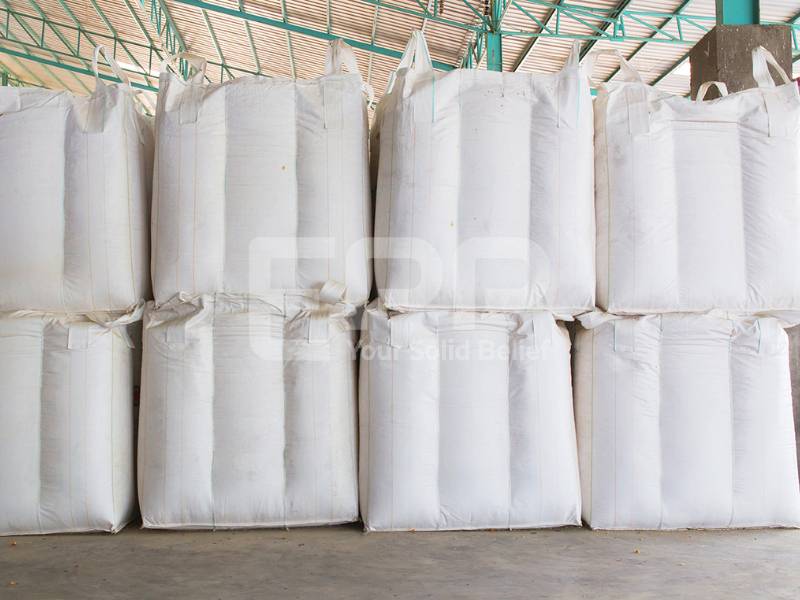
Baffle bags provide a level of structural integrity that standard bags simply cannot match. Because the sides are flat and the top remains level, you can stack these bags higher and with much more confidence.
- Safety First: Square bags don’t shift or “slump” over time. This reduces the risk of workplace accidents during forklift maneuvers.
- Vertical Storage: High stacking means you can double or triple your storage capacity without expanding your warehouse footprint. In expensive industrial zones, being able to stack 3-high instead of 2-high is a game-changer for overhead costs.
Improved Filling and Discharging Flow
Some people worry that internal baffles will make the bag harder to fill or empty. In reality, it’s often the opposite.
The holes in the baffles are strategically designed to ensure that the product distributes evenly into all four corners simultaneously. This prevents the “lopsided” fill that often happens with standard bags if the filling spout isn’t perfectly centered.
When it comes to discharging, the baffles don’t hold the material back. For very fine or “sticky” powders, we use Net Baffles (made of a mesh material) which ensure that 100% of the product flows out of the discharge spout without getting trapped in the corners. This is particularly important for high-value chemical and food-grade clients who can’t afford product waste.
Standard FIBC vs. Baffle Bag
To help your procurement team decide, here is a quick comparison:
| Feature | Standard FIBC | Baffle Bag (Q-Bag) |
| Shape (Filled) | Rounded/Circular | Square/Cubic |
| Stackability | Low to Moderate | High/Very Stable |
| Container Fit | Leaves gaps/wasted space | Flush/Full utilization |
| Aesthetics | Looks “sloppy” on pallets | Neat, professional, “retail-ready” |
| Best For | Low-cost domestic transport | International Export / Fine Powders |
Tips for Choosing the Right Baffle Bag
As a leading supplier from Vietnam, we always tell our clients to look at these three factors before ordering:
- Material Flow: If you are packing very large, chunky items (like big rocks), baffles might get in the way. Baffle bags are best for free-flowing solids like seeds, resins, or powders.
- Sift-Proofing: If you are shipping fine powders, ask for triple-dust-proof (sift-proof) seams. Because baffle bags have more sewing lines (where the baffles meet the outer walls), you want to ensure no product leaks through the needle holes.
- Coating vs. Liners: For moisture-sensitive goods, you can get coated baffle bags or even baffle liners. A baffle liner gives you the moisture protection of plastic with the square shape of a Q-bag.
People Also Ask (FAQ)
Are baffle bags more expensive than standard bags?
Yes, the initial unit price is higher because they require more fabric and more labor-intensive sewing. However, when you factor in the 20% savings on shipping costs and the reduced warehouse space needed, the “cost per ton shipped” is almost always lower with a baffle bag.
Do I need a special machine to fill baffle bags?
No. They work with standard filling spouts. However, they are particularly well-suited for automated filling lines because their square shape is predictable and doesn’t interfere with sensors or conveyor side-rails.
What is the standard size of a Q-Bag?
Most of our export clients use a 90 x 90 cm or 105 x 105 cm base. The height varies depending on the product density, but we typically see them between 110 cm and 180 cm.
Can baffle bags be reused?
Absolutely, provided they are manufactured with a 6:1 Safety Factor. At EPP Vietnam, we ensure the internal baffles are just as strong as the outer walls, so they maintain their square shape trip after trip.
Conclusion
Choosing baffle bags is one of the easiest ways to optimize a modern supply chain. By moving away from the “belly” effect of standard bags, you gain safety, stability, and—most importantly—significant savings on your freight bills.
At EPP Vietnam, we pride ourselves on being more than just a manufacturer; we are your logistics partners. We’ve seen firsthand how a switch to Q-bags has helped our clients stay competitive in a tough global market.

Would you like us to calculate the exact shipping savings you could achieve by switching your current 1-ton standard bags to our high-efficiency baffle bags?
