Jumbo bag with liner technology represents the standard of excellence for industrial bulk packaging. As global trade routes become more complex and quality standards more rigorous, the “standard” woven sack is often insufficient for protecting high-value cargo. A jumbo bag with liner—also widely recognized in the industry as lined super sacks—is a sophisticated, dual-layer packaging solution designed to provide both the structural strength of a traditional FIBC and the high-performance barrier protection of a specialized internal plastic sleeve.
As a premier FIBC manufacturer based in Vietnam, we have seen a dramatic shift toward these integrated systems. In this guide, we will explore the technical construction, material benefits, and strategic ROI of utilizing a jumbo bag with liner for your global supply chain.
How a Jumbo Bag with Liner is Built?
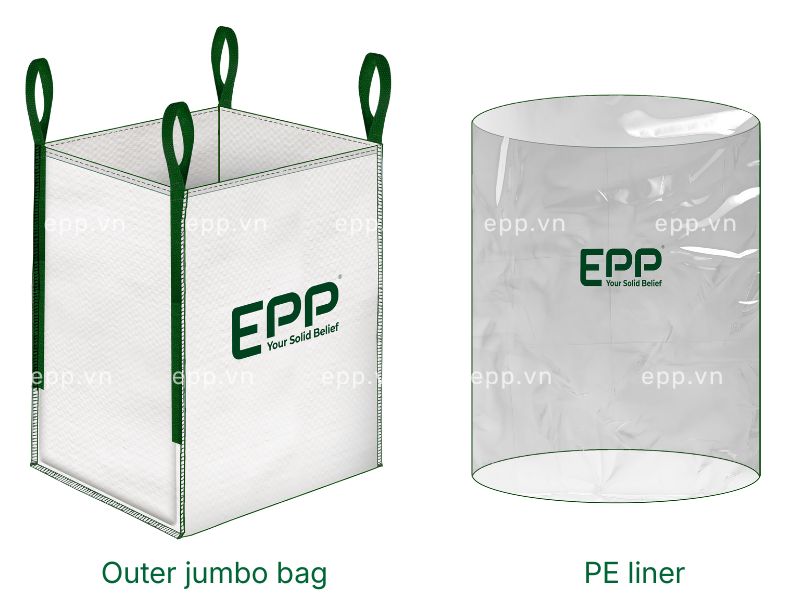
The architecture of a jumbo bag with liner is a masterpiece of material engineering, combining two distinct components into a single, functional unit.
The Outer Shell
The exterior is made from high-tenacity woven polypropylene (PP). This fabric is engineered to handle massive tensile stress, typically supporting Safe Working Loads (SWL) from 500kg up to 2,000kg. In our Vietnam facility, we use UV-aditives and virgin PP resin to ensure the outer big bags maintains its integrity even during long-term outdoor storage or sea freight
The Internal Barrier
The “heart” of the jumbo bag with liner is the internal FIBC liner. This is usually an extruded poly liner that is inserted into the woven shell. Depending on the application, this poly liner can be:
- Loose-fit: Simply inserted and folded over the top.
- Tabbed/Glued: Physically attached to the outer bag’s seams to prevent the liner from being pulled out during discharge.
- Form-Fit: Shape-matched to the bag’s spouts to ensure 100% flow efficiency.
Why Should We Use a Liner?
Transitioning to lined super sacks is often a strategic decision to mitigate risk. There are four critical reasons why an internal FIBC liner is essential:
- Absolute Moisture Protection: For hygroscopic materials like sugar, salt, or cement, atmospheric humidity is the enemy. A jumbo bag with liner creates a hermetic seal that prevents clumping and spoilage.
- Zero-Sift Performance: Standard woven bags have microscopic pores. For ultra-fine powders (like carbon black or flour), these pores allow “dusting.” A poly liner provides a seamless barrier that ensures 100% containment.
- Oxygen and Aroma Integrity: Many food-grade products and chemicals are sensitive to oxidation. Lined super sacks can be co-extruded with barrier resins (like EVOH) to keep oxygen out and preserve the product’s original aroma and potency.
- Enhanced Hygiene (BRCGS/FDA Compliance): The FIBC liner ensures that your product never touches the woven PP fabric, eliminating the risk of contamination from loose plastic tapes or external dust.
Standard FIBC vs. Jumbo Bag with Liner
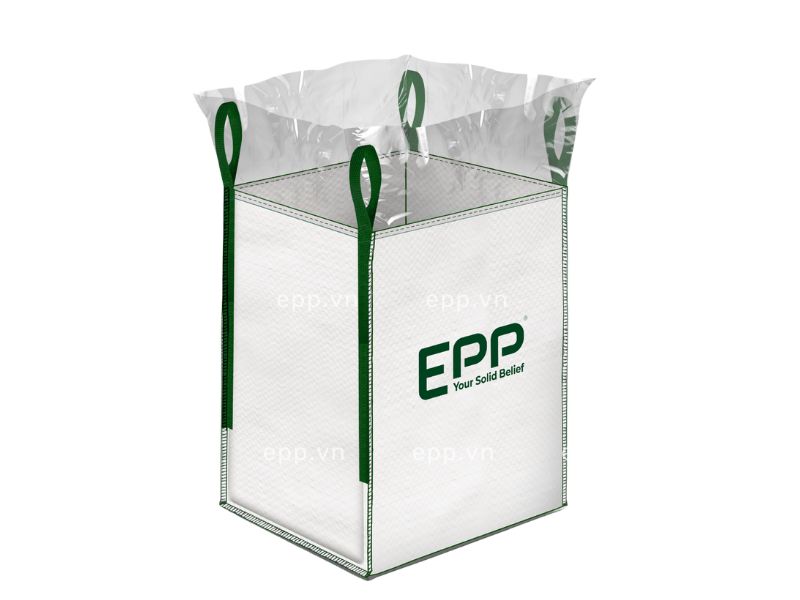
To help procurement managers make a data-driven choice, we have compiled this comparative benchmark between unlined containers and lined super sacks.
| Feature | Standard FIBC (Unlined) | Jumbo Bag with Liner |
| Moisture Barrier | Low (Breathable) | High (Waterproof) |
| Sift-Proofing | Requires felt/cord seams | Absolute (Seamless Barrier) |
| Product Purity | Moderate | Maximum (Virgin Poly Liner) |
| Best For | Sand, Gravel, Large Pellets | Fine Powders, Chemicals, Food |
| Logistics Risk | Potential for “Dusting” | Zero Leakage / Zero Loss |
While a jumbo bag with liner carries a slightly higher price point, the ROI is found in the “Cost of Failure.” The cost of a rejected 20-ton container due to moisture damage will far outweighs the marginal cost of a high-quality poly liner.
Navigating Micron Thickness and PE Resins
When ordering lined super sacks, the “Micron Rating” (µm) of the FIBC liner is your most important technical specification. Thickness determines the puncture resistance and barrier strength of the internal shield.
- 40 – 60 Microns: Ideal for fine food powders where the goal is simply to prevent dusting.
- 70 – 100 Microns: The industry standard for most industrial chemicals and agricultural fertilizers using a poly liner.
- 125 – 150+ Microns: Necessary for heavy minerals, sharp-edged granules, or semi-liquid materials.
The Material Choice: LDPE vs. LLDPE
In our Vietnam manufacturing hub, we rarely use a single resin in isolation. To create a poly liner that is perfectly suitable for each specific application, our Vietnam facility utilizes a sophisticated blending process. Typically, we mix 80% LLDPE (Linear Low-Density Polyethylene) with 20% LDPE (Low-Density Polyethylene).
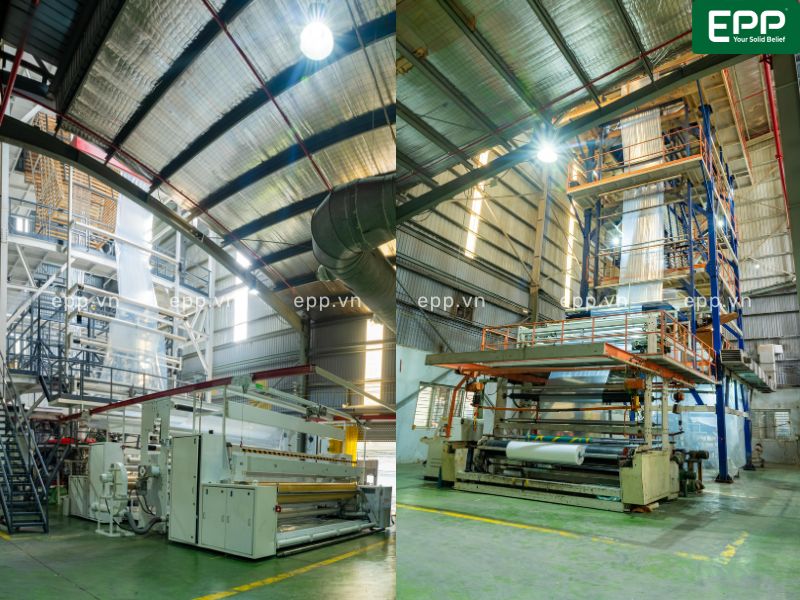
By leveraging high-tech 3 to 5-layer film blowing machines, we co-extrude these materials into a single, multi-layered shield. This “sandwich” construction allows us to harness the best of both worlds: the 80% LLDPE provides the extreme tensile strength and puncture resistance needed for 1,000kg+ loads, while the 20% LDPE ensures excellent sealability and flexibility. This multi-layer technology ensures that the jumbo bag with liner can withstand the immense pressure of being stacked three-high in a shipping container without the risk of the FIBC liner bursting.
A Shared Experience: Recently, a client exporting specialty cocoa powder was facing 3% product loss due to sifting through the seams of standard bags. By switching to a jumbo bag with liner (specifically a form-fit poly liner design), they eliminated product loss entirely. Furthermore, because the liner was “tabbed,” it stayed inside the bag during the automated discharge process at their European factory, preventing the liner from falling into their mixing vats. This is the precision that a Vietnam-based technical supplier brings to the table for lined super sacks.
Expert FAQ: Procurement Intelligence
Q: Can a jumbo bag with liner be reused?
A: If the outer bag has a 6:1 Safety Factor, it can be reused. However, for hygiene and safety, the FIBC liner should be replaced with a new one for every trip.
Q: Does the poly liner make the bag harder to recycle?
A: No. In a circular economy, the poly liner is simply pulled out of the PP bag. This allows for clean separation of Category 4 (PE) and Category 5 (PP) plastics, making the jumbo bag with liner a highly recyclable solution.

Q: Is it better to have the liner sewn in or loose?
A: For manual emptying, a loose liner is fine. For automated systems or “Spout Bottom” bags, we highly recommend a tabbed or glued poly liner to ensure it doesn’t block the discharge flow.
Q: How do I prevent static build-up in lined super sacks?
A: For explosive environments, we manufacture Anti-Static (Type L1/L2) liners that safely dissipate electrical charges.
Conclusion: Is a Jumbo Bag with Liner Right for You?
The transition to a jumbo bag with liner is a hallmark of a future-proof supply chain. By combining the structural resilience of Vietnamese woven PP with the high-barrier protection of specialized poly liner resins, you ensure that your product reaches its destination in the exact condition it left the factory.
Whether you are looking to solve a moisture problem or aiming for a “Zero-Waste” logistics model with lined super sacks, the jumbo bag with liner is the most effective tool in your packaging arsenal. Contact our technical team in Vietnam today to design a custom barrier solution for your next shipment.