For professionals in agriculture, logistics, and bulk commodities, the 500kg polypropylene woven grain bag is the frontline defense for preserving product quality and investment. Based on years of supply chain experience, I can tell you that optimizing packaging is where profit is secured or lost. The right woven grain bags do more than just hold product; they prevent spoilage, eliminate leakage, and guarantee safety from the silo to the processing plant. This guide provides the non-negotiable specifications and strategic sourcing methods needed to acquire high-performance bulk grain bags.
The Hidden Cost of the Wrong Polypropylene Woven Grain Bags

The common mistake in procurement is focusing solely on the lowest price per bag. A poorly specified bag may be cheaper, but the resulting product loss and liability will always cost significantly more.
Spoilage and Contamination Risk
Grain is vulnerable to moisture, which quickly leads to mold, caking, and contamination. If a big bag lacks adequate lamination or has faulty seams, atmospheric humidity will penetrate the container. When 500kg of specialty commodity is rendered unusable due to moisture ingress, the financial loss far outweighs the marginal cost saved on a cheaper container. These spoiled goods represent the largest hidden cost associated with low-quality 500kg polypropylene woven grain bags.
Sifting and Leakage Losses
Fine grains and powders will invariably escape through weak seams, resulting in ‘sifting.’ This leakage causes cumulative product loss across shipments and creates hazardous, dust-prone working environments. When you factor in the labor required for cleanup and loss reconciliation, the initial price saving on the grain storage bag quickly disappears.
Safety, Liability, and Structural Failure
A bag rated for 500kg must handle immense stress during filling, lifting, and transport. Structural failure is a major liability risk. If a bag fails mid-lift—due to weak fabric or a broken loop—it can damage equipment, contaminate the product, and potentially cause severe worker injury. This critical risk mandates that the technical specifications of your 500kg polypropylene woven grain bags are met without compromise.
The Core Specifications for 500kg Polypropylene Woven Grain Bags

Ensuring performance and mitigating risk starts with verifying three core technical specifications.
1. Fabric Quality, Density, and Virgin Resin
The foundation of reliable 500kg polypropylene woven grain bags is the fabric itself, which must be 100% virgin polypropylene (PP) resin. Avoid bags with high levels of recycled plastics or excessive calcium carbonate (CaCO3) filler, as these compromise the bag’s tear resistance and UV stability.
The crucial metric is the Grams Per Square Meter (GSM). This density measure directly correlates with the bag’s strength. For dense grain commodities, a robust GSM is mandatory to withstand the load and kinetic forces of handling. A higher GSM ensures tighter weave integrity and better defense against punctures. Furthermore, ensure the fabric includes necessary UV inhibitors if any temporary outdoor exposure is anticipated.
2. Sift-Proof Seaming for Fine Particles
Fine grains are highly effective at escaping standard stitching, making sift-proof seams essential. This feature involves using specialized stitching techniques that incorporate a filler cord (often acrylic or felt) woven into the seam line. This cord plugs the small channels created by the sewing needle.
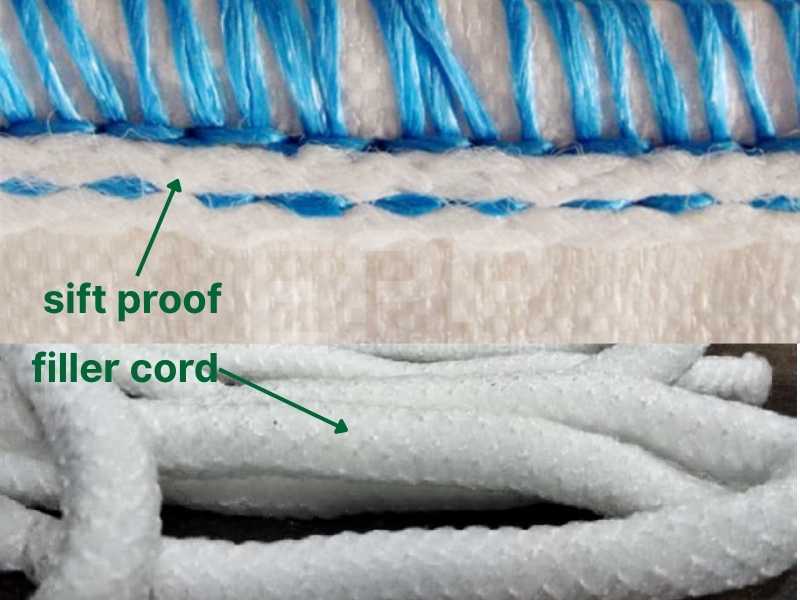
This process is critical in the areas where the lifting loops are attached to the body of the 500kg polypropylene woven grain bags, as this high-stress zone is the most common point of failure for leakage. Insisting on verified sift-proof stitching ensures your investment stays contained.
3. Lamination and Liners for Moisture Barrier
Woven PP is water-resistant, but not fully waterproof. To protect grain from humidity:
- Lamination: A thin PP film is applied to the fabric, creating a robust barrier against moisture ingress and improving general cleanliness.
- PE Liner: For highly sensitive or long-term storage, an inner Polyethylene (PE) liner is recommended, providing an hermetic, moisture-proof seal. The liner’s thickness should be specified according to the commodity’s needs.
Operational Efficiency and Safety Features
The best bags boost efficiency while minimizing safety risks.
Safe Working Load (SWL) and Safety Factor (SF)
Every quality bag must clearly state its Safe Working Load (SWL) of 500kg. More importantly, it must meet a verified Safety Factor (SF). For single-use 500kg polypropylene woven grain bags, this is 5:1 (meaning the bag must withstand 5x its rated load). Never accept generic assurances; demand testing reports for your specific batch to confirm the bag handles dynamic stress safely.
Optimized Handling Features

Efficiency is significantly improved by intelligent design:
- Duffle Top: A large sleeve at the top facilitates rapid, secure filling from bulk silos or hoppers.
- Bottom Discharge Spout: This is vital for controlled emptying. A discharge tube allows operators to regulate the flow of grain into processing machinery, reducing waste, dust, and labor.
Robust Lifting Loops
Always specify cross-corner loops, which provide better stability and squaring of the bag during lifting and stacking, simplifying handling with standard forklifts. Verify that the webbing is industrial-grade and that the attachment points are reinforced with heavy-duty stitching.
Sourcing Strategies for Wholesale 500kg Polypropylene Woven Grain Bags
To achieve optimal quality at wholesale prices, you must be a strategic buyer.
- Define Requirements First: Before seeking quotes, define your non-negotiables: Virgin PP, specific GSM, and verified sift-proof seams. This filters out unreliable suppliers immediately.
- Demand Quality Certification: Only partner with manufacturers who hold the ISO 9001:2015 Quality Management System certification. This ensures consistent, documented manufacturing and testing protocols, which reduces batch-to-batch variability.
- Leverage Bulk Volume: Consolidate your annual needs into larger purchase orders to meet the manufacturer’s Minimum Order Quantity (MOQ). Higher volume unlocks better unit pricing, maximizing your investment in high-quality wholesale 500kg polypropylene woven grain bags.
- Conduct Real-World Testing: Request a pre-production sample and run a small test batch through your actual filling, lifting, and storage process. Real-world performance validation is the only way to confirm suitability.
FAQ: Quick Answers for Grain Producers
| Question | Answer |
|---|---|
| What is the best way to stack 500kg polypropylene woven grain bags? | Stack on sturdy wooden pallets for moisture separation and use an interlocking pattern (or a pyramid shape) to ensure stability. |
| Are 500kg bags reusable? | Only if they are rated 6:1 Safety Factor and are thoroughly inspected for damage (tears, stitching wear, UV degradation) before each reuse. Otherwise, treat them as single-use. |
| How long can grain be stored in these bags? | Under ideal indoor conditions (low humidity, temperature control, laminated bag), 6–12 months is typical. Outdoor storage significantly reduces this lifespan. |
| Can these bags be customized with printing? | Yes, manufacturers can print branding, product names, lot numbers, and essential safety warnings directly onto the bag fabric during production, aiding inventory management. |
In closing, purchasing 500kg polypropylene woven grain bags should never be viewed as a simple commodity transaction. It is, fundamentally, an exercise in risk management. The integrity of your entire harvest rests on the quality of the fabric and seams. By adhering to the principles outlined here—demanding verifiable virgin PP, checking the GSM, insisting on sift-proof construction, and leveraging strategic sourcing—you transform your packaging cost from a necessary expense into a critical layer of insurance. Prioritize specification over price, and you ensure your grain arrives safely, cleanly, and profitably at its final destination.