
When planning B2B packaging and bulk transport, a primary question procurement managers face is: How many cubic metres in a bulk bag? Generally, a standard construction bulk bag holds 0.6 to 0.75 cubic metres (m³), while industrial FIBC super sacks range from 0.5 m³to over 2.0 m³ based on base dimensions and filling height.
Accurate volume estimation ensures you select the correct bag size, avoid overfilling, and maximize payload efficiency across sea and land freight. At EPP Vietnam, we engineer custom FIBC solutions tailored to the exact physical properties of your bulk solids, ensuring your shipping operations remain efficient, safe, and cost-effective.
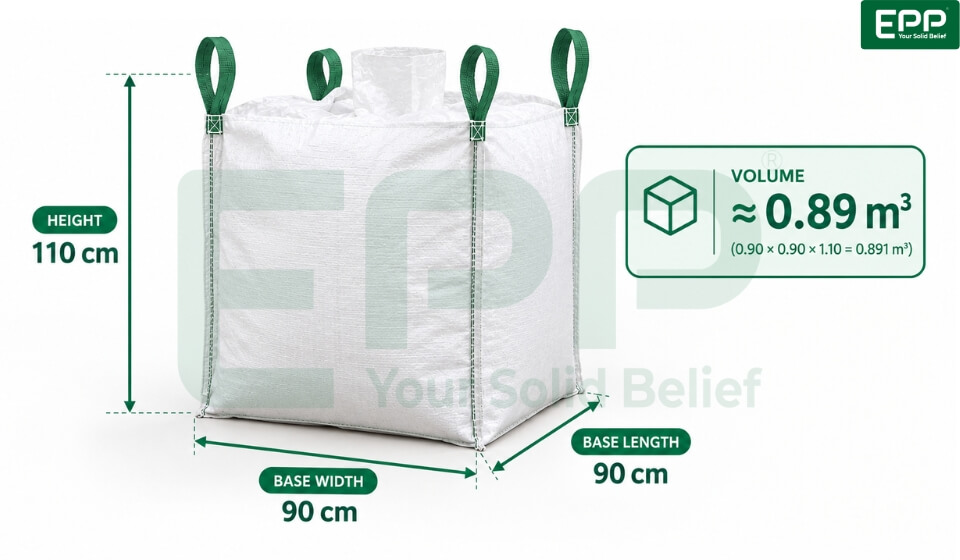
Determining how many cubic metres in a bulk bag helps optimize packaging efficiency and freight container space.
Standard Bulk Bag Volume (m³)
The volume of a bulk bag varies based on its operational purpose, ranging from compact construction builder bags to extra-tall industrial super sacks.
The table below outlines standard dimensions, volume capabilities, and common industry applications:
| Bulk Bag Category | Base Dimensions (cm) | Height (cm) | Theoretical Volume (m3) | Theoretical Volume (cu ft) | Primary Applications |
| Builder / Mini Bag | 85 x 85 | 85 | 0.61 m³ | 21.7 ft³ | Sand, Gravel, Aggregates |
| Standard-Size big Bag | 90 x 90 | 90 | 0.73 m³ | 25.7 ft³ | Ballast, Construction Waste |
| Medium Industrial | 95 x 95 | 120 | 1.08 m³ | 38.3 ft³ | Plastic Pellets, Animal Feed |
| Large Super Sack | 100 x 100 | 160 | 1.60 m³ | 56.5 ft³ | Grains, Fertilizers, Powders |
| Jumbo Extra-Tall | 105 x 105 | 200 | 2.21 m³ | 77.9 ft³ | Biomass, Flakes, Wood Pellets |
Knowing how big is a jumbo bag, how big is a super sack, or how big is a bulka bag allows procurement teams to match product bulk density with the appropriate bag volume and operational equipment.
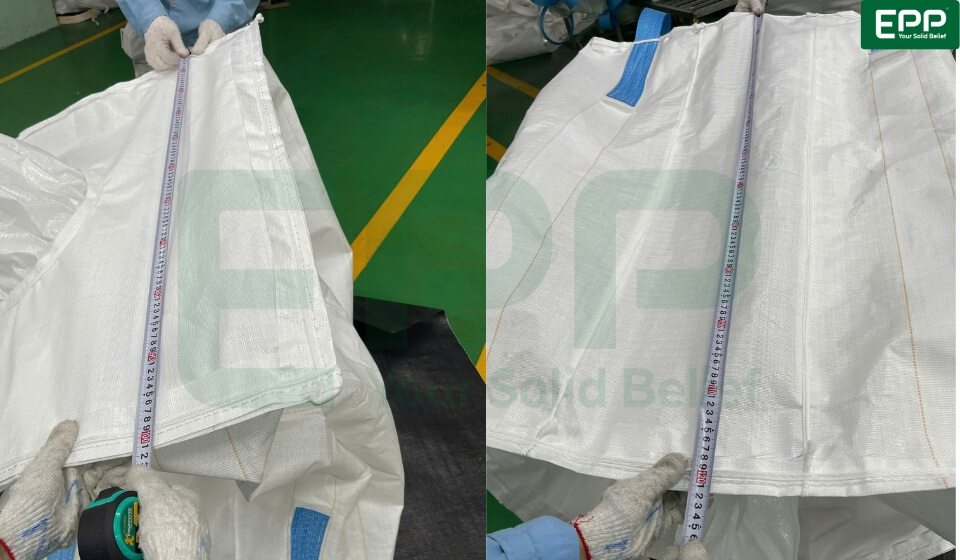
Bag height and base dimensions dictate the final cubic metre capacity of an FIBC super sack.
How many cubic metres in a bulk bag?
Theoretical Calculation Formula
To determine the theoretical volume of a standard rectangular or square-base FIBC, apply the standard mathematical cuboid formula:
Volume=Height×Width×Length
For example, to calculate what is the volume of a super sack measuring 95 cm x 95 cm x 120 cm:
Volume (m3) = (95 x 95 x 120) / 1,000,000 = 1.083 m³
What Determines the Volume of a Bulk Bag?
While the formula gives a baseline, several practical variables dictate actual working capacity during real-world filling operations:
- The “Bulging Effect”: Woven polypropylene fabric stretches under material weight. Unlined, standard 4-loop bags expand outward when filled, increasing actual filled volume by 10% to 15% beyond theoretical calculations.
- Internal Baffles (Q-Bags): Baffle bags incorporate internal fabric panels across corners. These prevent side deformation, holding a square shape after filling and preserving precise volume calculations for container packing.
- Top Closure Construction: An open top or duffle top allows slight over-mounding, whereas a narrow top filling spout restricts filling to the exact level seam height.
Review our technical guide on best FIBC bags specifications for industrial packaging to align bag construction with your volume requirements.
Connecting Volume (m³) and Weight (Tonnes)
Understanding Volume vs Mass
A frequent area of confusion in industrial packaging is conflating volume with payload capacity. Buyers often ask how big is a 1 ton bag or how big is a super sack in relation to mass. Volume (m³) measures physical space, while weight (tonnes) measures mass. Connecting them requires knowing the material’s bulk density (kg/m³).
Weight (kg) = Volume (m³) x Bulk Density (kg/m³)
Bulk Density Reference Table for Common Materials
Different materials require drastically different bag volumes to reach the same 1-tonne payload target:
| Material Type | Bulk Density (kg/m3) | Volume Required for 1 Tonne (1000 kg) | Recommended Bag Configuration |
| Dry Sand / Gravel | 1,600 kg/m³ | 0.625 m³ | 85 x 85 x 85 cm (Standard Builder) |
| Wheat / Grains / Corn | 750 kg/m³ | 1.33 m³ | 95 x 95 x 150 cm (Large Industrial) |
| Plastic Granules (PET/PP) | 650 kg/m³ | 1.54m³ | 100 x 100 x 155 cm (Tall Super Sack) |
| Wood Pellets / Bark Flakes | 350 kg/m³ | 2.85 m³ | 105 x 105 x 200 cm (Jumbo Baffle Bag) |
When sourcing jumbo plastic bags, selecting a bag based purely on weight capacity without factoring in bulk density can lead to half-empty bags or over-filled hazards. For structural details, explore our guide on how to calculate the weight of FIBC bag.
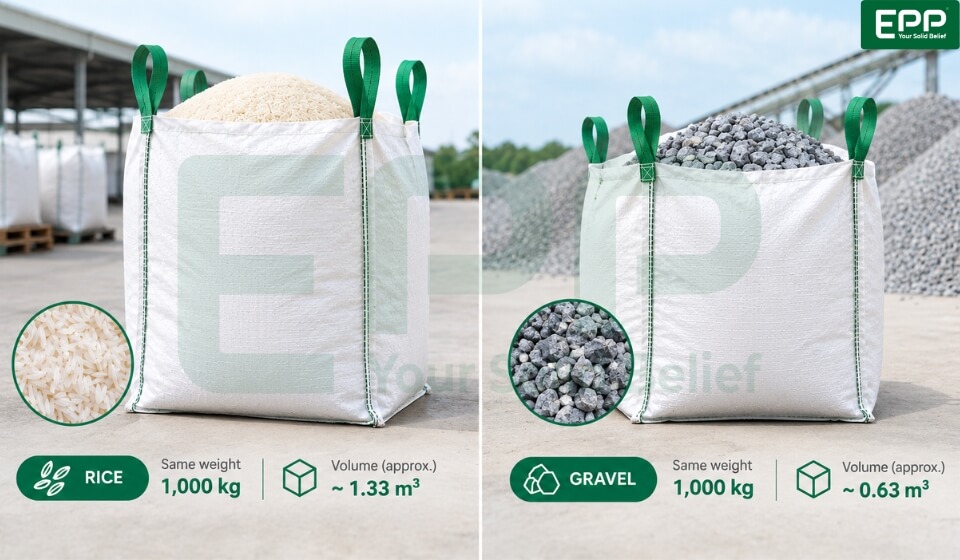
Material bulk density determines how many cubic metres are required to hold one tonne of payload.
Optimizing Container Logistics with FIBC Cubic Metre Calculations
Maximizing shipping container utilization requires matching your bag’s filled volume and outer dimensions to standard container boundaries:
- 20ft Dry Sea Container: Internal volume approx. 33 m³; Maximum payload approx. 24,000 kg.
- 40ft High Cube (HC) Container: Internal volume approx. 76 m³; Maximum payload approx. 26,500 kg.
Because a standard ISO shipping container internal width is approximately 235 cm, utilizing bags with base dimensions of 105 x 105 cm or 110 x 110 cm allows seamless side-by-side placement in two neat rows.
Using Baffle FIBCs (Q-Bags) prevents bag deformation, eliminating wasted space between rounded sidewalls. This allows shippers to pack up to 20% more cubic product per container shipment, significantly reducing ocean freight cost per unit.
How to Choose the Right Bulk Bag Volume for Your Product
Selecting the proper FIBC volume involves evaluating four key operational parameters:
- Calculate Product Bulk Density: Establish the settled weight per cubic metre (kg/m³) of your bulk solid.
- Identify Handling Limitations: Check maximum crane, forklift, and pallet racking weight capacities at both the origin and destination facilities.
- Factor in Aeration and Settling: Powders (like fine chemicals or flour) entrap air during high-speed filling, temporarily increasing required initial volume before settling.
- Determine Storage Conditions: If bags will be stacked two or three high in warehouses, utilize baffled construction to maintain vertical stack stability without bulging into aisles.
Discover additional configuration guidelines in our article on how much do super sacks hold.

Bulk Bag Volume FAQs & Practical Buying Guide
How many bulk bags to a cubic meter?
Depending on dimensions, it takes approximately 1.3 to 1.6 standard builder bags (0.61 – 0.73 m³) to equal 1 cubic metre. For full-size 1.0 m3 industrial super sacks, exactly 1 bag equals 1 cubic metre.
What is the volume of a super sack in cubic feet (ft³)?
One cubic metre equals 35.315 cubic feet. Consequently, a medium 1.0 m³super sack holds 35.3 ft³, while a large 1.5 m³ sack holds approximately 53 ft³ of material.
What is the typical 1 tonne bag volume?
For dense aggregate products, a 1 tonne bag volume is approximately 0.6 m³ to 0.75 m³. For lighter materials like grains or plastic pellets, a bag holding 1 tonne requires a larger volume of 1.3 m³ to 1.5 m³.

Selecting the optimal bulk bag volume balances physical material properties, safe handling limits, and container freight efficiency. As a leading FIBC manufacturer in Vietnam certified to ISO 9001:2015, ISO 22000, and BRCGS standards, EPP Vietnam provides custom-engineered packaging tailored to your supply chain requirements.
Contact our engineering team today to design custom FIBC specifications, request technical datasheets, and optimize your global packaging logistics.
Website: epp.vn
Alibaba website: https://eppvietnam.trustpass.alibaba.com/
Email: [email protected] Hotline/ Whatsapps: +84 986 002 888