Executing a successful HDPE liner installation prevents catastrophic liquid seepage, shields structural assets, and maintains regulatory compliance across industrial projects. High-density polyethylene (HDPE) liners are heavy-duty, impermeable geomembrane barriers engineered to contain liquids, gases, and hazardous wastes under extreme environmental stress.
As a leading supplier, EPP Vietnam connects international buyers, engineering contractors, and plant directors with certified packaging and lining networks. This technical guide outlines step-by-step HDPE liner installation protocols, quality control testing, repair procedures, and cost factors to guarantee leak-proof longevity for your facility.
Where Are HDPE Liners Used?
High-density polyethylene liners are manufactured from 100% virgin resin to deliver exceptional chemical resistance, high tensile strength, and superior puncture toughness. Thickness typically ranges from 20 mils (0.5 mm) up to 120 mils (3.0 mm) depending on structural static loads and containment severity. Subterranean installations carry operational lifespans rated up to 100 years.
Industrial HDPE liner installation procedures serve two distinct containment sectors:
- Environmental & Water Containment: Landfill base cells, hazardous waste dikes, agricultural reservoirs, irrigation canals, heap leach pads, and aquaculture lagoons.
- Industrial Bulk Packaging: Form-fit or lay-flat liner insertion inside FIBC bulk bags to isolate hygroscopic powders, fine minerals, or reactive chemicals from moisture and oxygen ingress.
When configuring bulk packaging systems, determining when should we use PE liners for bulk bags allows procurement managers to balance material safety against total packaging expenditure.
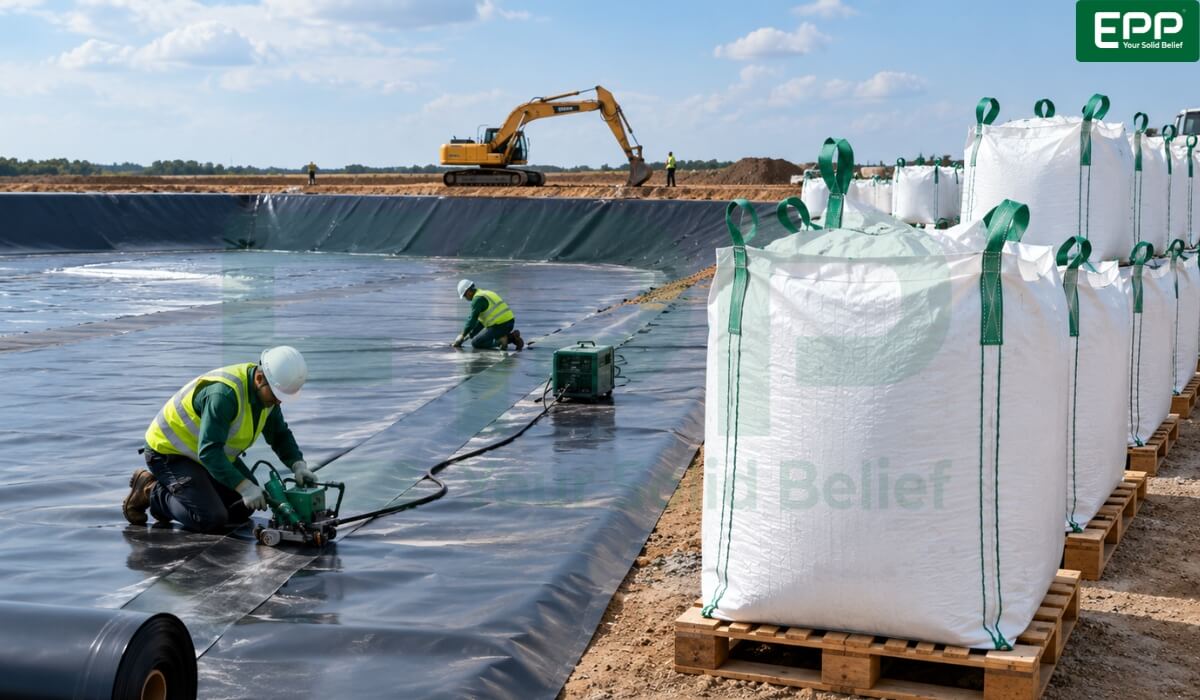
HDPE liner installation applications comparing geomembrane ponds and FIBC bulk bag liners.
Pre-Installation Protocols: Site & Material Preparation
Flawless site preparation eliminates early mechanical failure risks long before thermal fusion welding begins on-site.
Subgrade & Surface Inspection
Subgrade defects cause roughly 15% of all site liner punctures. Site engineers must inspect and dress the supporting surface according to rigorous earthwork standards:
- Surface Cleansing: Eliminate sharp stones, tree roots, wooden splinters, or standing water from the substrate.
- Compaction Tolerances: Ensure the subgrade is smooth, firm, and compacted to a minimum 90% Modified Proctor Density, with surface grade variation capped at ±12 mm.
- Geotextile Underlayment: Deploy a non-woven needle-punched geotextile cushion over rough rocky soils to buffer the geomembrane panel from sharp subgrade pressure points.
Material Handling & Quality Inspection
Managing raw materials safely prevents microscopic damage during transit. Unload geomembrane rolls using fabric slings or core spreader bars rather than bare steel chains.
Before committing panels to deployment, verify resin certificates from your audited HDPE liner manufacturers to confirm chemical purity and uniform sheet thickness. Never deploy liner sheets during active rainfall or high wind conditions exceeding 20 km/h.
Step-by-Step HDPE Liner Installation Process
Achieving a certified seal during an HDPE liner installation requires disciplined thermal fusion welding by qualified technicians.
Step 1: Panel Deployment & Overlap Alignment
Unroll HDPE geomembrane panels in a relaxed state without stretching or dragging the fabric across rough terrain. Align adjoining panels to maintain a consistent seam overlap of 100 mm to 150 mm for automated dual-track welding. Place clean sandbags weighing 10 to 15 lbs along unseamed edges to prevent wind uplift during layout alignment.
Step 2: Advanced Seam Welding Techniques
Commercial joining relies on precise thermal fusion processes:
- Hot Wedge Welding: The primary method for long continuous field seams. The self-propelled hot wedge melts opposing sheet edges at temperatures between 300°C and 400°C at speeds of 1.5 m/min to 2.5 m/min, pressing them together under calibrated nip rollers to create an airtight inner air channel.
- Extrusion Welding: Used primarily for patches, pipe penetrations, tight corners, and detailed repair work. A bead of molten virgin HDPE resin is extruded directly over pre-abraded sheet overlaps to bond the panels together.
Step 3: Anchor Trench Construction
To lock perimeter panels against hydraulic head pressure and wind suction, excavate an anchor trench (typically 50 cm x 50 cm) set back from the crest slope. Lay the geomembrane edge across the trench bottom, backfill with clean engineered soil, and compact thoroughly to eliminate structural slippage risks.
Step 4: Special Process for FIBC Bulk Bag Liner Insertion
Inserting protective liners into heavy-duty Jumbo bags requires specialized positioning. Form-fit HDPE liners are shaped to match the outer bag’s exact dimensions, including top spouts and bottom discharge spouts. Securing the liner tabs directly into the FIBC perimeter seams prevents liner twisting, eliminating product trapping during rapid discharge operations.
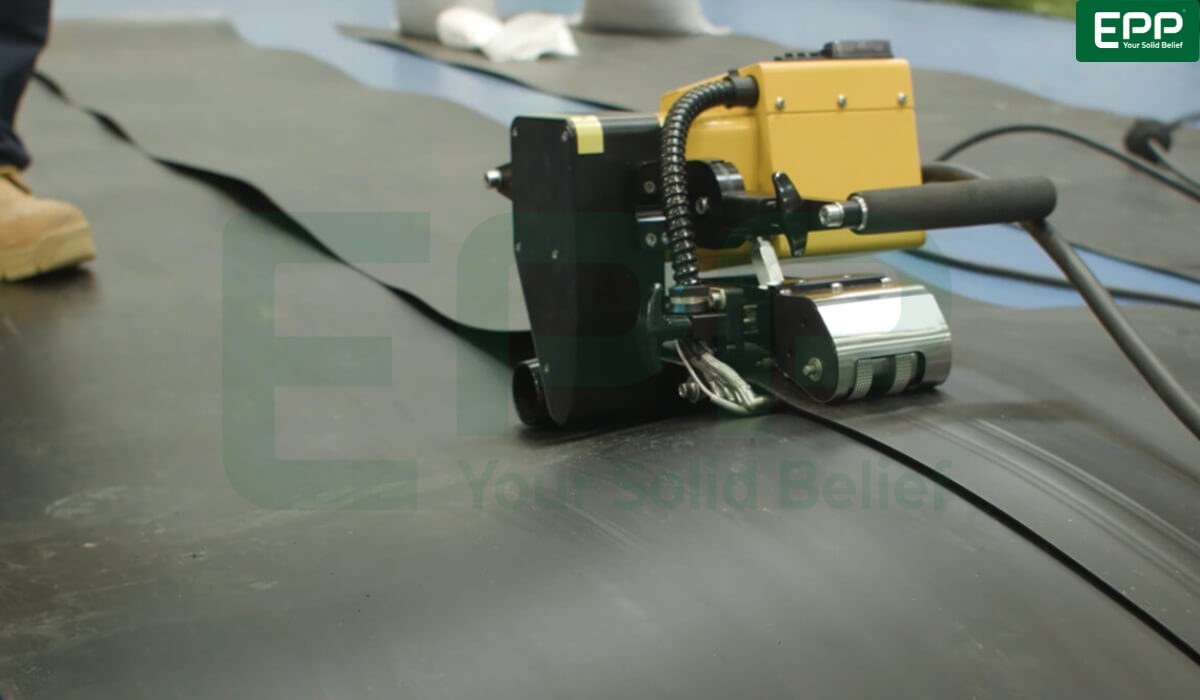
Hot wedge welding method during professional HDPE liner installation.
Quality Assurance, Seam Testing & Safety Standards
Strict Quality Assurance and Quality Control (QA/QC) validation ensures every field weld achieves structural parity with the parent material.
Non-Destructive Testing Methods
Technicians must verify 100% of field seams using non-destructive field testing:
- Air Pressure Testing (Dual-Track Seams): Seal both ends of the inner air channel created by the hot wedge welder. Inject compressed air to 200 – 250 kPa (30 – 35 psi) and monitor for 5 minutes. A pressure drop under 10% confirms a continuous leak-proof seal.
- Vacuum Box Testing (Extrusion Seams): Apply a soapy solution over single-bead extrusion welds, place a clear vacuum chamber over the wet seam, and draw a 5 psi vacuum. Bubbling instantly reveals pinhole leaks requiring repair.
Destructive Testing
Cut field seam samples at specified intervals (e.g., one sample per 500 feet of weld) for lab tensiometer testing:
Peel & Shear Testing: Measures bond strength under direct lateral load. The welded seam must demonstrate a Film Bond Tear (FBT), meaning the parent sheet breaks before the welded seam separates.

Common HDPE Liner Installation Problems
Analyzing field failures highlights the value of proactive quality management throughout the deployment phase:
| Common Installation Problem | Operational Impact | EPP Vietnam Risk Mitigation Strategy |
| Inadequate Subgrade Preparation | Sharp stones cause bottom punctures, accounting for 15% of field leaks. | Recommends geotextile cushioning layers and strictly enforces subgrade inspection standards. |
| Welding in Adverse Weather | Ambient moisture causes seam bubbling and brittle bonds. | Suspends field welding when relative humidity exceeds 80% or ambient temperatures drop below 5°C. |
| Twisted or Wrinkled FIBC Liners | Traps granular cargo during discharge, causing side wall tears. | Supplies custom Form-Fit and Bottle-Shaped Liners tabbed directly into outer FIBC seams. |
| UV Degradation on Exposed Panels | Solar radiation breaks down uninhibited polymer chains within months. | Supplies 100% virgin PP/PE liners formulated with certified ASTM D4355 UV stabilization. |
How to Repair a Damaged HDPE Liner?
When minor punctures, cuts, or seam voids are detected during QA/QC inspections, technicians must execute field repairs immediately using standardized extrusion welding steps:
- Surface Inspection & Cleaning: Locate the damaged area and thoroughly clean off dirt, moisture, and debris within a 300 mm radius.
- Patch Preparation: Cut an HDPE patch from matching parent liner material. Shape the patch into an oval or rectangle with rounded corners (minimum 100 mm – 150 mm overlap past the damaged edge) to prevent sharp corner peeling.
- Surface Abrasion: Mechanically abrade the patch edges and the target liner surface using a hand grinder (40-grit wheel) to remove oxidation films and create a mechanical key.
- Tack Welding & Extrusion Bead: Tack-weld the patch in place using hot air, then apply a continuous molten HDPE extrusion bead along the entire perimeter using a handheld extrusion gun.
- Vacuum Box Testing: Verify the integrity of the patch using vacuum box testing before approving the area for service.
In specialized agricultural and industrial containment, applying high-durability agricultural films alongside proper liner repairs preserves long-term reservoir capacity.
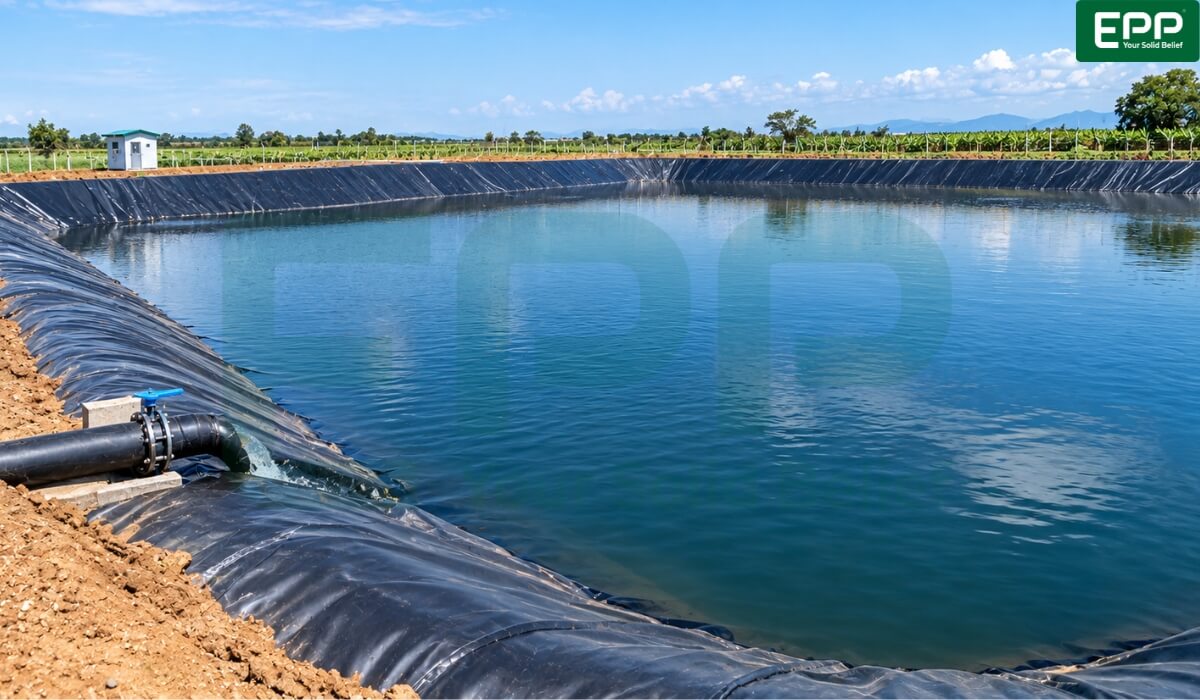
EPP Vietnam high-performance agricultural films and custom HDPE liners installed in a reservoir.
Frequently Asked Questions About HDPE Liner Installation
Can damaged HDPE liners be repaired on-site during installation?
Yes. Punctures, small tears, or failed seam sections can be repaired on-site using hand-held extrusion welders and rounded parent material patches following proper surface grinding and vacuum box testing.
How much does HDPE liner installation cost?
Total project costs depend on sheet thickness, site geography, labor rates, and packaging integration. Review our detailed technical guide on the top 5 factors affecting the HDPE liner cost to accurately budget your procurement timeline.
What thickness of HDPE liner is best for industrial applications?
Thickness selection depends on static load requirements: 20 mil to 40 mil (0.5 mm – 1.0 mm) suits temporary agricultural ponds; 60 mil to 120 mil (1.5 mm – 3.0 mm) is standard for hazardous landfills and mining pads; and 40 to 150 microns is ideal for protective FIBC bulk bag liners.

How long does a properly installed HDPE liner last?
When protected from mechanical abrasion and formulated with UV stabilizers, subterranean HDPE geomembranes carry service life ratings exceeding 50 to 100 years. Uncovered exposed surface liners typically last 20 to 30 years depending on solar radiation levels.
Conclusion
Executing a flawless HDPE liner installation requires combining 100% virgin polymer resin, proper subgrade preparation, calibrated thermal fusion welding, and rigorous non-destructive seam testing. Following these standards prevents environmental leaks and lowers long-term operational maintenance costs.
EPP Vietnam stands ready to streamline your material sourcing. Contact our engineering team today to request technical product specifications, receive competitive project quotes, or order free material samples for your facility.
Website: epp.vn
Alibaba website: https://eppvietnam.trustpass.alibaba.com/
Email: [email protected] Hotline/ Whatsapps: +84 986 002 888