
Big bags of rice have become the primary focus for global exporters as the demand for sustainable, clean, and high-quality food continues to skyrocket. Nowadays, the demand for clean food is increasing day by day. Along with clean vegetables and clean meat, the demand for clean rice is a matter of concern to many people. That is also the reason that consumers pay attention to the packaging of rice. Especially in the rice import and export model, the requirements for rice packaging are even higher.
Jumbo bags of rice are the golden solution applied by many businesses today. This is a line of bags with a large load, of environmentally safe materials, so it is very popular. As a leading manufacturer based in Vietnam—the world’s second-largest rice exporter—we have seen firsthand how switching to bulk bags of rice not only protects the product’s integrity but also serves as a powerful statement for environmental conservation.
The Global Shift in Rice Packaging
The traditional rice supply chain relied heavily on small 25kg or 50kg polypropylene (PP) sacks. While functional, this model is becoming obsolete in the face of modern “Green Trade” regulations and the high labor costs associated with manual handling. We are currently witnessing a massive global shift toward big bags rice solutions for several key reasons.
International importers, particularly in the European Union and North America, are now under strict mandates like the “European Green Deal,” which requires a reduction in single-use plastic waste. The concept of “Clean Rice” has also expanded. It no longer just means rice grown without pesticides; it refers to a “Clean Supply Chain” where the rice is protected from contamination, moisture, and pests from the field to the consumer’s plate.
In this context, Big bags for rice provide an airtight, controlled environment that small sacks simply cannot match. By consolidating rice into 1-ton or 2-ton units, exporters can ensure that their premium product remains pristine while meeting the rigorous sustainability audits required by modern retail giants.
Why Big Bags of rice are the “Eco-Friendly” Solution
When we talk about an “eco-friendly choice,” we must look at the life cycle of the packaging. Many people assume all plastic is inherently bad for the environment, but the reality of industrial logistics is more nuanced. Big bags of rice are eco-friendly because they prioritize Efficiency and Recyclability.
100% Recyclable Material
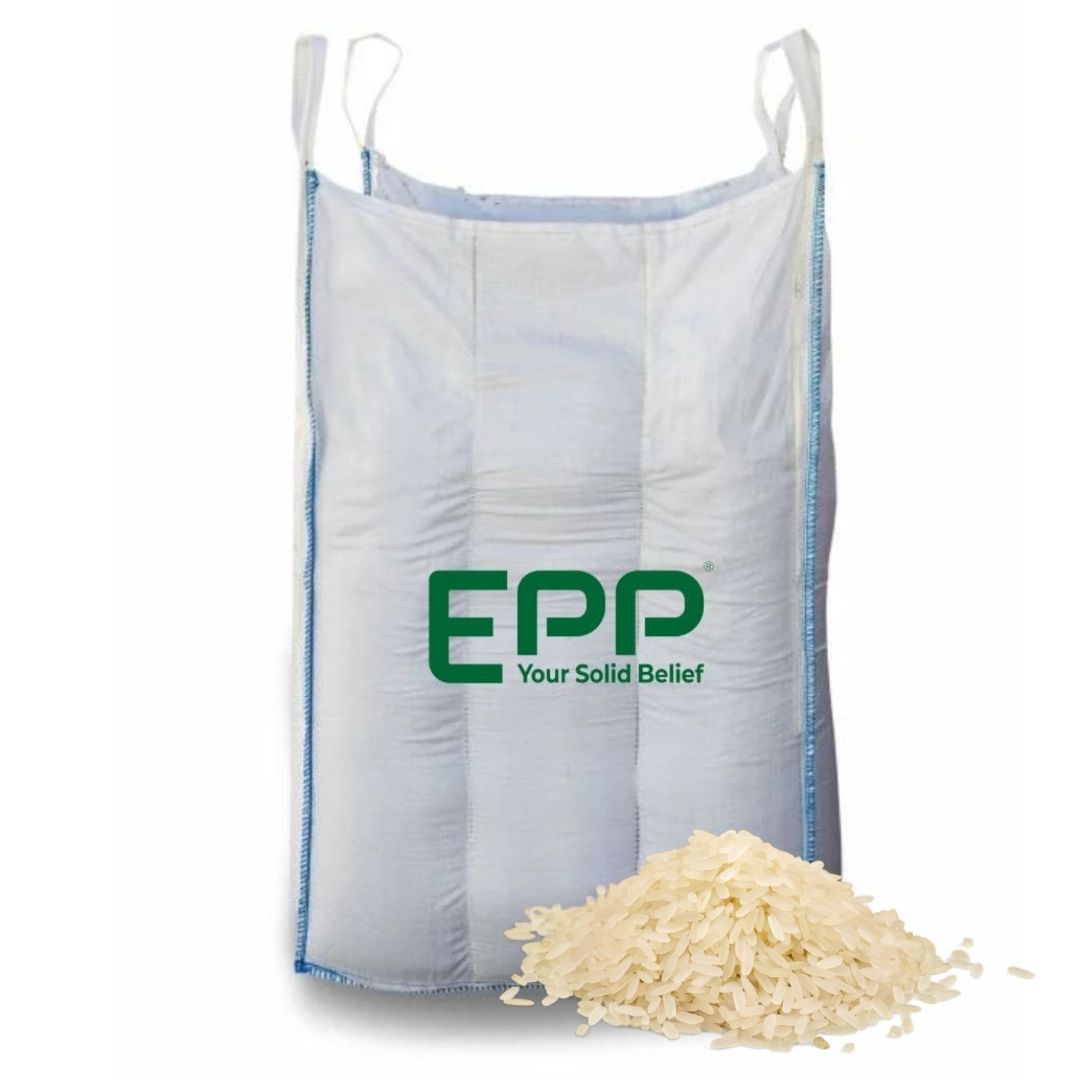
High-quality bulk bags of rice are manufactured from 100% virgin Polypropylene (PP). PP is a highly recyclable polymer. Once a jumbo bag has reached the end of its life, it can be shredded, melted, and pelletized to create new industrial products, such as automotive parts, plastic lumber, or even new industrial containers. This contributes directly to a “Circular Economy,” preventing plastic from entering landfills or oceans.
Reducing Food Waste
Environmental protection isn’t just about plastic; it’s about preventing the waste of the product inside. In the traditional small-sack model, “shrinkage” (product loss) due to bag breakage, spillage, and moisture damage can reach up to 5% of a total shipment. Big bags of rice solutions are significantly more durable. By preventing spillage, we ensure that every grain of “clean rice” harvested is actually consumed. Reducing food waste is one of the most effective ways to lower the overall carbon footprint of agriculture.
The Mathematics of Plastic Reduction when using big bags of rice
To understand why jumbo bags of rice are the greener choice, we must look at the numbers. This is where the environmental benefit becomes undeniable.
Imagine you need to transport 20 tons of rice:
- Option A (Small Sacks): You would need approximately 800 bags (25kg each). Each small bag weighs roughly 100-120 grams. That is nearly 80kg to 96kg of plastic used for the shipment. Furthermore, the stitching and ink usage across 800 individual units are significantly higher.
- Option B (Big Bags): You would need only 20 Jumbo Bags (1 ton each). A high-quality 1-ton FIBC bag typically weighs between 2kg and 2.5kg. This results in roughly 40kg to 50kg of plastic for the same 20-ton load.
By switching to big bags of rice, exporters can reduce their total plastic consumption by nearly 50%. When you multiply this by the millions of tons of rice exported from Vietnam annually, the reduction in global polymer usage is staggering. Fewer bags also mean fewer labels, less adhesive, and less energy consumed during the manufacturing process.
Modern Manufacturing & Tech-Driven Sustainability
As a specialized supplier in Vietnam, we believe that true sustainability is driven by technology. We don’t just “make bags”; we engineer packaging solutions that minimize waste through precision.
Proprietary Quoting & Design Software
One of the biggest contributors to waste in the FIBC industry is “Over-Engineering”—using more plastic than is actually needed for the job. Our factory utilizes proprietary calculation software that allows us to quote and design bags with surgical precision.
- By understanding the specific bulk density of your rice (e.g., Jasmine vs. Long Grain), our software calculates the exact fabric weight (GSM) required to maintain a Safety Factor of 5:1 or 6:1.
- This prevents the unnecessary use of excess plastic, ensuring that your Big bags of rice are as light as possible while remaining perfectly safe for transport.
Logistics Efficiency
Sustainability also involves “Carbon Footprint” reduction in transport. Big bags rice are designed for stackability. In a standard 40-foot High Cube container, you can fit 20 to 22 tons of rice in jumbo bags with zero wasted “dead space.” This maximizes the fuel efficiency of the shipping vessel. Furthermore, because these bags are handled mechanically by forklifts and cranes, the “turnaround time” at the port is reduced by up to 40%, lowering the energy consumption of port machinery.
Conclusion
Choosing big bags of rice is a decision that aligns business profitability with environmental stewardship. In an era where consumers are increasingly vigilant about “clean food” and “green packaging,” the FIBC bag stands out as the most logical, eco-friendly solution for the rice industry.
However, as we have discussed, with so many suppliers in the market, it is inevitable that poor-quality packaging exists. Poor-quality bags are the opposite of eco-friendly; they break, they spill, and they cannot be recycled easily. This is why EPP focuses on 100% virgin materials and tech-driven manufacturing.
Transition your supply chain today. Contact EPP for a custom quote on eco-friendly big bags of rice and join the movement toward a greener, more efficient agricultural future.
