
In the competitive world of industrial packaging, the physical weight of an empty bulk bag—commonly referred to as its “tare weight”—is the most reliable metric for auditing supplier quality, ensuring structural safety, and controlling logistics costs. While procurement managers often focus primarily on the Safe Working Load (SWL), understanding the exact physical weight of FIBC bag construction allows you to verify that the super sacks you receive strictly match the technical GSM specifications on your contract.
As a leading bulk packaging manufacturer from Vietnam with an annual output exceeding 6 million units, EPP Vietnam prioritizes total material transparency. In this guide, we break down the engineering formulas used to calculate empty jumbo bag weight, helping B2B buyers audit their suppliers and optimize global shipping operations.
Quick Lookup: Average Empty Jumbo Bag Weight (Tare Weight)
The table below provides a reference baseline for standard, unlined bulk bags across common industrial specifications:
| Bulk Bag Style | Safe Working Load (SWL) | Standard Dimensions (cm) | Empty Jumbo Bag Weight (Tare Weight) |
| Standard Builders Bag | 1000 kg (1 ton) | 90 x 90 x 90 | 1 kg – 2.0 kg |
| U-Panel Heavy Duty | 1250 kg – 1500 kg | 95 x 95 x 135 | 2 kg – 2.9 kg |
| Circular / Tubular Bag | 1000 kg – 1500 kg | 90 x 90 x 120 | 1.5 kg – 2.4 kg |
| Baffled Bag (Q-Bag) | 1000 kg – 2000 kg | 105 x 105 x 150 | 2.5 kg – 3.5 kg |
Variations in lifting loop densities, spout additions, or protective coatings will shift a bag’s final tare weight above or below these baselines.
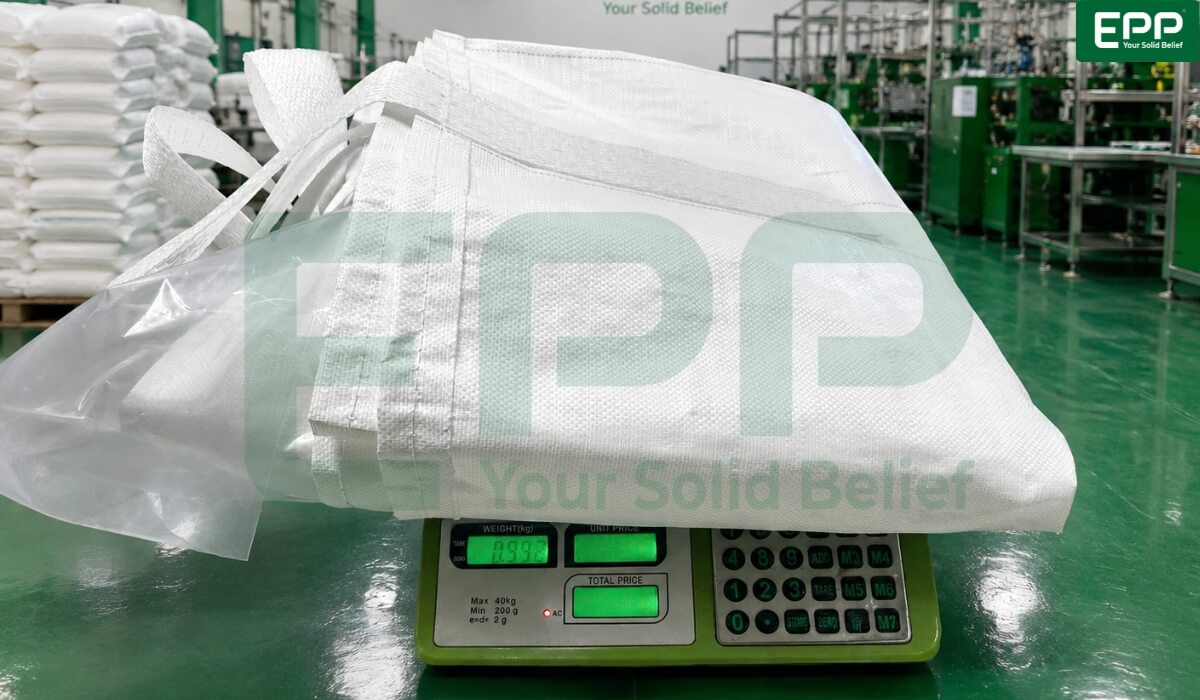
Independent tare weight verification ensures the FIBC fabric GSM matches technical contract specifications.
Why the Empty Jumbo Bag Weight is Your Ultimate Quality Audit Metric?
In polymer extrusion, polypropylene (PP) resin is a commodity traded by weight. When an unprincipled packaging supplier attempts to undercut competitors on price, the most common cost-cutting tactic is silently reducing the fabric’s GSM (grams per square meter)—for example, delivering 150 GSM fabric when 180 GSM was specified.
While a visual inspection cannot easily detect a 20 GSM difference, placing an empty container on a digital scale immediately exposes the discrepancy. Verifying the physical weight of FIBC bag shipments protects your organization from:
- Catastrophic Field Failures: A bag that is lighter than specified lacks the tensile strength required to maintain its certified Safety Factor (5:1 or 6:1), increasing the risk of tears during dynamic crane lifts.
- Overpaying for Missing Raw Material: If a 10,000-bag order arrives 200 grams light per bag, you have effectively paid for 2 metric tons of polypropylene plastic that was never delivered.
- Port Freight Surcharges: Unexpected tare weight discrepancies across thousands of units complicate container payload estimates, leading to overweight container penalties at destination ports.
How to Calculate the Weight of FIBC Bag
Determining the exact weight of a bulk bag requires treating the 3D container as a series of unfolded 2D panels. The total weight is calculated using the following primary formula:
Total Weight of FIBC Bag = Body Fabric Weight + Webbing Loop Weight + Spouts Weight + Accessories & Threads Weight
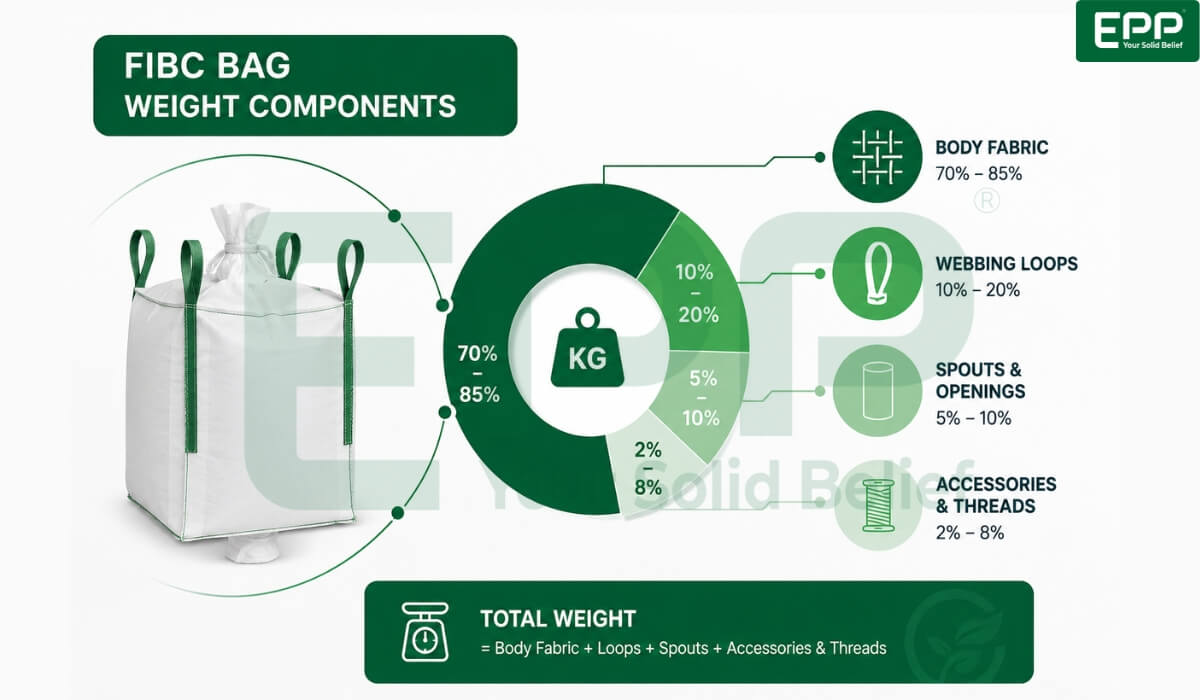
Pie chart breakdown illustrating the weight components of an FIBC jumbo bag to calculate total product mass
Step 1: Calculating Body Fabric Weight & Surface Area
To calculate the fabric weight, find the bag’s total surface area in square meters (m2) and multiply it by the combined fabric density (Base GSM + Coating GSM).
Calculate Surface Area based on Construction Style:
- For a U-Panel Bag: [(Length x Height x 2) + (Width x Height x 2) + (LengthxWidth)]
- For a Circular (Tubular) Bag: [(Width x 2 + Length x 2) x Height] + [Length x Width]
Apply the Density and Seam Allowance:
Once you have the area, use this formula to find the weight in grams:
*Note: 1.06 represents a 6% “Seam Allowance.” In Vietnam’s leading factories, we add this buffer to account for the fabric tucked and folded during industrial sewing.
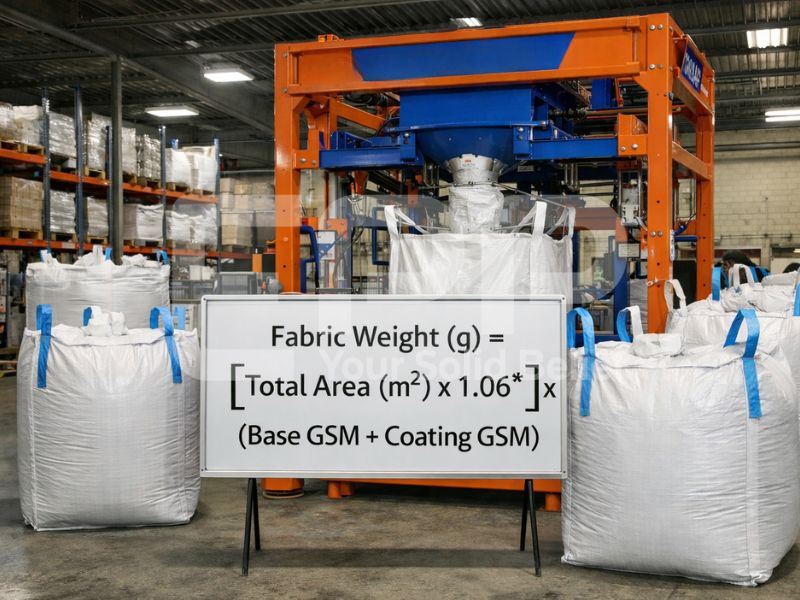
Mathematical formula diagram explaining how to calculate FIBC bulk bag fabric weight
Worked Calculation Example:
Imagine a U-Panel Jumbo Bag with dimensions 90 x 90 x 120 cm using 160 GSM fabric and 20 GSM coating.
- Side Panels (4 sides): (0.9 x 1.2) x 4 = 4.32 m2
- Bottom Panel: 0.9 x 0.9 = 0.81 m2
- Total Area: 4.32 + 0.81 = 5.13 m2
- Applying the Formula: [5.13 x 1.06] x (160 + 20) = 5.43 m2 x 180GSM = 977.4 g
Step 2: Calculating the Webbing and Loop Weight of FIBC Bag
Lifting straps are measured in linear density using Grams per Meter (g/m). To calculate loop weight accurately, you must measure the Total Developed Length—which includes both the free standing loop above the bag and the fully stitched reinforcement leg extending down the side seam.
Webbing Weight Formula:
Webbing Loop Weight (g) = Total Developed Length per Strap (m) x Strap Density (g/m) x Number of Straps
If your weight of FIBC bag calculation shows a very high fabric weight but very low webbing weight, the bag is likely “unbalanced” and could be dangerous to lift when fully loaded. High-quality Vietnamese exporters prioritize heavy-duty webbing (50g/m to 60g/m) for bags destined for heavy mineral or chemical transport.
Example: A 4-loop bag with 5.0 meters of total developed length per strap using 45 g/m heavy-duty PP webbing:
5.0 m x 45 g/m x 4 straps = 900 grams.
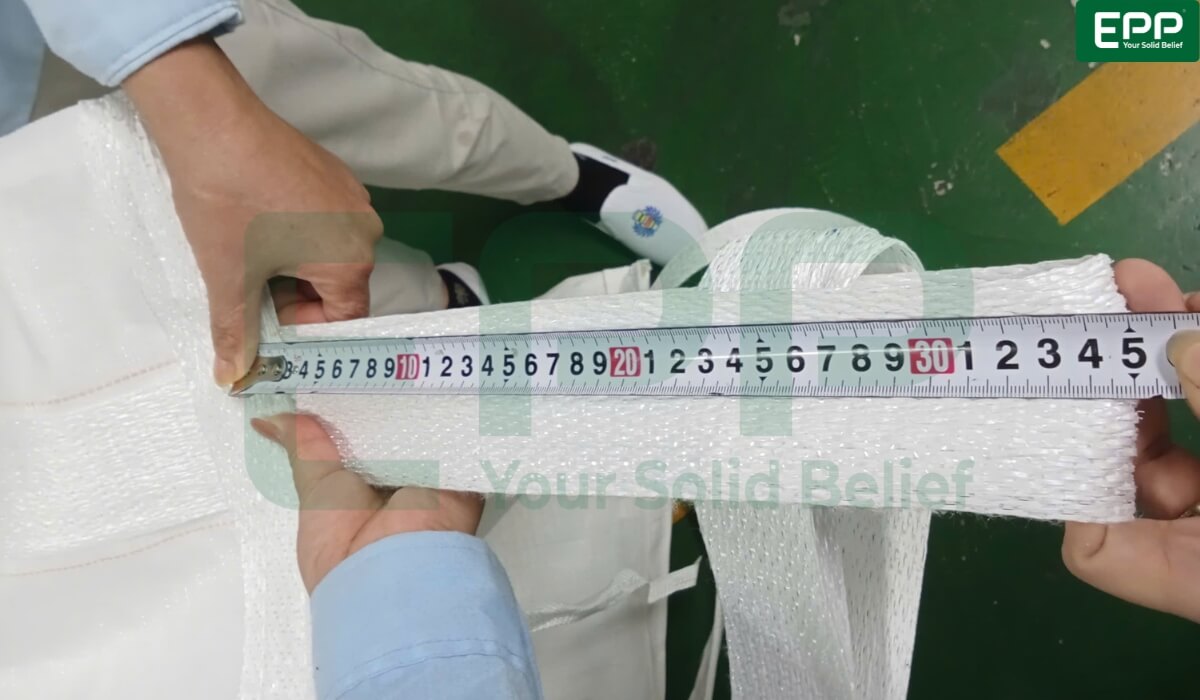
Precision micrometers verify PP FIBC loop to ensure strict compliance with ISO 21898 tolerance standards
Step 3: Factor in Accessories and Thread
Secondary structural elements and accessories typically add between 150 grams and 400 grams to the overall empty bag weight:
Filling and Discharge Spouts: Calculated by finding the surface area of the spout cylinder:
Spout Surface Area ( m2) = [3.1416 x Spout Diameter (m) x Spout Length (m)]
Spout Fabric Weight (g) = Spout Area ( m2) x Spout Fabric GSM (usually 70-100 GSM).
Thread and Sift-Proofing: Heavy-duty twisted polypropylene sewing thread adds approximately 40g to 60g to the weight of FIBC bag. Adding felt sift-proofing cords along seams adds an additional 20g to 30g.
Document Pouches and Tie-Locks: Standard PE document pouches add 15g, while plastic B-locks or tie cords add roughly 20g per closure.
Balancing loop strength and fabric selection is essential to creating compliant packaging. Review our guide on best fibc bags specifications for industrial packaging to align component choices with your product’s bulk density.
Manufacturing Tolerances & International Safety Standards
In industrial polymer extrusion, perfect weight consistency across every single unit is impossible due to minor micro-variations during tape stretching and weaving.
Under international manufacturing standard ISO 21898 (which governs non-rigid bulk containers), an allowable Manufacturing Tolerance of ±3% to ±5% is recognized across production runs.
If your technical calculation yields a target weight of 2.50 kg, a delivered bag weighing 2.40 kg falls comfortably within acceptable industrial limits. However, if the delivered product weighs 2.15 kg (a 14% reduction), the supplier has under-engineered the container, compromising the bag’s dynamic lift rating and safety margins.
To evaluate certified empty containers for your facility, browse available configurations through our catalog of empty bulk bags for sale.
How to Verify Your Supplier’s Big Bag Weight
To establish an airtight quality audit protocol for incoming overseas shipments, procurement teams should implement a standardized three-step verification workflow:
- Random Tare-Weight Sampling: Upon receiving a container shipment, select 10 empty bulk bags at random across different pallets. Weighed on a calibrated industrial scale, the average weight of FIBC bag batch should fall within ±3% of the agreed specification sheet.
- Calculate Fabric GSM Backwards: If a bag arrives significantly light, cut a precise 10 cm x 10 cm square sample from the body panel, weigh it on a precision laboratory scale, and multiply the reading by 100 to determine the actual physical GSM.
- Cross-Reference Dimensional Specs: Ensure that overall bag dimensions match contract drawings. For a complete guide on measuring outer versus inner proportions, refer to our comprehensive guide on big bags dimensions.
FAQ: Frequently Asked Questions
Does a PE liner affect the weight of FIBC bag?
Yes. An internal polyethylene liner adds noticeable mass to the container. A standard 50-micron PE liner typically adds between 400g and 700g to the total tare weight, depending on the bag’s length and circumference.
What is the average empty 1 ton jumbo bag weight in kg?
A standard 1-ton (1000 kg SWL) unlined jumbo bag typically weighs between 1.5 kg and 2.5 kg empty. The exact weight varies based on fabric GSM, loop reinforcement style, and whether top/bottom spouts are present.
How much does coating or lamination add to total super sack weight?
Standard polypropylene lamination (coating applied to prevent moisture ingress or fine powder leakage) adds roughly 15g to 20g per square meter (GSM) of coated surface fabric.
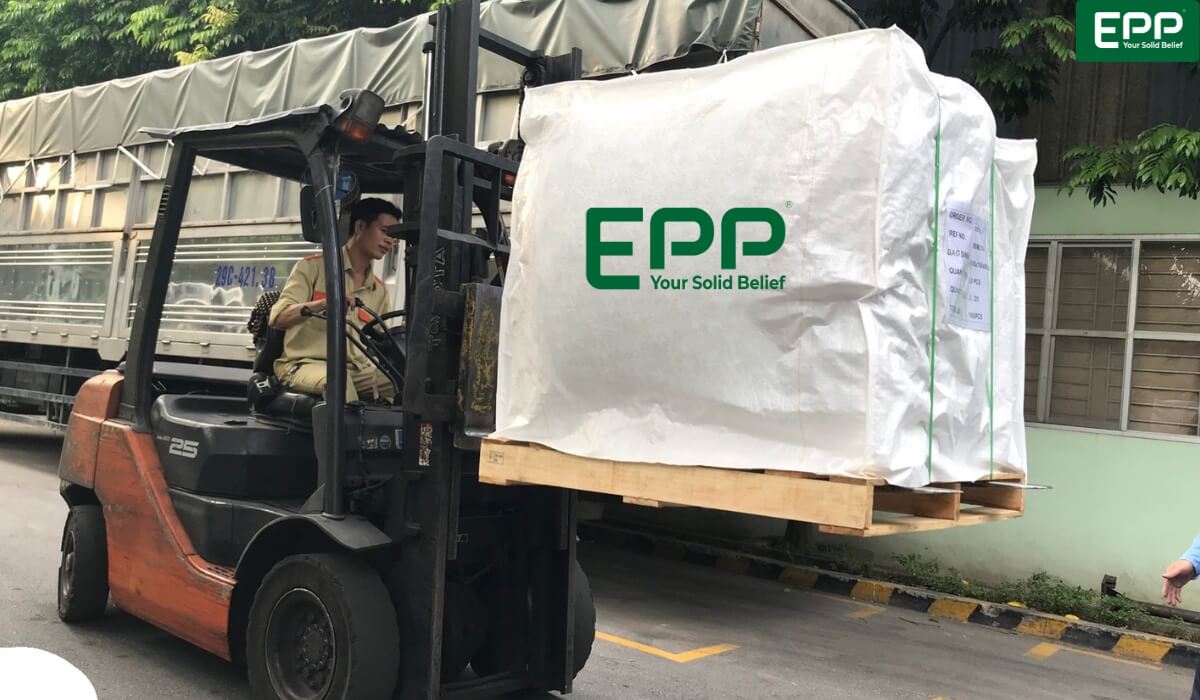
Factory-direct certified bulk bags packed and weighed for seamless export to US ports
Partner with EPP Vietnam for Fully Certified FIBC Solutions
Utilizing a reliable FIBC Bulk Bag Calculator to determine the exact weight of FIBC bag construction ensures your operations remain safe, compliant, and cost-effective. At EPP Vietnam, we provide a complete, itemized Weight Breakdown Sheet for every custom FIBC design we manufacture—ensuring the exact fabric GSM and webbing specs you order are delivered to your facility.
Contact our engineering team today to review your packaging specifications, request sample weight calculations, and receive a competitive factory-direct quote.
Website: epp.vn
Alibaba website: https://eppvietnam.trustpass.alibaba.com/
Email: [email protected] Hotline/ Whatsapps: +84 986 002 888