
Bulk bags of gravel, also known as jumbo bags or FIBCs, have completely transformed the way aggregate materials are handled in the construction and landscaping industries. Gone are the days when the only way to move stone was by dumping a massive, messy pile in the middle of a driveway or a busy street. Today, professional contractors and retail suppliers are turning to the “bagged” method to streamline their logistics and improve site safety.
At EPP Vietnam, we have supplied millions of heavy-duty FIBCs to aggregate producers worldwide. Moving gravel is a “heavy-weight” game; the material is dense, abrasive, and unforgiving. If your packaging isn’t up to the task, the results can be dangerous. In this guide, we will explore the outstanding advantages of using bulk bags of gravel and why they are the ultimate solution for modern logistics.
Bulk bags of gravel: Maximum Containment and Zero Product Loss

The most immediate benefit of using bulk bags of gravel is the total control you have over your inventory. When gravel is transported in a loose “bulk” dump truck, several issues arise that cost money.
Eliminating Spillage and Waste
Loose gravel often spills during transit or while being dumped, leading to road hazards and wasted product. With a bulk bag, 100% of the gravel you pay for stays inside the bag until it is ready to be used. This is particularly important for high-value decorative stones where every kilogram counts toward the project budget.
Contamination Control
On a busy construction site, loose piles of stone quickly get mixed with mud, dirt, or trash from surrounding activities. By keeping the gravel contained in a high-quality polypropylene bag, you ensure the stone remains clean. This is especially critical for high-end landscaping projects or specialized drainage systems where purity is key to the system’s performance.
Protection from the Elements
While gravel itself doesn’t “spoil,” keeping it contained prevents it from being washed away during heavy rain or buried under snow. Having your materials in bulk bags of gravel means they are always neatly contained and accessible, regardless of the weather conditions on-site.
Bulk bags of gravel: Flexibility and Easy-to-Use
One of the “outstanding advantages” often overlooked is how much easier bulk bags of gravel make site management, especially in restricted environments.
Precise Placement
In urban construction, space is at a premium. You cannot simply dump 20 tons of gravel on a city sidewalk or a narrow alleyway. Bulk bags allow for “Point-of-Use” delivery. Using a crane, telehandler, or forklift, a single 1-ton bag can be lifted over a fence, placed on a rooftop, or dropped directly into a small backyard. This flexibility saves hours of manual labor involving shovels and wheelbarrows.

Multi-Product Transport
In a single truckload, a supplier can deliver five different types of stone (e.g., pea gravel, crushed granite, and decorative river rock) because they are neatly separated in individual bulk bags of gravel. If these were loose, they would mix, or you would need five separate truck deliveries, which would skyrocket your transport costs and carbon footprint.
Bulk bags of gravel: Cost Efficiency and Reusability
While there is an upfront cost for the packaging, the Return on Investment (ROI) on bulk bags of gravel is realized through labor savings and reduced equipment wear.
Reduced Labor Costs
A forklift operator can move 10 tons of bagged gravel in a fraction of the time it takes a crew of three to shovel and move the same amount manually. For contractors, time is money, and reducing the “shoveling time” allows the crew to focus on the actual installation and finishing work.
The 6:1 Safety Factor and Reusability
For gravel, we often recommend a “Multi-Trip” bag with a 6:1 Safety Factor. This means the bag is engineered to be reused multiple times. If your company handles internal transfers between yards or “closed-loop” deliveries to regular job sites, a single bag can survive dozens of trips. This brings your “cost per fill” down to just pennies, making it an incredibly sustainable choice.
Brand Value and Professionalism
At EPP Vietnam, we can print your company logo and contact details directly on the side of the bag. Every time a crane lifts your bulk bags of gravel onto a high-profile job site, the bag acts as a giant, professional billboard. It signals to potential customers that your company is organized, clean, and uses modern logistics.
Technical Specs for Gravel Bulk Bags

Because gravel is heavy and its sharp edges can be abrasive, you cannot use a “standard” lightweight bag. Here are the technical specifications we recommend at EPP Vietnam for aggregate materials to ensure safety and durability:
| Feature | Recommended Specification |
| Safe Working Load (SWL) | 1,000 kg (1 Ton) to 1,500 kg |
| Safety Factor (SF) | 5:1 (Single-use) or 6:1 (Multi-trip) |
| Fabric Weight (GSM) | 160g to 220g (Heavy-duty woven PP) |
| Top Design | Open Top or Duffel Top (for fast hopper filling) |
| Bottom Design | Flat Bottom (for stability) or Discharge Spout |
| Lifting Loops | 4 Reinforced Cross-Corner or Side-Seam Loops |
People Also Ask abotu bulk bags of gravel
Can gravel bags be lifted by a standard crane?
Yes, absolutely. Bulk bags of gravel are specifically designed with four heavy-duty lifting loops for this exact purpose. As long as the crane’s hooks, spreader beam, or lifting frame are rated for the weight (typically 1,000 kg or more), they can safely lift the bag.
Pro Tip: We always recommend using all four loops simultaneously to maintain balance. Never lift a bag using only one or two loops unless the bag is specifically designed for a “single-point lift,” as this can cause the fabric to tear and create a serious safety hazard on the job site.
How much area does a 1-ton bulk bag of gravel cover?
As a general rule of thumb, one bulk bag of gravel (1,000 kg) will cover approximately 10 to 12 square meters (about 100-120 square feet). If you are creating a deeper base for a driveway or heavy drainage, you should calculate for roughly half that coverage.
Can bulk bags of gravel be stored outside for long periods?
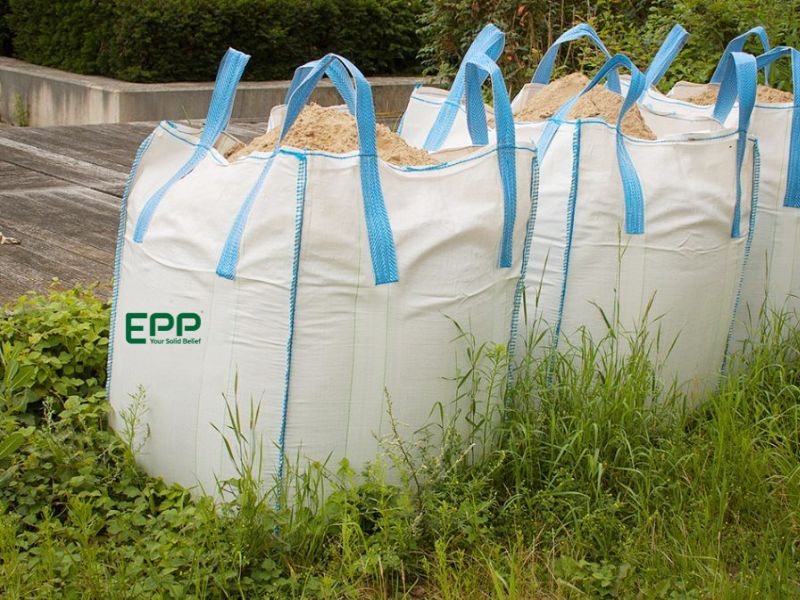
Yes, but they must be UV-stabilized. Because gravel is often stored in outdoor yards, the polypropylene fabric is treated with UV inhibitors during manufacturing at EPP Vietnam. However, even with UV protection, we recommend covering the bags with a tarp if they will be sitting in direct sunlight for more than six months to prevent the lifting loops from becoming brittle.
Is it better to use a Flat Bottom or a Discharge Spout for gravel?
For most construction sites, a Flat Bottom is preferred because it provides maximum stability when the bag is placed on uneven ground. However, if you are filling narrow trenches or small decorative planters, a Discharge Spout is better because it allows you to control the flow of the stone precisely, acting like a giant funnel and reducing manual shoveling.
Conclusion:
The transition to using bulk bags of gravel is a sign of a professional, efficient, and forward-thinking operation. Whether you are a retail supplier looking to offer a premium product or a contractor looking to cut labor costs and improve site cleanliness, the advantages are undeniable. By choosing the right technical specifications and a reliable supplier like EPP Vietnam, you ensure your aggregate is delivered safely, cleanly, and profitably.