
Where to Buy Quality Bulk Bags Garden Stones? This is the million-dollar question for quarry managers, landscaping suppliers, and aggregate exporters heading into the 2026 season. If you are in the business of moving heavy, abrasive, and often sharp-edged minerals, you know that the bulk bags garden stones you choose is more than just a sack—it’s the only thing ensuring your product reaches the customer without a catastrophic (and expensive) spill.
In this article, we aren’t talking about the stones themselves; we are diving deep into the engineering of the packaging and why sourcing the right technical spec from the right region—like Vietnam—can save your bottom line.
Challenges Customers Face with Garden Stone Packaging

Let’s get real: nobody thinks about the bag until it breaks. When a bulk bags garden stones fails, it is usually due to a few frustrating and avoidable reasons. First, there is the “Pinhole” puncture. Garden stones, especially crushed slate or jagged granite, have sharp points. If the fabric is too thin, these stones pierce the weave during transit. Once a small hole starts, the weight of the stone does the rest, leading to a leaky bag that ruins a delivery and creates a safety hazard on-site.
Another major issue is UV “Loop Snap.” Because garden stones are almost always stored outdoors in sun-exposed yards, the polypropylene loops are under constant attack from ultraviolet rays. If the bulk bags garden stones wasn’t manufactured with high-quality UV inhibitors, those loops become brittle. One lift with a forklift and the loop snaps, dropping a ton of stone.
Standard FIBCs often round out at the bottom, creating a “Leaning Tower” effect. This makes them nearly impossible to stack safely in a warehouse or on a flatbed truck, leading to wasted space and dangerous instability during transport.
What Makes a Quality Bulk Bags Garden Stones?
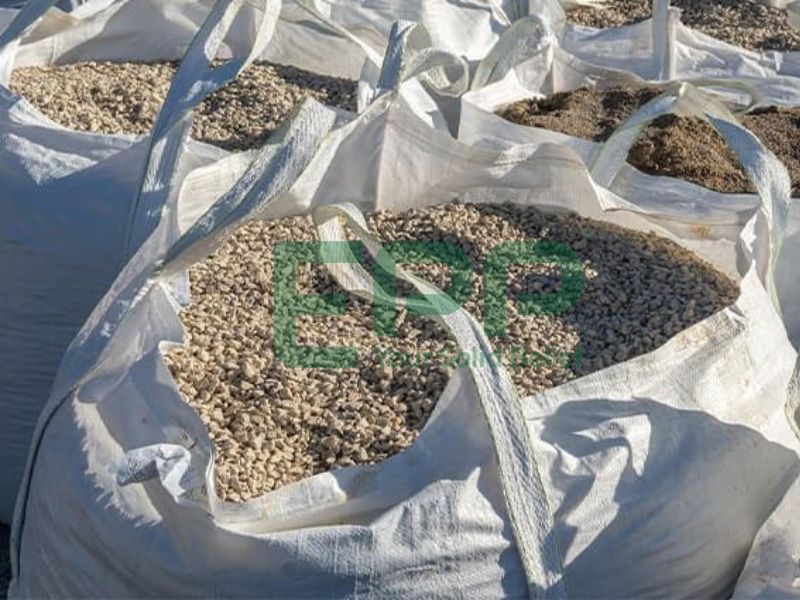
Identifying a quality bulk bags garden stones requires looking past the white plastic and checking the technical data sheet. A professional-grade jumbo bag must meet these non-negotiable standards:
- High GSM (Fabric Density): For sand or fine soil, 140-160 GSM might work, but for stones, you need a minimum of 180 to 220 GSM to provide the puncture resistance necessary to handle internal friction.
- 6:1 Safety Factor (SF): While 5:1 is for single trips, the industry is moving toward 6:1, meaning the bag has been lab-tested to hold six times its rated capacity for extra “dynamic safety.”
- Heavy-Duty UV Stabilization: A quality bag should be treated with at least 150 to 200 KLY of UV protection so it retains its strength even after months in direct sunlight.
- Reinforced Lifting Loops: The loops should be sewn deep into the body of the bag using high-tensile thread to prevent tearing at the attachment points.
Popular Types of Bulk Bags Garden Stones
Choosing the right “shape” for your bulk bags garden stones can significantly impact your logistical efficiency. The U-Panel Bag is often considered the “Gold Standard” for stability. It is made from one long, continuous piece of fabric that forms the bottom and two sides, with two additional panels sewn in to complete the structure. This design is incredibly strong and specifically resists “bellying” or bulging under the massive weight of heavy stone. For even more rigidity, a 4-Panel Bag is used, where four separate pieces of fabric are sewn together with a reinforced base, creating a very structured, box-like shape that is easier to palletize.

The configuration of the top and bottom is equally important for different quarry operations. An Open Top bag with a Flat Bottom is the most common choice for rapid filling via overhead hoppers, providing a sturdy base that stands upright independently.
If you need to protect the stones from rain or road debris during transport, a Duffle Top (Skirt) bag with a Flat Bottom allows you to tie the top shut while maintaining a stable base. For automated filling machines, a Flap Top bag with a Flat Bottom provides a clean, professional closure that keeps the contents secure. Finally, for “wet” garden stones or cobbles, a Vented or Breathable Bag is best, allowing moisture to drain out and preventing algae growth while the product sits in inventory.
Where to Buy Quality Bulk Bags Garden Stones?
If you are looking for volume, reliability, and the best “bang for your buck,” the answer is Sourcing from Vietnam. Vietnam has become the world’s “Resilience Hub” for FIBC manufacturing. Companies like EPP Vietnam have cornered the market by offering lower import duties thanks to the EVFTA and CPTPP. Many Western countries enjoy 0% duties on Vietnamese bulk bags garden stones, which is a massive financial incentive.
Vietnam also uses 100% virgin polypropylene resin, which is significantly stronger and more consistent than the recycled-mix bags often found on cheap marketplace websites. Modern customization is another major draw; you can get high-quality 4-color printing of your logo and safety instructions directly on the bags. This turns a simple piece of packaging into a high-visibility marketing tool for your landscaping brand, helping you stand out in a crowded retail market.
FAQ
How much stone is in a bulk bag?
Most bulk bags garden stone are designed to hold 1,000 kg (1 metric ton). In terms of volume, this typically equates to about 0.6 to 0.7 cubic meters, depending on the size and density of the stone. For example, a bag of slate will take up more volume than a bag of heavy granite for the same 1-ton weight.
Can I reuse a bulk bag garden stones?
Only if the bag has a 6:1 Multi-Trip rating. If the bag is marked “Single Trip” (5:1), you should not reuse it for heavy stone, as the plastic fibers may have already been stretched to their safety limit during the first use, making a second lift dangerous.
How do I stop my bulk bags from “leaning” in the yard?
If you are already using standard bags, ensure you are filling them on a perfectly level surface and using a “vibrating table” or shaking the bag during the filling process to settle the stones evenly.
What is the best way to recycle empty bulk bags?
Most bulk bags garden stones now are made from 100% Polypropylene (PP). Look for a local recycler that handles Grade 5 plastics. To get the best price for your scrap, ensure the bags are shaken out to remove all stone dust and debris before bundling them for pickup.
Conclusion
Sourcing a bulk bags garden stones isn’t just a simple supplies purchase; it is a strategic decision that affects your safety, your brand image, and your profit margins. By moving toward high-GSM, UV-stabilized bags from a hub like Vietnam, you ensure your stones are handled with the respect they—and your customers—deserve. Investing in high-quality packaging today prevents the costly headaches of damaged goods and unsafe work sites tomorrow.
Would you like me to generate a custom technical spec sheet for a 1.5-ton “Extreme Duty” bag designed specifically for sharp-edged volcanic rock?
